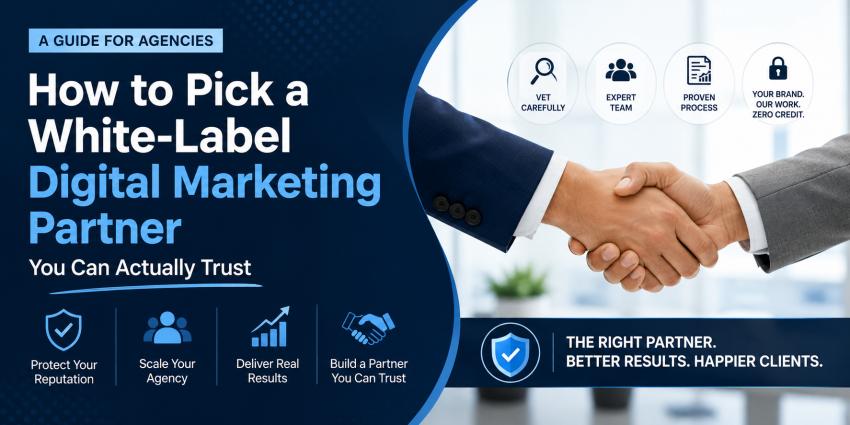
Most agency owners don't go looking for a white-label partner because business is slow. They go looking because it's the opposite problem — too many clients, not enough hands. It's a pattern that shows up so often it has a name in the industry: most agencies hit a growth wall around the $500,000 revenue mark, simply because one team can only deliver so much before quality slips.
That's usually the moment things get risky. You're excited, you're in a hurry, and you sign with the first provider who sends over a nice-looking deck. Six months later, you're firefighting a client relationship because the "expert team" behind your brand delivered generic content and vanished during a Google update.
So here's the real question this post answers: how do you vet a white-label partner before you hand them your reputation?
Why this decision matters more in 2026 than it used to
The numbers explain why so many agencies are having this conversation right now. The white-label marketing market is on track to hit $99.19 billion globally by the end of 2026. The SEO services market alone reached an estimated $83.98 billion this year, growing at roughly 12.3% annually. And agencies that lean on white-label partnerships report scaling their service offerings 2-3x faster while cutting overhead by 30-50% compared to hiring in-house.
That growth is exactly why the space is getting crowded — and why not every provider claiming "white-label expert" actually has the team to back it up.
A story that plays out more than agencies admit
An agency owner brings on a white-label SEO partner mid-quarter because a new client just signed and the internal team is already stretched. The partner's sales deck looks sharp. The pricing seems fair. Three weeks in, the first "deliverable" arrives. Content that could have been written for any business in any city, with no sign anyone actually looked at the client's site, competitors, or target audience.
By the time the agency owner catches it, the client has already seen the work. That's the moment trust starts leaking, and it's almost never recoverable in one conversation.
The partners that don't cause this problem tend to do one thing differently before they ever start work: they ask questions first. What does this client actually sell? Who's the competition? What's already been tried and failed? A provider that starts producing deliverables before asking anything is telling you exactly how the rest of the relationship will go.
What to actually check before you sign anything
1. Ask to see real client examples, not just a portfolio page
Anyone can put logos on a website. Ask specifically: "Can you show me before-and-after rankings or traffic for a client in your niche?" A partner with nothing to show, or who gets vague when you ask, is telling you something.
2. Find out who's actually doing the work
Some providers subcontract to a third party you'll never meet. Ask directly: is this an in-house team, or does work get passed along further? You want to know exactly how many hands touch your client's project.
3. Test their communication speed before you need it urgently
Send a mildly complicated question during the sales process not a simple "what's your pricing" question. See how long it takes to get a real answer, and whether that answer actually addresses what you asked.
4. Check how they handle a mistake, not just a win
Ask what happened the last time a campaign underperformed. A partner who says "that's never happened" is either new or not being honest. The ones worth trusting have a story about catching a problem early and fixing it.
5. Confirm the reporting is genuinely white-label
This sounds obvious, but check it anyway. Some platforms leave their own branding buried in exported PDFs or email footers. Your client should never see a name that isn't yours.
6. Understand the exit terms before you start
What happens if the partnership doesn't work out three months in? Do you keep the content, the backlinks, the campaign history? Get this in writing before you need it.
A word on AEO and AI Overviews - because your clients are asking about this now
If you're picking a partner for SEO specifically, ask how they're handling Answer Engine Optimization and AI Overviews, not just traditional rankings. Google's own guidance treats this as SEO fundamentals applied to AI-powered search, not a separate discipline requiring some secret formula. A partner who understands that distinction, rather than selling you "AEO packages" as a brand-new service, is usually the more honest one.
This isn't a fringe move anymore either — 66% of businesses with more than 50 employees already outsource at least one marketing function. The question for most agencies isn't whether to partner, it's who to trust with the partnership.
Frequently asked questions
What is white-label digital marketing?
It's a setup where a specialized team delivers marketing work SEO, PPC, content, and so on and it goes out to the end client under your agency's brand. The client never knows a third party was involved.
How do I know if a white-label partner is legit?
Ask for niche-specific proof of results, confirm who actually does the work, and test their responsiveness before you're relying on them for a real client. Vague answers to direct questions are the clearest warning sign.
Is white-label marketing worth it for a small agency?
For most small agencies hitting a capacity wall, yes. It lets you say yes to more clients without the cost and risk of hiring full-time specialists for every service line.
What happens if the white-label partnership doesn't work out?
That depends entirely on your contract. Always confirm ownership of content, data, and campaign history upfront, along with a clear exit clause, before you sign.
If you're an agency owner trying to figure out which white-label partner actually fits your clients, I help agencies make that match — so you can stay focused on bringing in new business instead of vetting providers alone.
Badal Kumar Connect with me on LinkedIn