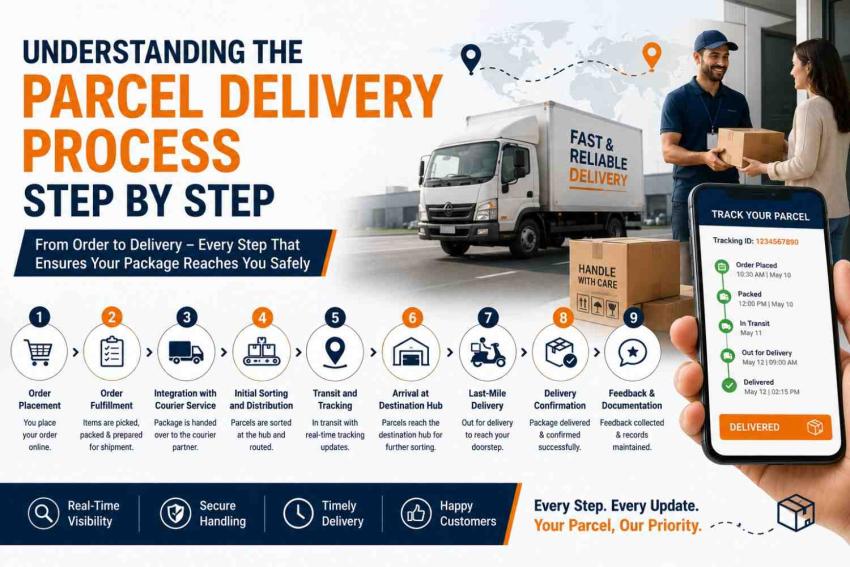
The e-commerce and the logistics industry are two of the main sectors in the global economy. As an entrepreneur or a consumer who is looking forward to a parcel, the following stages a good either direct or indirect perspective on this complex operation. The following is a step-by-step approach to the parcel delivery process that not only ensures that the packages are delivered safely and on time but also to the most efficient manner:
1. Order Placement
A customer starts the journey by making a purchase through an online platform. This takes place after the customer has pressed the buy button that includes searching for products, adding them to the cart, and also completing the required information on the delivery address and shipping instructions. When the order is confirmed, the seller sends a dispatch request to the delivery company resulting in the package being handled properly before it reaches the customer.
2. Order Fulfillment
The stage consists of the selection, packing, and preparation of the product for shipment. Warehouses are mainly set up to increase their storage efficiency and to use the right place so that they will be able to store products picked using the automatic assistance of highly enhanced inventory management systems. The products are carefully packed after which, they are attached with labels that contain the shipping details which among other things show the recipient's address and the barcode that is used for tracking.
3. Integration with Courier Service
When the package is complete, it is given to pickers of the logistics service provider. An integrated system may include fleet pick up, or possibly close-by centers where the extra workload is managed. The courier firm checks the parcel, charging their system with the particular information for tracking purposes.
4. Initial Sorting and Distribution
After the packages are collected from initial humps, they are sorted out through the automatic devices used for the purpose. The parcels are sent to the sorting devices which are run by a computer to make sure that the parcels are sent to their respective regions and that the last-mile delivery routes are followed accordingly.
5. Transit and Tracking
At this time of the journey, the parcels move through transits from the source hub to the destined stations. While tracking technology is within the phase, it is the most preferred as it gives the courier company and the customer a real-time report on all the changes. India Post Tracking, for example, enables that the consignments are regularly kept in the loop by providing data on their location and the status and thus all the transparencies of the delivery process.
6. Arrival at Destination Hub
Arrival of the parcels at the destination center is marked by their further allocation of the process. Here, packages are simply sorted according to the final delivery routes to avoid any extra refinements and thus ensuring the process to be economical. In this phase, there is a shift from the long-haul transport to the local delivery teams.
7. Last-Mile Delivery
During last-mile delivery, goods are taken by trucks or vans and are finally delivered to the end customer. This procedure is one of the most crucial and difficult parts in the delivery process because of obstacles such as traffic, the variety of delivery addresses, and the short delivery window. To this end, when the couriers work, they try to be efficient enough and also they struggle to be in time to the delivery process and thus to meet the customers' expectations.
8. Delivery Confirmation
After the courier company delivers the package, a receiver can consent through digital fingerprint identification, or alternatively, in case the recipient is not acquirable, the package can be placed at a safe place for a period. Moreover, the recipient and the sender can view the transaction completion status in the system after updating the delivery status which for both of them means the closing of the transaction.
9. Feedback and Documentation
Another important role of a company is to get client feedback after the safe production of their goods. The information is evidenced by logistics to enhance service results as well. Furthermore, these details are stored when any kind of transaction is done, and they are shown in different parts of the background including tracking data, delivery confirmation, and notes about any customer interaction.
Walking through these steps can help to create a better sight of the work of the shipment system and the complex process of the assuredness of the successful delivery of the parcels. As the technology is advancing, these companies are forced to modify the ways by adding things like more advanced digital tracking, AI root optimization as well as better communication with the customers. The devices like Indian Post Tracking that are added to services such as this make the activity even more reliable and transparent.