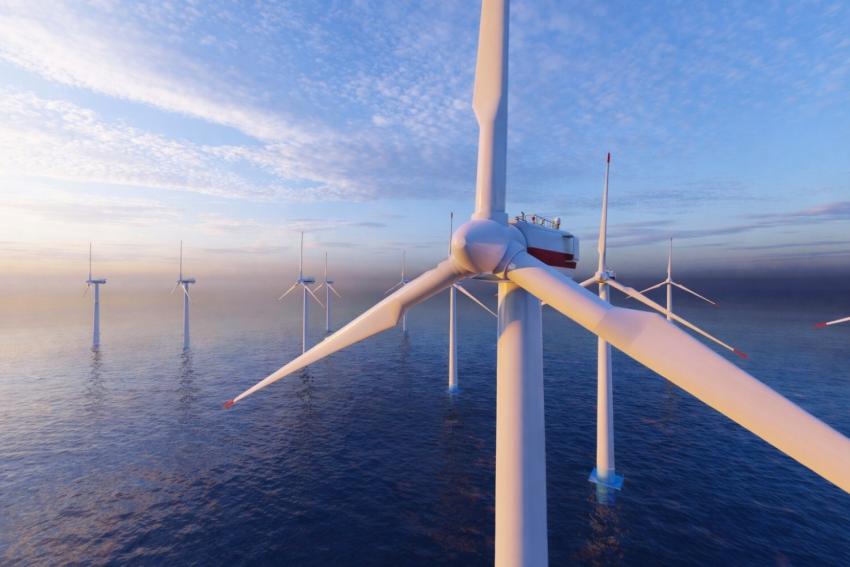
The global energy transition needs speed. Governments are racing to replace fossil fuels with cleaner alternatives, and the pressure to add new capacity quickly has never been greater. Among all the options available today, floating wind stands out as one of the most promising solutions for unlocking large-scale renewable energy in places where traditional methods simply cannot reach.
What Makes Floating Wind Different
Most wind turbines are fixed to the seabed. That works well in shallow coastal waters, but much of the world's strongest and most consistent wind resources sit far out at sea, where the water is too deep for fixed foundations. Floating wind turbines solve this by attaching to buoyant platforms that are anchored to the ocean floor with cables. This means they can be deployed in waters 60 meters deep or more, opening up an enormous amount of ocean that was previously off-limits.
The wind at deeper sea locations tends to be stronger and more stable than near the coast. This improves the overall energy output and makes the technology genuinely attractive for developers looking to build large-scale projects.
Why It Could Move Faster Than Expected
Speed in energy development usually comes down to two things: available resource and reduced planning friction. Floating wind scores well on both.
Because floating installations are located far offshore, they are less likely to face the local opposition that slows down onshore wind and solar projects. Visual impact concerns are minimal at long distances. Marine space, while not without its conflicts, is generally less contested than land.
Supply chains for floating wind are also being built out rapidly. Countries including Norway, South Korea, and Portugal have made significant investments in their industrial base to manufacture floating platforms at scale. This is creating the kind of manufacturing momentum that pushes costs down over time, similar to what happened with fixed-bottom offshore wind a decade ago.
Case Study 1: Kincardine Offshore Wind Farm, Scotland
Most people think of Hywind Scotland as the only early mover in floating wind, but the Kincardine project deserves attention. Developed by Cobra Group and later acquired by Copenhagen Infrastructure Partners, Kincardine became the world's largest floating wind farm when it reached full capacity in 2021, with five turbines totaling 50 MW installed in the North Sea off Aberdeen.
What made Kincardine notable was the involvement of Spanish shipyards in fabricating the semi-submersible platforms, demonstrating that floating wind manufacturing does not need to be clustered around the project site. The platforms were towed from the Cadiz region in southern Spain to Scotland. This proved that international supply chains can support floating wind at realistic project scales, reducing the dependency on local port infrastructure.
Case Study 2: Provence Grand Large, France
France launched the Provence Grand Large pilot project in the Mediterranean, deploying three floating turbines off the coast of Marseille. The project, which reached operational status in 2023, was designed partly as a testbed for semi-submersible technology in a landlocked sea environment with different wave and wind conditions compared to the Atlantic or North Sea.
The results have informed France's wider ambitions. The French government has since announced commercial-scale floating wind tender processes targeting several gigawatts of capacity, directly building on lessons from Provence Grand Large. This is a clear example of how pilot projects can accelerate commercial rollout faster than most analysts initially expected.
The Role of Offshore Wind in the Bigger Picture
Offshore wind as a category has already proven it can deliver at scale. Hundreds of gigawatts of fixed-bottom projects have been developed globally, and the lessons learned in project finance, grid integration, and operations are transferable to floating. This existing ecosystem gives floating wind a significant head start compared to entirely new technologies.
The levelized cost of electricity from floating wind is still higher than fixed-bottom today, but the gap is closing. Industry estimates suggest costs could reach competitive levels within this decade, especially as projects move from pilot scale to full commercial arrays.
Conclusion
The pace at which floating wind is moving from demonstration to commercial deployment is genuinely remarkable. Developers, governments, and investors are paying close attention, and the momentum is building. For anyone working in the energy space, attending a floating wind conference has become an important way to stay current on technology developments, financing structures, and policy signals. The conversations happening in those settings are shaping the decisions that will define how fast this sector grows. Given the resources available, the supply chain progress already underway, and the political will in key markets, floating wind may well prove to be one of the fastest routes to adding new clean capacity at the scale the world needs.
Frequently Asked Questions
Q1. How deep can floating wind turbines be installed?
Floating wind turbines can operate in water depths ranging from around 60 meters to over 1,000 meters. This makes them suitable for deep ocean locations where fixed-bottom turbines are not technically or economically viable.
Q2. Are floating wind projects commercially available yet?
Yes, though the sector is still in the early commercial stage. Several pilot and demonstration projects are already operational, and multiple countries including the United Kingdom, Norway, South Korea, Japan, and France have active tender processes for commercial-scale projects.
Q3. What are the main types of floating platform designs?
The three main designs are semi-submersible platforms, spar-buoy structures, and tension leg platforms. Each has different stability characteristics, cost profiles, and suitability for different water depths and sea conditions.
Q4. How does floating wind compare to onshore wind in terms of energy output?
Floating wind generally produces more energy per turbine than onshore wind because wind speeds are higher and more consistent far offshore. Capacity factors for floating wind projects can reach 50 to 60 percent, compared to 25 to 40 percent for many onshore installations.
Q5. What is holding back faster deployment of floating wind?
The main barriers are higher upfront costs compared to fixed-bottom offshore and onshore wind, limited port and assembly infrastructure in many regions, and the fact that supply chains are still being established. Policy certainty and long-term contracts from governments are critical to bringing costs down through scaled production.