By December 2025, the Nigerian entertainment tech space is no longer a playground for startups with a "cool idea." It is a graveyard for those who ignored the economics. While the PwC Africa Entertainment and Media Outlook correctly identifies Nigeria as the fastest-growing market with an 11.2% growth rate, that top-line number hides a brutal reality: Revenue in Naira does not equal profit in Dollars.
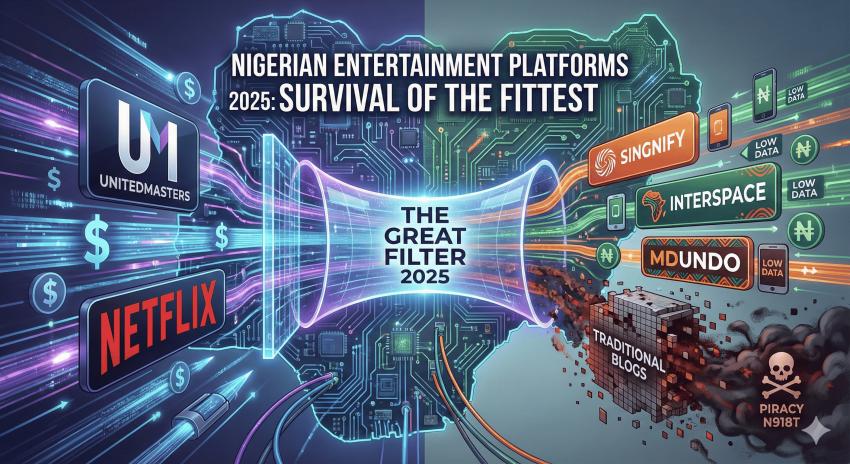
The days of launching a generic "music blog" or a "Nollywood streaming app" are over. The audience has moved on, and the infrastructure is merciless to anyone who isn't aggressively innovating. We are witnessing a "Great Filter"—a moment where platforms either evolve into complete ecosystems or die out entirely.
This report breaks down the current state of Nigerian entertainment platforms, exposing the distribution wars, the streaming profitability crisis, and the only metric that matters right now: Retention.
1. The Distribution Wars: Aggregators vs. The "Own Your Masters" Movement
The biggest battlefield in 2025 isn't on the radio; it's in the metadata. The fight for who controls the pipe between the artist and the DSPs (Digital Service Providers) has turned ugly.
The Rebranding of NextXtar: In May 2025, music distribution platform NextXtar rebranded to Singnify. This wasn't just a logo change; it was a survival tactic. By positioning itself as a "global hub" rather than just a local uploader, they are trying to stop the bleeding of talent to foreign giants.
UnitedMasters’ Aggressive Push: The American giant UnitedMasters has aggressively cornered the Nigerian market with their "Keep 100% of your royalties" model. This has forced local platforms to rethink their business models. If you are a local distributor taking 20% in 2025, you are already dead; you just don't know it yet.
The InterSpace Expansion: While others went digital-only, InterSpace Distribution opened a physical office in Port Harcourt in March 2025. This is a smart, contrarian play. They realized that while the product is digital, the trust is physical. Artists in the Niger Delta were being ignored by Lagos-centric tech, and capturing that market is a strategic masterstroke.
2. The Streaming Paradox: High Traffic, Low Value
Here is the uncomfortable truth about streaming in Nigeria that nobody wants to put in a pitch deck: The users are there, but the money isn't.
The Devaluation Trap: A Netflix or Showmax subscription priced at N5,000 might look good on a subscriber chart, but with the Naira fluctuating wildly against the dollar, the real value of that user has plummeted. International platforms are effectively subsidizing their Nigerian user base.
Data is the Real Gatekeeper: The average Nigerian youth spends 70% of their data budget on TikTok and Instagram. Dedicated streaming apps are fighting for the remaining 30%. If your platform does not have a "Data Saver" mode that actually works, or a partnership with MTN/Airtel for zero-rating, you are building a castle in the sky.
The Mdundo Model: This is why platforms like Mdundo continue to survive and grow. They built for the low-end device, low-data user from day one. High-def, 4K streaming platforms are niche products in a mass market that runs on 3G and lite apps.
3. The Death of the "Entertainment Blog"
If you are running a WordPress site that just copy-pastes press releases in 2025, you are obsolete. The audience doesn't visit websites for news anymore; they get it from Instablog9ja or Twitter (X) threads.
Social Discovery Dominance: 84% of ad spend is shifting to digital, but it's bypassing traditional blogs and going straight to influencers and social platforms.
The Pivot to "Tech-Enabled" Media: The only platforms surviving are those integrating tools. A blog is just text. A platform offers chart analytics, booking tools for artists, or merchandise integration. Uncutxtra Global understands this shift—moving from "reporting" the culture to "facilitating" the business of culture.
4. The Copyright Crisis
We cannot talk about platforms without addressing the elephant in the server room: Piracy.
The N918 Trillion Claim: Estimates regarding piracy losses have hit astronomical numbers (around N918 trillion according to some aggressive NCC reports). While the number sounds inflated, the reality is stark. Telegram channels are the biggest "entertainment platforms" in Nigeria right now, distributing terabytes of movies and music for free.
Enforcement Failure: The Copyright Act of 2022 was a nice piece of paper, but in 2025, enforcement is still zero. Legitimate platforms are competing with free, illegal alternatives that have better user experiences and faster download speeds.
5. Future Outlook: What Survives in 2026?
Vertical Integration: Expect platforms to start signing talent directly. Distribution platforms will become record labels (technically, they already are).
Fintech Mergers: The next big wave is entertainment platforms merging with fintech. If you can stream music and pay your bills on the same app, retention doubles.
Niche Dominance: Generalist platforms will fail. The winners will be hyper-specific: "The platform for Gospel," "The platform for Alté," "The platform for Indigenous Rap."
Conclusion
The Nigerian entertainment platform space is currently in a state of violent correction. The vanity metrics of "registered users" mean nothing. The only thing that counts is ARPU (Average Revenue Per User). If your platform isn't solving the data cost issue, the payment gateway issue, or the monetization issue, it is not a business—it is a hobby.