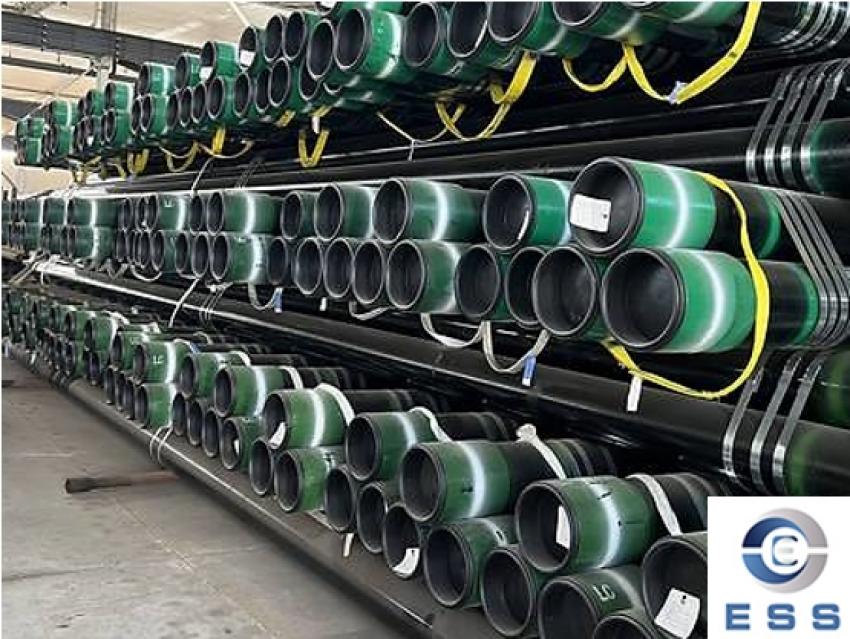
What are the inspection items for OCTG pipe? What are the specific project indicators? Since different implementation standards specify different items, we can choose appropriate items for inspection according to the implementation standards of the products.
What are the inspection items for OCTG pipes?
1. Appearance inspection
Use visual inspection and tool-assisted inspection to check whether there are cracks, dents and other defects on the external surface of the OCTG pipe.
2. Dimension measurement
Use professional measuring tools to accurately measure the geometric parameters such as the diameter and thickness of the OCTG pipe to ensure that it meets the specified standards.
3. Chemical composition analysis
Use spectral or chemical analysis methods to determine the chemical composition of the OCTG pipe material to verify its material qualification and purity.
4. Tensile test
Tensile test the OCTG pipe on a special testing machine to evaluate its mechanical properties under stress.
5. Hardness test
Use Brinell or Rockwell hardness tester to measure the surface hardness of the OCTG pipe to reflect the material's ability to resist deformation.
6. Impact test
By applying a rapid impact load to the OCTG pipe, its ability to absorb energy and its ability to resist impact damage are measured.
7. Metallographic inspection
Observe and analyze the microstructure of the metal structure of the OCTG tube with the help of a microscope to determine the internal quality of the material.
8. Nondestructive testing
Use X-ray, ultrasonic and other technologies to conduct comprehensive inspections on the OCTG tube to identify internal hidden defects.
9. Corrosion performance test
Evaluate the ability of the OCTG tube to resist chemical corrosion under simulated actual working conditions.
10. Tensile strength test
Measure the ability of the OCTG tube to withstand the maximum tensile force without breaking, which is one of the important mechanical performance indicators.
11. Yield strength test
Determine the minimum stress value at which the material begins to produce plastic deformation, and characterize the bearing capacity of the material.
12. Elongation test
Calculate the elongation percentage of the material from the original length to the breaking point to describe its ductility.
13. Bending test
Bend the OCTG tube at a certain angle to a specific radius to test its toughness and bendability.
14. Flattening test
Apply pressure to deform the tube until it breaks, and examine its pressure resistance and deformation characteristics.
15. Corrosion resistance test
Specially conducted for the common corrosive environment in oil wells to evaluate the corrosion resistance of materials.
16. Sulfide stress corrosion test
Specially evaluated for the material's resistance to stress corrosion cracking in sulfide-containing environments.
17. Hydrogen crack test
Study whether the material is prone to embrittlement and cracking in a high hydrogen partial pressure environment.
18. Sour gas corrosion test
Simulates working conditions containing sour gas to test the corrosion resistance of the material in this environment.
19. High temperature oxidation test
Test the material's ability to resist oxidation under high temperature conditions to ensure its reliability in high temperature operations.
20. Low temperature impact test
Evaluate the material's performance when subjected to impact at extremely low temperatures to ensure its safety in cold environments.
How to choose OCTG pipe testing items?
OCTG pipes are steel pipes designed for oil and gas drilling and extraction. They must be able to withstand extreme underground environments, including high temperatures, high pressures, and erosion by corrosive fluids. These pipes are usually made of specially treated steel to meet the requirements of use in complex geological conditions. There are many types of OCTG pipes, such as drill pipe, casing pipe and tubing, each of which has its specific purpose. For example, drill pipes are used to transmit the power of the drill bit during drilling, casing is used to fix the well wall, and tubing is used to transport oil and gas from underground to the surface. The manufacture and selection of OCTG pipes must follow strict standards and specifications to ensure the safety and efficiency of operations.
When applying for an OCTG pipe inspection report, what specific items need to be inspected? We need to select some OCTG pipe items for inspection based on the purpose of the OCTG pipe report in order to save inspection costs. You can also let the OCTG pipe third-party inspection agency recommend some conventional items for us, such as: appearance inspection, size measurement, chemical composition analysis, hardness test, metallographic structure inspection, non-destructive.