
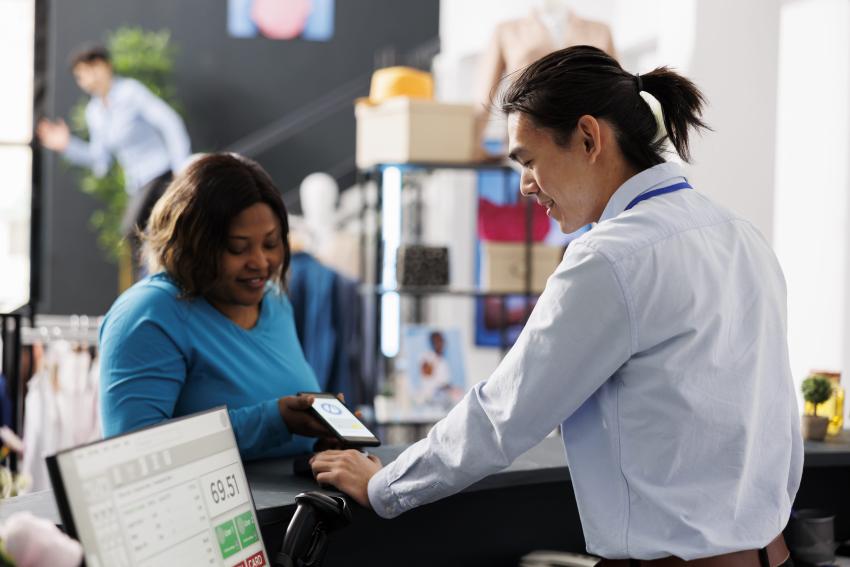
A modern retail store is about so much more than just displaying goods and taking payments. Behind every sale there may be a number of systems at work managing stock, customer data, orders, payments and reporting. When those systems are all working in concert, the retailer is in a far better position to run their day-to-day business and provide a much better shopping experience.
As businesses invest in retail software development services, connected technology is increasingly becoming a key part of the way stores operate. It enables different applications to pass information to each other rather than operating as isolated systems and as such, helps the retailer to respond to the ever-changing needs of the customer and the business.
What is Connected Retail Software?
Connected retail software is software that's able to talk to and share information with other bits of software across the business. This could be point of sale (POS) software, inventory software, an e-commerce site, a CRM system and accounting software.
For instance, if a customer buys a product in the store, the POS system can automatically update the stock levels. That same stock level can then be reflected on the retailer’s website so the customer can see if it's in stock.
Connecting Online and In-Store Operations
Customers will often move between the online and the bricks-and-mortar channels. They might look at products on a website, check availability via the app and then go into the store to complete the purchase.
Connected software enables retailers to co-ordinate all of these activities. With information shared between their online and physical store systems, they can offer things like click and collect, online returns in store and the ability to have the same product availability across both channels.
How Connected Systems Improve Retail Operations
Connecting the retail applications can reduce the amount of repetitive work and improve access to business information.
Key benefits include:
- Inventory visibility: Store teams can check stock levels across locations and sales channels.
- Order management: Both online and in-store orders can be tracked via the connected systems.
- Customer information: Employees can access the relevant customer and purchase records.
- Sales reporting: You can combine data from different stores and different channels for more effective reporting.
- Operational efficiency: Automated data exchange reduces the need for manual updates.
These enhancements help retailers spend less time wrestling with disconnected information and more time actually supporting their customers.
The Role of APIs in Retail Integration
Application programming interfaces (APIs) allow software applications to talk to each other. They're the interface between applications, enabling them to pass information to and from each other without necessarily using the same technology.
For instance, a retailer’s point of sale system could be linked to an inventory system via an API. When a sale occurs, the POS would pass the relevant product and transaction data over to the inventory system to update the stock.
APIs can also be used to connect payment gateways, delivery services, loyalty programmes and the eCommerce platforms themselves, thereby creating a more integrated retail environment.
Why Retailers May Need Custom Software
Not all retailers operate in the same way. A business with a number of stores, a number of warehouses, an online channel and a whole host of specialist processes may find that standard software doesn't meet all its operational needs.
A custom software house can help you to design applications and integrations around your particular business processes. This could be as simple as integrating a number of existing platforms together, or as complex as designing a central management system or building in features that aren't available with standard retail products.
Modernising Existing Retail Systems
A lot of retailers are still on old software to run their business. It's quite expensive to replace all of it at the same time.
Instead, the approach is to modernise incrementally by integrating the existing applications, upgrading the old bits and pieces and introducing the new digital capabilities where they are actually required.
Designpluz help businesses to build custom software and to connect up their digital systems to meet their operational needs.
The Future of the Connected Retail Store
Connected software is helping retailers to move towards a more coordinated and data-driven approach to their operations. With the right integrations, you can improve your inventory visibility, manage orders across channels and make better use of your customer and sales data.
The modern retail store is becoming part of a wider digital ecosystem. Its success is going to be much more dependent on the individual apps it uses than it ever was before, and it's going to be as much about how well those apps work together as anything else.