So, is Palo Alto Networks actually a good vendor for small businesses—or is it expensive overkill?
The short answer: Palo Alto Networks can be an exceptional choice for small businesses that handle sensitive data, face strict compliance requirements, or plan to scale quickly—provided you have either an IT specialist or a Managed Security Service Provider (MSSP) to run it. However, if you want a low-cost, plug-and-play router you can set up in ten minutes without technical help, it will likely frustrate both your team and your budget.
Here is an objective look at where Palo Alto Networks excels for small businesses, the hidden hurdles buyers often overlook, and how to decide if it fits your company.
Why Small Businesses Consider Palo Alto Networks
Unlike some enterprise vendors that release stripped-down "lite" operating systems for smaller tiers, Palo Alto Networks brings its full security architecture down to its entry-level lineup.
1. Enterprise-Grade Protection on Compact Hardware (The PA-400 Series)
With its PA-400 Series desktop firewalls (such as the fanless PA-410 and PA-440), Palo Alto Networks made its technology far more accessible for small offices and branch locations. Crucially, these smaller appliances run the exact same PAN-OS software and Single-Pass Architecture found in their massive data-center firewalls.
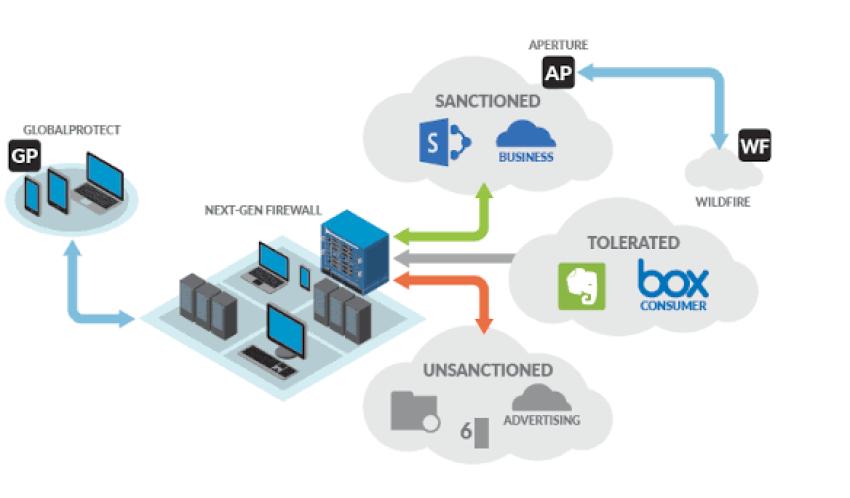
Instead of relying solely on basic port-and-protocol blocking, PAN-OS uses App-ID, User-ID, and Content-ID to inspect traffic at Layer 7. That means your business can distinguish between safe business tools and risky shadow IT—for example, allowing Slack or Microsoft 365 while blocking unauthorized file-sharing apps or risky browser extensions—without slowing down the network.
2. Strong Fit for Remote and Hybrid Teams
Many modern small businesses don't even have a traditional headquarters; their employees work from home, coffee shops, and client sites.
For businesses with a small central office, PANW's built-in GlobalProtect client provides reliable, policy-enforced VPN access.
For fully distributed small businesses, Prisma Access (their cloud-delivered SASE platform) allows teams to enforce consistent firewalling, URL filtering, and Zero Trust access without maintaining physical hardware in an office closet. (Note: Prisma Access for very small seat counts is most commonly sourced through a Managed Service Provider due to minimum licensing thresholds).
3. Unified Security Without Tool Sprawl
Small IT teams suffer heavily from "dashboard fatigue"—juggling one vendor for their firewall, another for endpoint antivirus, and a third for email or cloud monitoring. Palo Alto Networks offers a tightly integrated ecosystem combining network security (Next-Gen Firewalls), endpoint detection and response (Cortex XDR), and cloud/SASE tools. While you don't have to buy everything at once, having a clear upgrade path prevents painful rip-and-replace migrations as your headcount grows.
The Hidden Challenges for Small Businesses
Before signing a purchase order, small businesses need to weigh three realities that rarely show up in marketing brochures.
1. Total Cost of Ownership (TCO) and Subscription Layering
Palo Alto Networks is rarely the cheapest option on the market. Beyond the upfront cost of a firewall appliance, the real intelligence of the platform—Threat Prevention, WildFire (cloud malware analysis), Advanced URL Filtering, DNS Security, and 24/7 Support—requires recurring annual or multi-year subscriptions.
If you buy the hardware without the security subscriptions, you are essentially paying a premium for a basic stateful router. Always evaluate the 3-year Total Cost of Ownership (hardware + bundled subscriptions + support renewals) before comparing it to SMB-focused competitors like Fortinet, WatchGuard, Sophos, or Cisco Meraki.
2. The "Zero-IT" Management Gap
PAN-OS is engineered for precision, not consumer simplicity. Setting up security zones, NAT rules, dynamic blocklists, and SSL/TLS decryption policies requires genuine networking knowledge. Even simple administrative workflows—like staging configuration changes and running a "Commit"—take time to learn.
If your business relies on an office manager or a non-technical founder to manage Wi-Fi and internet security, Palo Alto Networks will feel overly complex. Misconfigured rules can either lock employees out of critical apps or leave security gaps open.
3. Sizing for Encrypted Traffic (A Common Buying Mistake)
Over 90% of modern web traffic is encrypted (HTTPS). To catch malware hiding inside encrypted sessions, a firewall must perform SSL/TLS decryption, inspect the traffic, and re-encrypt it—which demands significant CPU power.
A common mistake small businesses make is sizing a firewall based on its raw firewall throughput rather than its Threat Prevention throughput (with decryption enabled). If your business has a 1 Gbps fiber internet connection and buys an entry-level unit rated lower under full threat inspection, your internet speeds will bottleneck. Always match the model to your encrypted inspection requirements, not just your ISP speed test.
Quick Decision Framework: Is PANW Right for You?
Palo Alto Networks is likely a GOOD fit if:
You operate in a regulated or high-risk niche: Healthcare (HIPAA), finance, legal firms, defense contractors (CMMC), or B2B software startups handling sensitive client data.
Cyber insurance demands strict controls: Many insurers now scrutinize firewall logging, endpoint detection, and Zero Trust access before issuing or renewing policies.
You work with an MSP/MSSP: Partnering with a Managed Security Service Provider lets you gain enterprise-grade protection while offloading configuration, monitoring, and renewal management.
You plan to scale rapidly: If you have 20 employees today but expect to have 150 employees across three offices in two years, PANW scales seamlessly.
You should probably look elsewhere if:
You have no IT support and refuse to hire an MSP: Look at simpler cloud-managed platforms (like Cisco Meraki) or turnkey SMB bundles (like WatchGuard or Sophos) designed for generalist administrators.
Your budget is strictly minimal: If your primary need is basic guest Wi-Fi, simple routing, and minimal threat exposure, enterprise-tier licensing will strain your budget unnecessarily.
You want flat, subscription-free pricing: If recurring annual security licensing doesn't align with your financial model, PANW won't deliver its intended value.