That is why Ecommerce Web Scraping Cost can vary significantly from one project to another. The amount of data, number of websites, extraction frequency, website complexity, JavaScript rendering, geographic coverage, product matching, data cleaning, delivery method, and ongoing maintenance can all influence the final price. A low-cost scraping API may be enough for a small experiment, while a large retail intelligence program may require managed infrastructure, continuous monitoring, and custom data pipelines.
For businesses budgeting a scraping project in 2026, the most useful approach is not to look for one universal price. It is to understand what you are actually paying for, which pricing model fits your requirements, and where costs can increase as the project moves from a simple extraction task to a continuously maintained ecommerce data operation.
What Is Ecommerce Web Scraping Cost?
Ecommerce Web Scraping Cost is the total expense involved in collecting, processing, maintaining, and delivering structured ecommerce information from online stores and marketplaces. Depending on the project, that information may include product names, SKUs, prices, discounts, inventory, ratings, reviews, seller information, categories, specifications, and promotional data.
The cost can be calculated through different billing models. Some tools charge based on requests or credits, while others use compute units, records, page loads, bandwidth, subscriptions, or project-based pricing. Managed data providers may instead quote a monthly fee based on the number of sources, records, refresh frequency, data fields, and delivery requirements. This makes it difficult to compare two providers simply by looking at their advertised monthly price.
For example, a $50 scraping plan may look inexpensive until you discover that JavaScript-heavy pages consume several credits per request, while a higher-priced managed service may already include data processing, monitoring, maintenance, and structured delivery. The cheaper option is not necessarily cheaper once the complete workflow is considered.
How Much Does Ecommerce Web Scraping Cost in 2026?
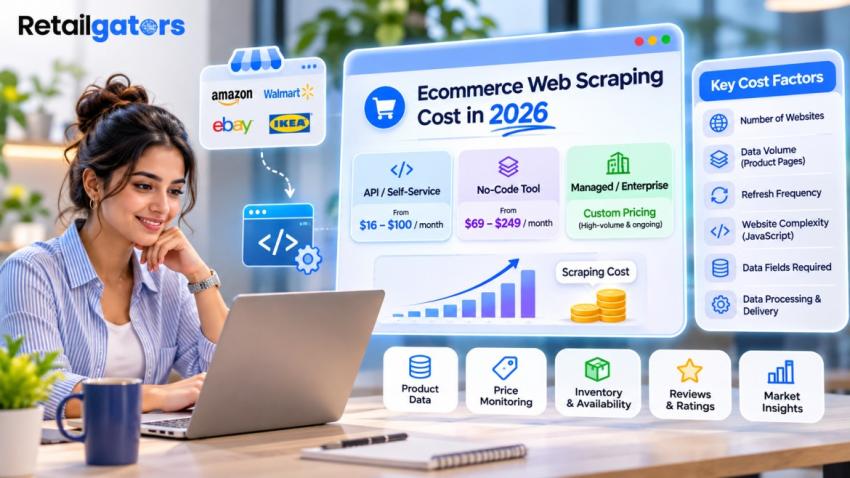
There is no standard industry rate, but current 2026 public pricing gives businesses a useful reference point. Self-service scraping APIs can start in the tens of dollars per month, with mid-tier plans commonly reaching the low hundreds and enterprise arrangements moving into custom pricing. Current published examples include API entry plans around 16–49 per month and higher-volume plans around 99–300 or more, depending on the provider and usage model.
No-code scraping platforms can also start relatively low. For example, Octoparse currently lists paid plans beginning at $69 per month when billed annually, with a Professional plan at $249 per month; enterprise pricing is custom.
Managed scraping is a different category because the provider takes responsibility for much more than simply making requests. Current managed-service offerings in the market show monthly commitments that can reach four figures and above, depending on the number of sources, volume, maintenance requirements, and level of service. Bright Data, for example, currently positions fully managed data acquisition as a sales-led service with custom scope and enterprise-oriented delivery.
These figures should be treated as market reference points rather than universal quotes. Your actual ecommerce scraping cost depends on what needs to be collected and how often it needs to be updated.
What Factors Affect Ecommerce Web Scraping Cost?
The biggest mistake businesses make when estimating web scraping pricing is focusing only on the number of pages. Page volume matters, but it is only one part of the equation.
Number of Websites and Product Pages
A project scraping one ecommerce website with a few thousand products is relatively straightforward compared with monitoring 50 retailers across several countries. Every additional website introduces its own page structure, product taxonomy, pagination behavior, data fields, and technical requirements.
The number of product pages also matters. Monitoring 10,000 products once a month creates a very different workload from monitoring the same 10,000 products every day or every few hours.
Website Complexity
Not every ecommerce website behaves the same way. Some product pages contain information directly in the HTML, while others load pricing, availability, reviews, or variants dynamically through JavaScript.
Dynamic websites may require browser rendering or other additional processing, which can increase the cost of data collection. Current 2026 pricing comparisons consistently show that JavaScript rendering and protected websites can cost substantially more than simple HTML requests.
Data Fields Required
The amount and complexity of data you need also influence cost. Collecting only product name and price is simpler than collecting product descriptions, specifications, variants, seller information, ratings, reviews, shipping details, promotions, inventory, and historical changes.
For a business that needs structured product information across large catalogs, product data scraping services can be used to collect and structure product, pricing, inventory, SKU, seller, and catalog information according to project requirements.
Refresh Frequency
Frequency is one of the most overlooked cost drivers. A one-time product dataset is very different from a daily monitoring system.
If a retailer only needs monthly assortment information, monthly collection may be sufficient. A pricing team monitoring fast-moving products may require daily or even more frequent updates. As collection frequency increases, so do requests, processing requirements, storage, validation, and monitoring overhead.
Geographic Coverage
Prices and product availability can vary by country, region, currency, language, and location. A US-only project is generally simpler than a global ecommerce monitoring program covering the US, UK, Canada, Australia, UAE, Germany, France, and other markets.
Geo-specific requirements may require additional infrastructure and localized collection workflows, which should be included in the initial cost estimate.
Ecommerce Scraping Cost by Project Type
Not every ecommerce scraping project should be budgeted in the same way. The business objective often determines the appropriate cost structure.
A small product research project may involve a limited number of websites and a one-time dataset. In this situation, a self-service tool or API can make sense because the business does not need continuous infrastructure or maintenance.
A competitor pricing project is different. Here, the business may need thousands of products monitored across multiple retailers on a recurring schedule. Historical pricing, discount tracking, product matching, and alerts become important, so the cost is driven not only by extraction volume but also by the monitoring layer.
An enterprise ecommerce data program can involve multiple marketplaces, millions of records, frequent updates, historical storage, regional data, product matching, dashboards, APIs, and internal system integration. At this stage, comparing the project to a simple monthly scraping tool is misleading. The business is effectively operating a data pipeline rather than buying a basic scraper.
For larger organizations, enterprise web scraping services are designed around high-volume, multi-source data collection, ongoing monitoring, historical data, and integration with enterprise analytics and decision-support systems.
Web Scraping Pricing: API vs Managed Service vs In-House
The right pricing model depends heavily on who is responsible for operating the scraping system.
With an API, the business generally pays for usage and manages the application layer itself. This can be cost-effective when the team has developers who can handle scheduling, parsing, data storage, error handling, and changes to website structures.
A managed service shifts more of that operational responsibility to the provider. The business pays more for the service, but the provider handles tasks such as data collection, monitoring, maintenance, validation, and delivery. This can make sense when the company's priority is using the data rather than building and maintaining scraping infrastructure.
An in-house solution gives the business maximum control, but the real cost is larger than servers alone. Development, proxies, browser infrastructure, monitoring, site changes, debugging, data quality, and ongoing engineering time all contribute to total cost. Industry analysis in 2026 shows that engineering and maintenance can become a major part of the total cost of ownership as the number of sources and collection frequency increase.
Why Cloud-Based Web Scraping Can Change the Cost Equation
Infrastructure becomes a bigger consideration as a project grows. Running crawlers locally may be sufficient for a small experiment, but large ecommerce programs often need distributed processing, scheduling, storage, monitoring, and the ability to scale workloads up or down.
Cloud-based web scraping can help businesses operate large-scale data collection through scalable infrastructure rather than maintaining every component locally. RetailGators describes its cloud approach as supporting large volumes of web data, scheduled or real-time collection, multi-region workflows, validation, and structured delivery.
The cost advantage is not simply about paying less for servers. The bigger question is whether the infrastructure can handle changes in volume without forcing the business to redesign the entire collection process.
How Data Delivery Affects Ecommerce Scraping Cost
The scraping itself is only part of the project. Businesses also need to decide what happens after the data is collected.
A basic project might deliver a CSV file. A more advanced workflow may require JSON, Excel, database delivery, cloud storage, API access, dashboards, or direct integration with internal analytics systems.
For example, if a pricing team needs product prices every morning in a dashboard, simply delivering a spreadsheet once a month does not solve the business problem. The data needs to move through a repeatable pipeline.
Web scraping API services can be useful when structured ecommerce data needs to be delivered programmatically into applications, dashboards, or internal systems. RetailGators' API service page describes real-time and scheduled extraction, structured outputs, and multi-source data collection.
Why Product Matching and Data Cleaning Add to the Cost
Raw scraped information is not automatically ready for analysis.
Suppose a retailer lists a product as "Wireless Headphones – Black, 2-Pack," while another marketplace uses a different title and product identifier. A basic scraper may collect both records, but it cannot automatically assume they represent the same comparable product.
Product matching, normalization, duplicate removal, missing-field checks, variant handling, and data validation can therefore become important parts of an ecommerce project.
This is particularly relevant for data scraping cost because businesses sometimes compare the price of extraction alone with the price of a fully prepared dataset. The second may cost more because it includes work that would otherwise fall to the internal analytics team.
How Price Monitoring Changes the Cost Structure
When the objective is ongoing competitive pricing, the project moves beyond one-time scraping. It becomes a monitoring program.
A price monitoring system may need to collect current prices, compare them with historical values, identify price changes, capture promotions, track availability, and alert teams when predefined conditions occur.
RetailGators' price monitoring services are positioned around ongoing price tracking, competitor benchmarking, promotional monitoring, historical price analysis, and scalable monitoring across ecommerce platforms.
For a business, this distinction matters because a one-time scraper and a continuous price-monitoring system have very different operating requirements.
How Ecommerce Data Analytics Adds Value Beyond Scraping
The final goal of ecommerce scraping is usually not the dataset itself. Businesses collect the data because they want to answer commercial questions.
Which competitor is changing prices most frequently? Which products are repeatedly discounted? Which categories are expanding? Where are products going out of stock? How does pricing vary by market? Which products are gaining or losing visibility?
This is where ecommerce data analytics services can become relevant. RetailGators describes ecommerce analytics around pricing, customer behavior, sales trends, market movements, competitor activity, assortment, inventory, and other business signals.
The cost of analysis should therefore be considered separately from the cost of collection. A business may save money by buying cheaper raw data, but if the dataset requires significant internal cleaning and transformation before analysts can use it, the apparent saving may disappear.
How to Reduce Ecommerce Web Scraping Cost Without Sacrificing Data Quality
The best way to control ecommerce scraping cost is not necessarily to choose the cheapest scraping provider. It is to define the project correctly before collection begins.
Start by identifying the exact business questions. If the goal is competitor pricing, you may not need every review, image, or product attribute. If the objective is assortment analysis, price history may be less important than complete product catalogs and variants.
Next, prioritize sources. Instead of monitoring every possible retailer, begin with the competitors that influence your category most directly. The same principle applies to refresh frequency. Not every product needs to be monitored every hour.
It is also useful to separate must-have data from nice-to-have data. A clear data schema reduces unnecessary extraction and makes pricing easier to evaluate. Businesses should also consider whether they need raw data, cleaned datasets, analytics-ready information, or a complete managed workflow.
What Should Businesses Ask Before Getting a Scraping Quote?
Before requesting a quote, prepare a clear project brief. Include the websites or marketplaces you want to monitor, approximate product or page volume, required data fields, update frequency, target countries, preferred delivery format, historical data requirements, and whether you need dashboards, APIs, or alerts.
Also ask how the provider handles website changes, failed requests, data validation, product matching, duplicate records, monitoring interruptions, and ongoing maintenance. These details can have a much greater impact on the real cost than the headline monthly price.
RetailGators' ecommerce data scraping offering is structured around product, pricing, inventory, review, seller, promotion, and marketplace data, with structured delivery options and scalable collection for retail use cases.
Is Cheap Ecommerce Scraping Always the Better Option?
Not necessarily. A low monthly subscription can be attractive for a small project, but it may not be appropriate for a business that depends on reliable daily pricing or inventory data.
Imagine a retailer saving $100 per month on scraping but spending several hours every week fixing broken extraction jobs, cleaning inconsistent records, and checking whether the latest dataset is complete. The software invoice is low, but the actual cost of the workflow is not.
On the other hand, an expensive enterprise platform may be unnecessary for a company that only needs a small one-time dataset.
The better question is not "What is the cheapest scraping option?" It is "What is the lowest total cost for getting reliable data that the business can actually use?"
Final Takeaway
There is no universal answer to How much does ecommerce web scraping cost in 2026? A simple project can operate on a relatively small self-service budget, while large-scale ecommerce intelligence programs can require substantial ongoing investment.
The biggest factors are usually data volume, number of sources, website complexity, JavaScript requirements, refresh frequency, geographic coverage, product matching, data cleaning, delivery method, infrastructure, and maintenance. Once these requirements are clear, comparing web scraping pricing becomes much easier.
For small projects, an API or no-code tool may be sufficient. For recurring ecommerce monitoring, a managed service can make more sense. For large enterprises, scalable pipelines, APIs, cloud infrastructure, analytics, and continuous maintenance may be part of the overall solution.
The most practical approach is to define the data you actually need first, then choose the collection model that delivers it reliably at a sustainable total cost.