How Is the India Online Alcohol Delivery Market Performing?
The market is expanding as digital adoption, urbanization, and demand for convenience reshape how consumers buy wine, beer, and liquor. App-based services and e-commerce platforms are attracting urban, technology-enabled shoppers, while premium and craft brands see online channels as a direct route to new customers. However, alcohol is regulated at the state level in India, and rules on online sales and home delivery differ widely from one state to another.
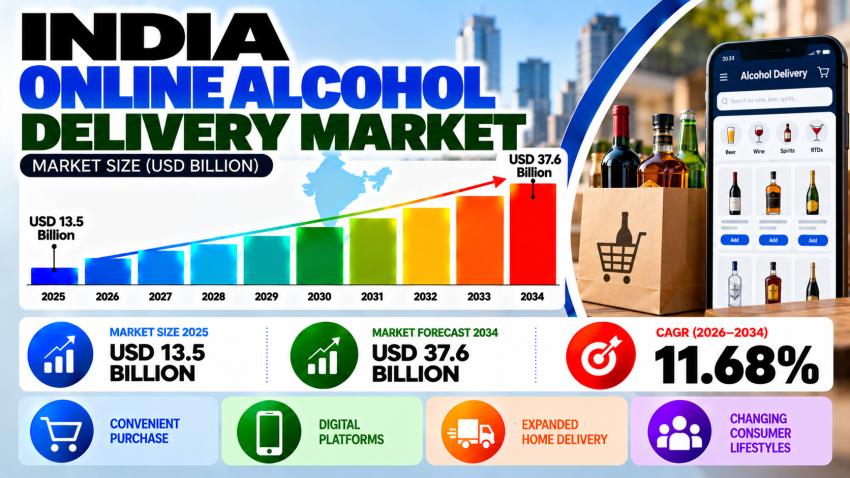
This patchwork shapes market accessibility and operating models. Some states have allowed online orders and home delivery under licensing and age-verification conditions, others have run only temporary or pilot arrangements, and others restrict or prohibit alcohol sales altogether. The India online alcohol delivery market size was valued at USD 13.5 Billion in 2025 and is projected to reach USD 37.6 Billion by 2034, growing at a CAGR of 11.68% during 2026-2034.
Growth is supported by app-based services, regulatory easing in selected states, digital age verification, premiumization, and investment in last-mile logistics. The market forecast therefore depends not only on consumer demand but also on how quickly and consistently state excise authorities permit and structure online sales.
Market Snapshot
- Market Size (2025): USD 13.5 Billion
- Forecast Value (2034): USD 37.6 Billion
- CAGR (2026-2034): 11.68%
- Types Covered: Wine, liquor, beer, others
- Delivery Places Covered: Tier 1, Tier 2, and Tier 3 cities
- Regions Covered: North India, South India, East India, West India
- Regulatory Context: State-regulated; permissions, licensing, and restrictions vary by state
Explore the Full Report with Charts, Table of Contents, and List of Figures
What Growth Factors Are Driving the India Online Alcohol Delivery Market?
- State-Level Policy Reform and Controlled Online Sales
Regulatory shifts are a central lever for India online alcohol delivery market growth. Because alcohol is a state subject, each state decides whether to allow online orders, who may deliver, and under what conditions. West Bengal and Odisha are the states most often cited as permitting online liquor sales and home delivery, and reports indicate that premium alcohol brands have seen a 20% to 30% sales lift across Odisha and West Bengal through online channels.
The pandemic accelerated interest, with several states, including Maharashtra, Jharkhand, Chhattisgarh, and Assam, temporarily allowing deliveries during lockdowns before those permissions lapsed. Authorities have since explored controlled online sales to curb black-market trade and improve tax collection, with licensing provisions and digital age verification shaping how such frameworks are designed.
- Pilot Projects and Platform Participation
In July 2024, several states, including Kerala, Punjab, Goa, New Delhi, Haryana, and Karnataka, announced plans to approve pilot ventures allowing alcohol home delivery through platforms such as Blinkit, Swiggy, Zomato, and BigBasket. The first phase was expected to emphasize low-alcohol types such as liqueurs, wine, and beer.
These pilots are proposals and trials, not blanket permissions. Businesses should treat each state as a separate market: delivery windows, dry-day rules, zone-based delivery guidelines, and licensing requirements can differ, and approvals can be changed or withdrawn.
- Premiumization and Craft Demand
Preferences are shifting toward premium and craft beverages, helped by rising disposable incomes, urbanization, and exposure to global drinking trends. Online platforms give consumers access to imported wines, craft beers, and small-batch spirits that traditional stores may not stock.
For emerging distilleries and breweries, direct-to-consumer sales offer a way to build awareness without relying on conventional distribution networks, a particularly useful route where state rules allow online selling.
- Investment in Last-Mile Logistics, Payments, and Responsible Drinking
Structured online sales are driving investment in last-mile logistics, secure payment solutions, and responsible drinking campaigns. Digital age verification and delivery verification are central to compliance.
Operators that build auditable workflows, including license checks, ID-based age verification, zone-based delivery, and records for excise authorities, will be better positioned as regulators evaluate wider permissions.
What Are the Latest Emerging Trends in the India Online Alcohol Delivery Market?
- State-by-State Expansion Through Licensed Retailers and Platforms
Rather than a single national rollout, expansion is happening state by state, often through licensed retailers and approved platforms working within local excise rules.
Companies that tailor entry plans to each state’s licensing, timing, and delivery conditions are better placed to scale without regulatory setbacks.
- Premium and Craft Curation, Including Direct-to-Consumer Models
Digital marketplaces allow craft distilleries and breweries to reach consumers directly, while curated selections and subscription-based delivery cater to shoppers seeking personalized choices.
AI-driven recommendations, limited-edition releases, and virtual tasting events, where permitted, are helping brands engage consumers and reinforce premiumization.
- Compliance Technology as a Competitive Advantage
Digital age verification, licensing checks, and delivery records are becoming core features of operating models rather than add-ons.
Platforms that make compliance seamless for consumers and auditable for regulators can build trust with state authorities, which may support broader permissions over time.
What Opportunities Lie Ahead for the India Online Alcohol Delivery Market in the Coming Years?
The market is positioned for expansion through 2034 as more states weigh regulated online sales, digital adoption deepens, and consumers continue to trade up. Growth is currently most visible in metropolitan and Tier 1 cities, with Tier 2 and Tier 3 cities forming a longer-term opportunity as policies and logistics mature.
Winning will require regulatory fluency as much as technology. Companies that partner with licensed retailers, invest in compliant delivery operations, and tailor entry strategies state by state can build durable positions. Investors should model scenarios in which approvals broaden, stall, or are reversed in individual states.
How Is the India Online Alcohol Delivery Market Segmented?
By Type
- Wine
- Liquor
- Beer
- Others
Pilot proposals have emphasized low-alcohol types such as liqueurs, wine, and beer, reflecting a cautious, phased approach by authorities. Where permitted, wine and beer are natural starting categories for online delivery.
Premium and craft offerings across wine, beer, and spirits are a particular opportunity online, since digital catalogues can be broader than a typical store’s shelf. Availability in each state, however, depends on local excise rules.
By Delivery Place
- Tier 1 Cities
- Tier 2 Cities
- Tier 3 Cities
Tier 1 cities are the early focus, supported by higher digital penetration, dense logistics networks, and technology-enabled consumers.
Tier 2 and Tier 3 expansion depends on state permissions, delivery infrastructure, and consumer awareness, making them a longer-term growth frontier.
By Region
- North India
- South India
- East India
- West India
Regional outlook is shaped by state policy as much as by geography. East India includes West Bengal and Odisha, where online sales and home delivery have been reported, while outcomes in other regions depend on whether pilot discussions in states such as Delhi, Haryana, Punjab, Kerala, Karnataka, and Goa lead to approvals.
IMARC Group’s report provides regional forecasts for 2026-2034 across all four regions.
Competitive Landscape
The report offers an in-depth examination of the competitive landscape, including market structure, key player positioning, leading strategies for success, a competitive dashboard, and a company evaluation quadrant. Players leveraging e-commerce platforms and app-based services are navigating state-specific regulations that directly influence market accessibility and operating models.
Investment & Growth Opportunities
- Licensed-retailer and platform partnerships in states where online sales are permitted, aligned with local excise rules.
- Last-mile logistics and delivery verification technology supporting compliant doorstep delivery.
- Digital age verification, KYC, and compliance software for operators and retailers.
- Premium, craft, and imported brand marketing through direct-to-consumer and curated online experiences, where permitted.
- Subscription and tasting experiences for consumers seeking personalized selections.
- State-by-state regulatory advisory and market-entry planning for brands and platforms preparing for pilot expansions.
India Online Alcohol Delivery Market Recent Developments & News
- Ongoing: Industry reports indicate that online sales have lifted premium brand sales by 20% to 30% in Odisha and West Bengal.
- Ongoing: Licensing provisions and digital age verification are shaping the structure of online alcohol sales in states that permit them.
- Pandemic period: Temporary delivery permissions in Maharashtra, Jharkhand, Chhattisgarh, and Assam during lockdowns reportedly lapsed after restrictions eased.
Source: IMARC Group