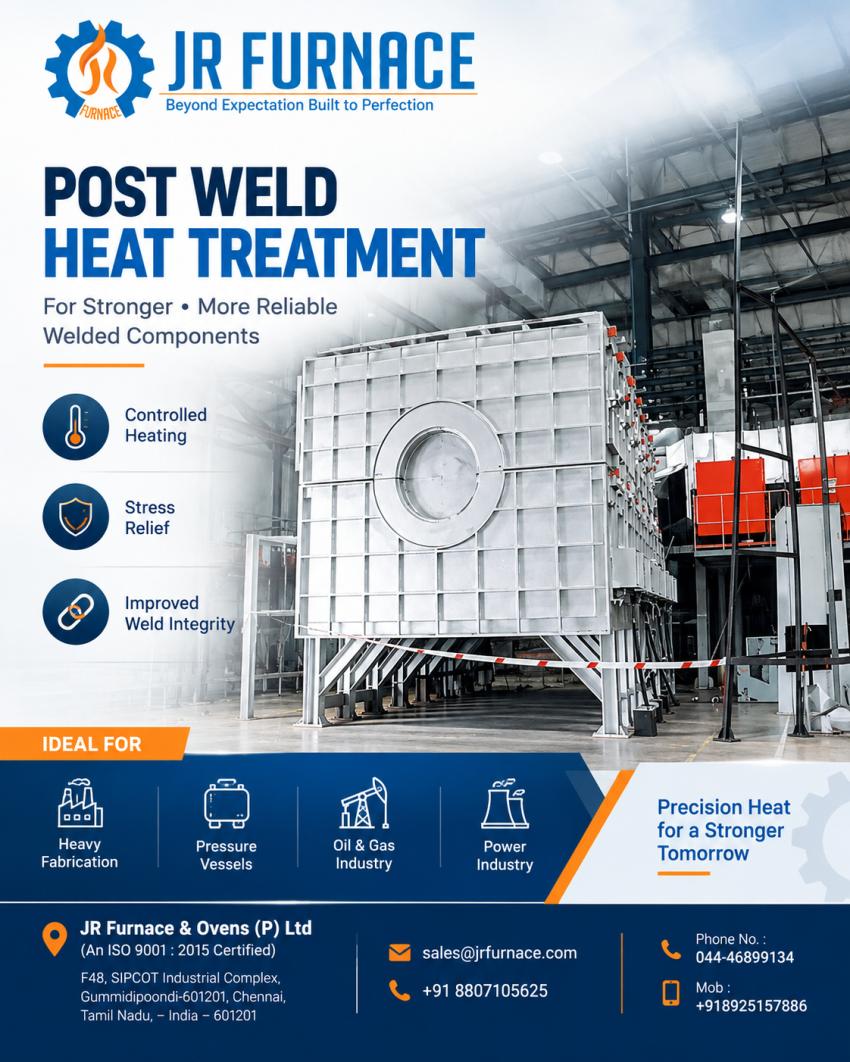
Post Weld Heat Treatment for Better Weld Quality and Industrial Reliability
Introduction
Welding is an essential process in industries that manufacture pressure vessels, pipelines, boilers, structural components, and heavy engineering equipment. Although welding creates strong joints between metal components, the intense and localized heat can introduce residual stresses and changes in the microstructure surrounding the weld. These changes may affect the performance and reliability of the finished component.
Post weld heat treatment is an important thermal processing method used to manage these effects in suitable materials. By applying a controlled heating, holding, and cooling cycle after welding, manufacturers can reduce residual stresses and improve the metallurgical condition of welded components when the treatment is appropriate for the material.
Understanding the process, its benefits, and the equipment involved helps manufacturers make informed decisions about fabrication quality and long-term component performance.
What Is Post Weld Heat Treatment?
Post weld heat treatment, commonly known as PWHT, is a controlled thermal process performed on a welded component after the welding operation has been completed. The component is heated to a specified temperature, held for a defined period, and cooled according to an approved procedure.
The purpose of the treatment depends on the material and application. For many carbon and low-alloy steel components, stress relieving is a common objective. In other applications, the treatment may be intended to temper hard microstructures or achieve specified metallurgical properties.
The temperature, holding time, and cooling rate must be selected according to the material grade, component thickness, welding procedure, and applicable engineering standards. Not every welded component requires PWHT, so the decision should be based on the relevant technical requirements.
For more information about the process, read this detailed guide to post weld heat treatment after welding.
Why Is Post Weld Heat Treatment Important?
During welding, the weld area becomes extremely hot while the surrounding material remains comparatively cooler. As the weld cools, the metal contracts, and the surrounding material can restrict this movement. This can leave residual stresses within the component.
Depending on the material and welding conditions, the heat-affected zone may also develop undesirable hardness or microstructural changes.
Post weld heat treatment helps manage these effects when correctly specified and performed.
1. Reduction of Residual Stresses
Stress-relief heat treatment can reduce residual stresses created during welding. This is particularly important for certain heavy fabrications and components exposed to demanding operating conditions.
2. Improved Metallurgical Properties
For suitable steels, an appropriate thermal cycle can temper hard microstructures and help achieve the required material properties. The actual result depends on the alloy composition and treatment parameters.
3. Support for Dimensional Stability
Reducing residual stresses can help limit some forms of distortion during subsequent machining or service. However, the final dimensional outcome also depends on component geometry, support arrangements, and manufacturing methods.
4. Reduced Risk of Certain Cracking Problems
When required by the material and welding procedure, suitable post-heating or PWHT can help reduce susceptibility to specific cracking mechanisms. It does not replace correct welding practices, inspection, or other necessary quality controls.
How Does the PWHT Process Work?
A typical post weld heat treatment cycle involves three main stages.
Controlled heating: The welded component is heated gradually to the temperature specified for the material and application. Appropriate heating rates help prevent excessive temperature differences across the component.
Soaking period: Once the required temperature is reached, the component is held for the specified duration. This allows the intended metallurgical changes or stress-relief effects to occur.
Controlled cooling: The component is cooled according to the approved procedure. Cooling rates must be appropriate for the material because uncontrolled cooling can introduce additional thermal stresses or affect the final properties.
Temperature monitoring and recording are important throughout the cycle. Proper documentation helps verify that the specified process conditions were achieved.
Types of Post Weld Heat Treatment
The required treatment depends on the welding application, material properties, and applicable standards.
Post Heating
Post heating involves maintaining a welded component at a specified elevated temperature after welding to help reduce the risk of hydrogen-induced cracking in susceptible materials. Timing and temperature requirements depend on the material and approved welding procedure.
Stress Relieving
Stress relieving is commonly used for suitable welded steel components to reduce residual stresses. The component undergoes a controlled thermal cycle designed to achieve the required stress reduction without compromising its properties.
Tempering
Certain steels may require tempering after welding or other thermal processing to adjust hardness and improve toughness. This treatment must be selected according to the specific alloy and metallurgical requirements.
These processes are related but are not interchangeable in every application. Selecting the correct treatment is essential for achieving the intended result.
Which Furnaces Are Used for Post Weld Heat Treatment?
The equipment used for PWHT depends on component size, weight, geometry, production requirements, and the required thermal cycle.
Bogie Hearth Furnace
A bogie hearth furnace is suitable for many large or heavy components that require batch processing. Its movable hearth allows workpieces to be loaded and unloaded more conveniently.
This arrangement can be useful for heavy fabrications, large welded assemblies, and components that require controlled heating throughout a substantial load.
Learn more about bogie hearth furnace applications.
Chamber Furnace
A chamber furnace provides an enclosed heating space for components that fit within its working dimensions. Depending on its design and operating specifications, it can support different industrial heat treatment processes, including suitable PWHT applications.
The chamber size, heating capacity, temperature uniformity, insulation, and control system should match the component and the required process.
Explore the design considerations for an industrial chamber furnace.
Localized Heating Systems
When a welded structure is too large to fit inside a furnace, localized heating may be considered. Resistance heating and induction heating are possible methods, depending on the component, procedure, and applicable requirements.
The choice between furnace treatment and localized heating should be made by qualified personnel based on engineering specifications and the required temperature distribution.
Industrial Applications of Post Weld Heat Treatment
Post weld heat treatment is used in industries where welded components must meet defined mechanical, metallurgical, and quality requirements.
Pressure vessels and boilers: Certain welded components require PWHT according to material specifications and construction codes.
Oil and gas equipment: Selected pipelines, process equipment, and fabricated components may require controlled thermal processing.
Power generation: Boilers, pressure equipment, and other welded assemblies may undergo treatment when specified by the relevant engineering requirements.
Petrochemical plants: Suitable welded equipment may require stress relief or other post-weld thermal treatments.
Heavy engineering: Large fabricated structures and machine components may require PWHT to manage residual stresses and achieve specified material properties.
The treatment must always be selected according to the particular component and its intended service conditions.
Factors to Consider When Selecting a PWHT Furnace
Choosing the right furnace is important for obtaining repeatable processing results. Manufacturers should evaluate several factors before selecting equipment.
Material and thickness: These influence the required temperature, holding time, and heating and cooling rates.
Component dimensions and weight: The furnace must accommodate the complete load and provide a suitable loading arrangement.
Temperature uniformity: Appropriate heating element placement, insulation, temperature sensors, and controls help maintain the required conditions.
Control and recording systems: Reliable instrumentation supports monitoring and documenting the complete thermal cycle.
Energy consumption and maintenance: Insulation quality, heating system design, operating schedules, and maintenance access can influence long-term operating costs.
Applicable standards: The selected equipment and treatment procedure must support the relevant material specifications, construction codes, and customer requirements.
Working with an experienced industrial furnace manufacturer can help businesses assess these factors before choosing a suitable heating solution.
Conclusion
Post weld heat treatment plays an important role in the fabrication of many industrial components where residual stress, hardness, and metallurgical properties must be carefully managed. When required and correctly applied, it can improve the condition of suitable welded components and support reliable manufacturing quality.
The effectiveness of the process depends on selecting the correct thermal cycle, using suitable heating equipment, monitoring temperatures, and following the applicable engineering specifications. By considering these requirements, manufacturers can make better decisions about heat treatment and the long-term reliability of welded products.
Frequently Asked Questions
1. What is the main purpose of post weld heat treatment?
Its purpose depends on the application, but common objectives include reducing residual stresses and modifying the microstructure or hardness of suitable welded materials.
2. Is post weld heat treatment required for every welded component?
No. Whether PWHT is required depends on the material, thickness, design, service conditions, and applicable standards or construction codes.
3. Which furnace is suitable for post weld heat treatment?
A chamber furnace or bogie hearth furnace may be suitable for components that fit within its working capacity. Larger structures may require an approved localized heating method.
4. Why is temperature monitoring important during PWHT?
Temperature monitoring helps verify that the component follows the specified heating, soaking, and cooling cycle. Appropriate records also support quality assurance and process traceability.