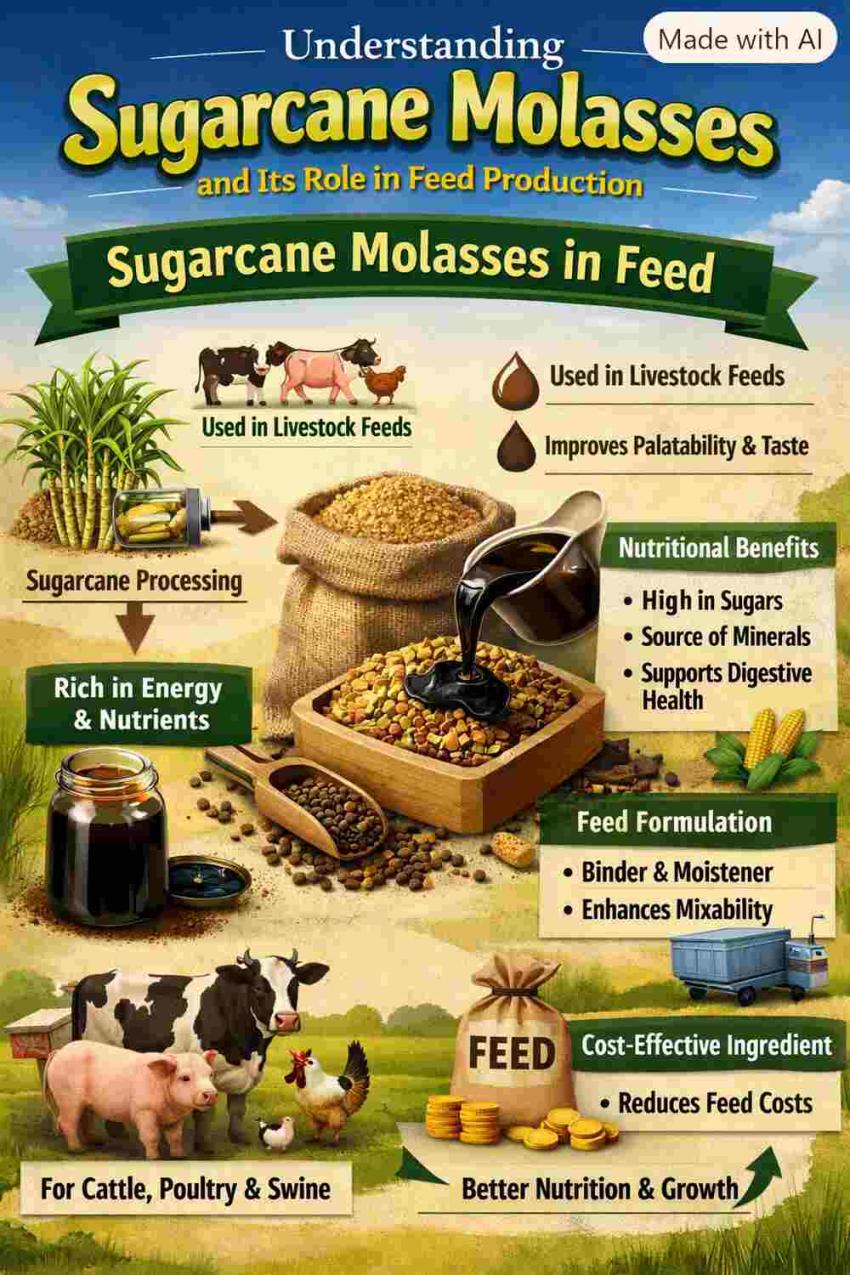
Sugarcane molasses is a valuable byproduct of the sugar manufacturing process that has become an important ingredient in modern animal feed production. Although it is commonly associated with its sweet taste and dark appearance, molasses offers much more than simple sweetness. Its combination of fermentable sugars, minerals, moisture, and functional properties makes it useful for improving feed quality, supporting animal nutrition, and enhancing the overall handling of feed ingredients.
As livestock and poultry producers continue to seek cost-effective and practical feed solutions, sugarcane molasses has gained attention as a versatile feed ingredient. Understanding its composition, benefits, applications, and limitations can help feed manufacturers and farmers use it more effectively.
What Is Sugarcane Molasses?
Sugarcane molasses is produced during the extraction and crystallization of sugar from sugarcane juice. After much of the sucrose has been removed to produce sugar crystals, the remaining thick, dark liquid is collected as molasses. Because it retains soluble carbohydrates and various naturally occurring nutrients, it can be utilized in several industrial applications, including animal feed and fermentation.
The exact composition of molasses can vary depending on sugarcane variety, processing conditions, and production methods. Generally, it contains significant amounts of sugars, along with minerals and small quantities of other organic compounds. This nutritional profile makes it a practical source of readily available energy when incorporated into properly formulated animal diets.
Why Is Molasses Used in Animal Feed?
One of the primary reasons sugarcane molasses is used in feed production is its carbohydrate content. The sugars in molasses can provide a readily available energy source for livestock and other farm animals. When included at appropriate levels, molasses can complement other feed ingredients such as grains, protein sources, fiber, vitamins, and minerals.
Molasses can also improve the palatability of certain feed formulations. Its naturally sweet flavor may encourage animals to consume feeds that contain ingredients with less desirable tastes or odors. This can be particularly useful when manufacturers need to balance nutritional requirements with feed acceptance.
Another advantage is its role in feed manufacturing. Molasses can help bind dusty or fine ingredients together, reducing dust during handling and transportation. This property can contribute to better feed consistency and easier processing.
Improving Feed Palatability
Feed intake is an important factor in livestock production. Even a nutritionally balanced formulation may not deliver its intended benefits if animals do not consume it adequately. Sugarcane molasses can help address this challenge by adding a naturally appealing flavor to feed.
When used correctly, it can make certain rations more attractive to cattle, goats, sheep, and other livestock. Its sweetness can also help mask the taste of selected ingredients, making it easier for producers to incorporate alternative raw materials into feed formulations.
However, palatability should not be the only consideration. The inclusion rate must be carefully controlled because molasses contains substantial amounts of sugar and can influence the overall nutrient balance of a ration.
A Useful Source of Energy
Sugarcane molasses is particularly valuable as an energy ingredient because its carbohydrates are readily available. In ruminant diets, for example, fermentable carbohydrates can contribute to microbial activity in the rumen when the overall ration is appropriately balanced.
This makes molasses useful in feed programs designed to complement forage and other feed materials. However, its nutritional contribution depends on the animal species, production stage, diet composition, and inclusion level. Professional feed formulation remains essential to ensure that energy, protein, fiber, minerals, and other nutrients are supplied in suitable proportions.
Molasses as a Feed Binder
Beyond nutrition, sugarcane molasses can provide functional benefits during feed manufacturing. Its viscous consistency allows it to act as a natural binding component in selected feed products.
By helping fine particles adhere to one another, molasses can reduce dust and improve the physical quality of certain feeds. This can be useful in mash feeds, supplements, and other formulations where ingredient separation or excessive dust may create handling problems.
Its binding characteristics may also support the production of more uniform feed products, although processing equipment and formulation requirements must be considered.
Supporting Sustainable Feed Production
The use of sugarcane molasses in animal feed also demonstrates how agricultural byproducts can be converted into useful resources. Instead of allowing a sugar-processing residue to go to waste, manufacturers can utilize its remaining nutritional and functional value.
This approach supports a more circular agricultural economy by connecting the sugar industry with livestock production. Turning suitable byproducts into feed ingredients can potentially improve resource efficiency while reducing dependence on some conventional raw materials.
Important Considerations When Using Molasses
Despite its benefits, sugarcane molasses should not be treated as a complete feed ingredient. Its relatively high sugar content means that excessive inclusion can negatively affect feed formulation and animal performance. Storage conditions are also important because molasses is a liquid or semi-liquid material that can be affected by temperature, contamination, and handling practices.
Quality consistency is another major consideration. Feed manufacturers should evaluate factors such as moisture, sugar content, mineral composition, cleanliness, and storage history before incorporating molasses into commercial formulations.
The appropriate inclusion level should always depend on the target animal and the complete nutritional profile of the ration.
Conclusion
Sugarcane molasses is a versatile and valuable ingredient for animal feed production. Its readily available carbohydrates, appealing flavor, and useful binding properties make it suitable for a variety of feed applications. At the same time, its use can contribute to more efficient utilization of agricultural byproducts and support sustainable feed manufacturing.
For feed producers, the key is to use sugarcane molasses strategically rather than simply adding it as a sweetener. With proper quality control, storage, and nutritional formulation, molasses can become an effective component of balanced animal feed. As demand grows for practical and resource-efficient feed ingredients, sugarcane molasses is likely to remain an important resource for the livestock and feed industries.
Post by: https://moltaraindo.com