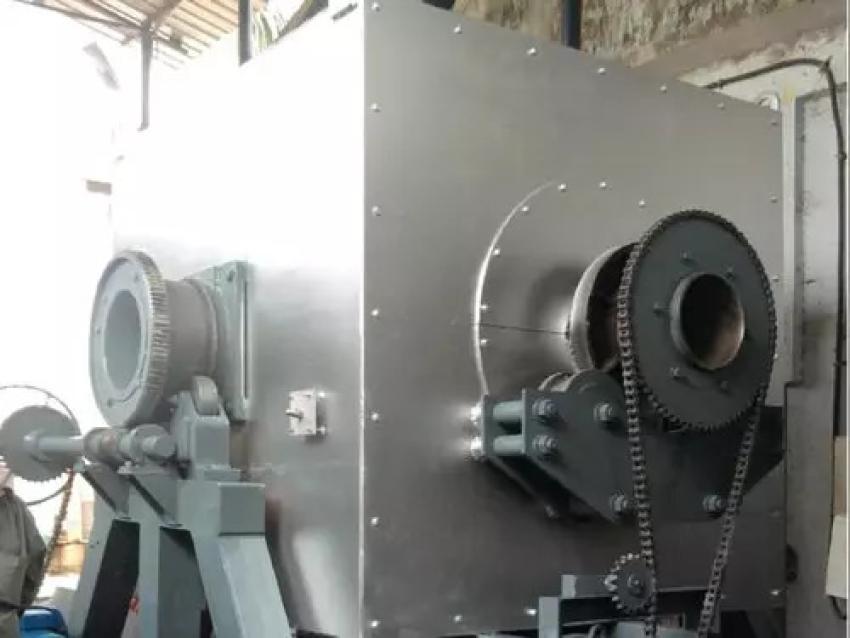
Rotary Retort Furnace for Consistent Heat Treatment of Small Components
Heat treatment is an important part of manufacturing metal components because it can improve surface hardness, wear resistance, strength, and service life. For industries processing large quantities of small metal components, maintaining uniform heating and consistent treatment across every batch can be challenging. A Rotary Retort Furnace provides a practical solution by combining controlled heating with continuous movement of the components inside a rotating chamber.
What Is a Rotary Retort Furnace?
A Rotary Retort Furnace is a specialized industrial heat treatment system designed for processes such as carburizing and carbonitriding. It contains a rotating retort in which the components are heated under controlled process conditions. The rotation keeps the parts moving and mixing during treatment, helping expose different surfaces to heat and the controlled atmosphere.
This type of furnace is particularly suitable for smaller components that are manufactured in large quantities. Applications can include screws, bolts, nuts, pins, rollers, bearing components, chain parts, and selected automotive components.
How Does a Rotary Retort Furnace Work?
The process starts by loading the required components into the retort. The retort is then heated to the temperature specified for the particular heat treatment cycle. During the process, the chamber rotates at a controlled speed, causing the components to tumble and move continuously.
For carburizing and carbonitriding, a controlled atmosphere is introduced into the retort. In carburizing, carbon is introduced into the surface of the steel, while carbonitriding introduces both carbon and nitrogen. The combination of controlled temperature, atmosphere, and movement helps achieve more consistent treatment throughout the batch.
After the required treatment period, the components proceed through the appropriate cooling or subsequent processing stage depending on the production requirements.
Why Rotation Is Important
One of the main characteristics of a rotary retort system is the continuous movement of the workpieces. In a static batch, components can remain in the same position for a significant portion of the process. Parts may also come into contact with one another, affecting heat and atmosphere exposure.
Rotation helps change the position of the components during processing. This allows different surfaces to receive exposure to the furnace atmosphere and heat. As a result, the process can provide better consistency when treating large quantities of small parts.
Industrial Applications
Rotary retort systems are commonly considered for applications where many small components need controlled surface treatment. Industries may use them for:
Automotive components
Bearing parts
Gears and small transmission components
Screws and fasteners
Chain links and rollers
Pins and other small steel parts
Bicycle components
General engineering components
The exact furnace configuration depends on the component dimensions, material, production volume, treatment temperature, atmosphere requirements, and desired metallurgical properties.
Benefits of Rotary Retort Technology
A properly designed rotary retort system can provide several operational advantages. Continuous movement helps improve contact between the components and the furnace atmosphere. Controlled temperature management supports repeatable processing, while automated controls can help operators maintain the required heating cycle.
Another advantage is its suitability for batch production of small components. Instead of manually arranging individual parts on trays, components can be processed together inside the rotating retort. This can simplify material handling and support higher production requirements.
Modern systems can also incorporate automatic temperature monitoring, atmosphere control, process timers, and other automation features depending on the application.
Factors to Consider When Selecting a Furnace
Before choosing a Rotary Retort Furnace, manufacturers should evaluate the type and size of components, required production capacity, operating temperature, heat treatment process, atmosphere requirements, and cooling method.
The retort material is also important because it must withstand repeated exposure to high temperatures and the operating atmosphere. Rotation speed, loading capacity, heating arrangement, insulation, and control systems should be selected according to the process requirements.
Proper furnace design is essential because heat treatment results depend not only on temperature but also on atmosphere, processing time, component movement, and cooling conditions.
Rotary Retort Furnace Manufacturer in India
JR Furnace & Ovens manufactures industrial furnace and heat treatment equipment for different manufacturing applications. Its Rotary Retort Furnace systems are designed for applications including carburizing and carbonitriding of small metal components. The systems can incorporate electric or gas-fired heating and automatic or semi-automatic process controls according to the required application.
Manufacturers looking for a suitable Rotary Retort Furnace should evaluate their component requirements and production process before selecting the furnace configuration. A customized design can help align furnace capacity, temperature control, atmosphere management, and material handling with the intended heat treatment cycle.
Conclusion
A Rotary Retort Furnace is a useful solution for industries that need controlled and repeatable heat treatment of small metal components. Its rotating chamber keeps components moving during processing, while controlled temperature and atmosphere systems support consistent carburizing and carbonitriding results.
By considering component size, production volume, temperature requirements, atmosphere, retort construction, and automation, manufacturers can select a furnace configuration that fits their production needs. For high-volume heat treatment operations, rotary retort technology can provide a practical combination of controlled processing and efficient batch handling.