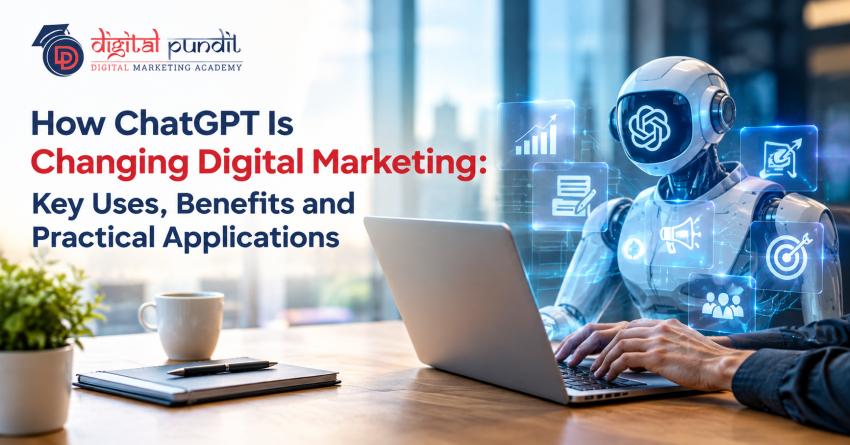
Digital marketing has changed significantly with the growth of artificial intelligence. Marketers are no longer dependent only on traditional keyword research tools, content calendars and manual campaign analysis. AI tools such as ChatGPT are becoming part of everyday marketing workflows, helping professionals research ideas, create content, analyze information, develop campaigns and improve productivity.
OpenAI itself describes ChatGPT as a tool that can support marketing teams across campaign planning, content creation, research, brainstorming and data analysis. The important point is that ChatGPT works best as a marketing assistant rather than a complete replacement for a digital marketer. Human strategy, creativity, fact-checking and business understanding are still essential.
For anyone learning digital marketing today, understanding how ChatGPT is used in digital marketing is becoming increasingly important. From SEO and content marketing to social media, email campaigns and paid advertising, ChatGPT can support almost every stage of the marketing process.
What Is ChatGPT in Digital Marketing?
ChatGPT is an AI-powered conversational tool that can understand instructions and generate responses based on the context provided by the user. In digital marketing, it can be used for tasks that traditionally require considerable time, such as brainstorming, writing first drafts, creating campaign ideas, organizing information and analyzing marketing data.
However, ChatGPT should not simply be treated as a button that creates finished marketing content. A marketer needs to provide information about the business, target audience, product, competitors, objectives and brand voice. The better the input and context, the more useful the output becomes.
This makes ChatGPT for digital marketing particularly valuable for marketers who know how to combine AI with traditional marketing fundamentals.
1. ChatGPT for Content Marketing
Content marketing is one of the most obvious applications of ChatGPT. Marketers can use it to brainstorm topics, develop content outlines, create first drafts, rewrite existing material and adapt content for different audiences.
For example, a digital marketing agency can provide ChatGPT with a business category, target audience and marketing objective and ask it to generate potential blog topics. The marketer can then evaluate those ideas based on search demand, business relevance and customer intent.
ChatGPT can also help develop blog structures with H1, H2 and H3 headings, introductions, FAQs and conclusions. It can rewrite complicated explanations into simpler language or create multiple versions of the same message.
The important distinction is that AI-generated content still requires human editing. ChatGPT can accelerate the writing process, but marketers should verify facts, add genuine experience and make sure the final content provides something useful to the reader.
2. ChatGPT for SEO and Keyword Research
Search engine optimization is another important area where ChatGPT can assist digital marketers.
A marketer can use ChatGPT to brainstorm keyword variations, identify long-tail keyword ideas, group keywords by search intent and develop topic clusters. It can also help marketers understand the questions that users may ask around a particular subject.
For example, instead of targeting only a broad keyword such as "digital marketing course," a marketer can use ChatGPT to explore related searches such as digital marketing course in Ahmedabad, AI digital marketing course, SEO course, digital marketing course fees, digital marketing syllabus and career opportunities.
ChatGPT can also help create SEO briefs, title ideas, meta descriptions, FAQ questions, internal linking suggestions and content outlines.
But it should not be considered a replacement for professional SEO tools or actual search-result analysis. Search volume, competition, ranking data and current SERPs should be validated using appropriate SEO platforms and search engines.
3. ChatGPT for AEO and AI Search Optimization
Search is becoming increasingly conversational. People are asking AI systems complete questions rather than relying only on short keywords.
This has created growing interest in Answer Engine Optimization (AEO) and optimization for AI-driven discovery.
ChatGPT can help marketers identify the questions customers are likely to ask about a product or service. It can also help structure content around direct answers, FAQs, comparisons, definitions and problem-solving information.
For example, instead of creating an article that only repeats the keyword "digital marketing course in Ahmedabad," a marketer can build sections answering questions such as:
- What is a digital marketing course?
- What does a digital marketing course include?
- How long does it take to learn digital marketing?
- What skills are required for a digital marketing job?
- How much does a digital marketing course cost?
This question-focused approach can make content more useful for both traditional search users and people interacting with AI-powered search systems.
4. ChatGPT for Social Media Marketing
Creating social media content consistently can be time-consuming. ChatGPT can help marketers develop ideas and adapt one topic into multiple social media formats.
A marketer can provide a blog article and ask ChatGPT to turn it into LinkedIn posts, Instagram captions, Facebook content, short-video scripts or carousel concepts.
It can also generate multiple hooks for a reel, different caption variations and calls to action for different audience segments.
For example, a digital marketing institute could take one article about AI marketing and convert it into:
- A LinkedIn educational post for professionals.
- An Instagram reel script for students.
- A Facebook post for business owners.
- A short video script explaining AI marketing.
- An email newsletter for existing leads.
This is where ChatGPT for social media marketing becomes particularly useful: marketers can spend less time starting from a blank page and more time improving the creative idea.
5. ChatGPT for Email Marketing
Email marketing requires more than simply writing an email. Marketers need appropriate subject lines, personalization, persuasive copy and a clear call to action.
ChatGPT can help create different versions of an email for different stages of the customer journey.
For example, a company could use it to draft a welcome email, product announcement, abandoned-cart message, lead-nurturing email or promotional campaign.
It can also generate multiple subject-line ideas and rewrite an email in different tones.
The marketer should still decide which message fits the brand and audience. AI can generate variations quickly, but actual campaign performance needs to be evaluated using open rates, click-through rates, conversions and other campaign metrics.
6. ChatGPT for Google Ads and Paid Advertising
Paid advertising requires continuous testing. A marketer may need multiple headlines, descriptions, hooks and value propositions for a single campaign.
ChatGPT can help create variations based on different customer motivations.
For example, an education company might create ad-copy angles based on:
- Career opportunities
- Practical training
- Live projects
- Affordable fees
- Experienced trainers
- AI-based learning
The marketer can then test different versions through the advertising platform.
This is particularly useful because AI can generate multiple creative directions quickly. OpenAI's current marketing guidance also emphasizes producing diverse ad variations and focusing copy on clear benefits, relevance and user intent.
However, ChatGPT should not decide the advertising budget, targeting or campaign strategy without human oversight. Those decisions require actual performance data and business context.
7. ChatGPT for Customer Persona Development
Understanding the target customer is fundamental to digital marketing.
ChatGPT can help marketers create initial customer-persona frameworks by organizing information around demographics, problems, goals, objections, motivations and buying behavior.
For example, a digital marketing institute may have several audiences:
- Students looking for their first career.
- Graduates looking for employment.
- Working professionals wanting to change careers.
- Business owners wanting to generate leads.
ChatGPT can help create different messaging strategies for each segment.
The marketer can then refine these personas using actual customer interviews, analytics, sales conversations and campaign data.
8. ChatGPT for Competitor and Market Research
Another important use of ChatGPT in digital marketing is research.
Marketers can use it to organize competitor information, compare positioning, identify content topics and brainstorm potential differentiation strategies.
With appropriate research capabilities and reliable source material, ChatGPT can help summarize market information and turn large amounts of information into a more understandable brief. OpenAI's marketing guidance specifically highlights competitor analysis, audience insights and market research as marketing use cases.
However, marketers should distinguish between AI-generated assumptions and verified information. Competitor prices, rankings, product features, statistics and market data should be checked against current sources before publication or decision-making.
9. ChatGPT for Landing Pages and Website Copy
A landing page needs a clear message, strong value proposition and logical structure.
ChatGPT can help marketers create the first draft of landing-page sections such as the headline, subheadline, benefits, features, objections, FAQs and calls to action.
It can also create different messaging angles for different audiences.
For example, a software company could create separate landing-page messaging for startups, enterprises and agencies.
The final page should still reflect the actual product and include genuine proof such as customer results, testimonials, case studies and accurate product information.
10. ChatGPT for Content Repurposing
One of the most practical uses of ChatGPT is content repurposing.
Imagine a company has created a 2,000-word blog article. Instead of creating every piece of promotional content from scratch, ChatGPT can help transform that article into several formats.
The same content could become a LinkedIn post, Instagram carousel, email newsletter, YouTube script, short-video script, FAQ section and social media captions.
This allows marketers to extend the value of existing content across multiple channels.
For businesses with small marketing teams, this can be particularly useful because creating a strong piece of content does not have to mean using it only once.
11. ChatGPT for Marketing Analytics
ChatGPT can also help marketers understand data.
When provided with appropriate campaign data, it can help identify patterns, summarize performance and explain information in simpler language. OpenAI lists campaign performance analysis, channel performance, funnel analysis and A/B test interpretation among marketing use cases.
For example, a marketer could provide campaign results containing impressions, clicks, conversions and costs and ask ChatGPT to explain the major changes and identify questions that deserve further investigation.
The key is that ChatGPT should support analysis rather than replace proper analytics. Marketing decisions should be based on accurate data and appropriate statistical and business judgment.
12. ChatGPT for Digital Marketing Strategy
Beyond individual tasks, ChatGPT can also function as a brainstorming partner for marketing strategy.
A marketer can provide the business model, target audience, product, competitors, objectives and available channels. ChatGPT can then help develop campaign ideas, content themes, customer journeys and testing ideas.
The process becomes more valuable when the marketer asks follow-up questions rather than accepting the first response.
A strong workflow is:
Research → Strategy → AI brainstorming → Human evaluation → Execution → Measurement → Optimization
This keeps AI involved throughout the marketing process while maintaining human control over important decisions.
Why ChatGPT Skills Are Important for Digital Marketers
The biggest advantage of learning ChatGPT is not simply the ability to generate text. It is the ability to work faster while thinking more systematically.
A marketer who knows how to write effective prompts can ask ChatGPT to act as a researcher, copywriter, SEO assistant, campaign planner, content editor or data-analysis assistant depending on the task.
At the same time, marketers need to understand traditional fundamentals such as search intent, branding, conversion optimization, analytics, paid advertising and customer psychology.
What this really means is that AI knowledge and marketing knowledge need to work together.
Learning ChatGPT without understanding marketing can produce generic content. Learning digital marketing without understanding modern AI tools can leave marketers less prepared for AI-assisted workflows.
How to Learn AI-Based Digital Marketing in Ahmedabad
For students, graduates, professionals and entrepreneurs in Ahmedabad, learning digital marketing now increasingly involves understanding both conventional marketing channels and AI-assisted workflows.
Digital Pundit is one option for people looking to learn digital marketing in Ahmedabad, with training covering areas such as SEO, social media marketing, Google Ads, content marketing, analytics and AI-based digital marketing. Its website also highlights practical assignments, live projects, industry tools and job assistance.
The institute's recent course material also emphasizes the role of AI in SEO, content marketing, social media, personalization, chatbots and performance tracking.
Students comparing a digital marketing institute in Ahmedabad should look beyond certificates and ask whether the training includes practical assignments, live projects, current marketing tools, analytics, AI applications and opportunities to actually implement campaigns.
What Should You Learn Along With ChatGPT?
ChatGPT is only one part of the modern digital marketing ecosystem.
A well-rounded learner should understand SEO, Google Ads, Meta Ads, social media marketing, content marketing, email marketing, Google Analytics, conversion optimization and marketing strategy.
On top of these fundamentals, learning how to use AI tools for research, content creation, campaign development, analysis and optimization can make the overall workflow more efficient.
The goal should not be to become dependent on AI. The goal should be to become a better marketer who knows when and how to use AI.
Final Thoughts: ChatGPT Is a Marketing Assistant, Not a Marketing Strategy
ChatGPT is changing the way digital marketers work. It can help with content creation, SEO research, social media, email marketing, advertising, competitor research, customer personas, landing pages, analytics and content repurposing.
But the most important skill is knowing how to combine ChatGPT with marketing knowledge.
A marketer still needs to understand customers, identify the right audience, create a meaningful strategy, verify information, measure results and make business decisions. AI can accelerate many of these processes, but human judgment remains essential.
For anyone planning a career in digital marketing, learning AI-assisted marketing alongside core digital marketing skills can be a practical way to prepare for the changing industry. In Ahmedabad, students looking for structured training can explore programs such as the AI-based digital marketing course at Digital Pundit, particularly if they want classroom learning combined with practical digital marketing and AI applications.
The future of digital marketing is not simply about marketers versus AI. It is increasingly about marketers who know how to work effectively with AI.