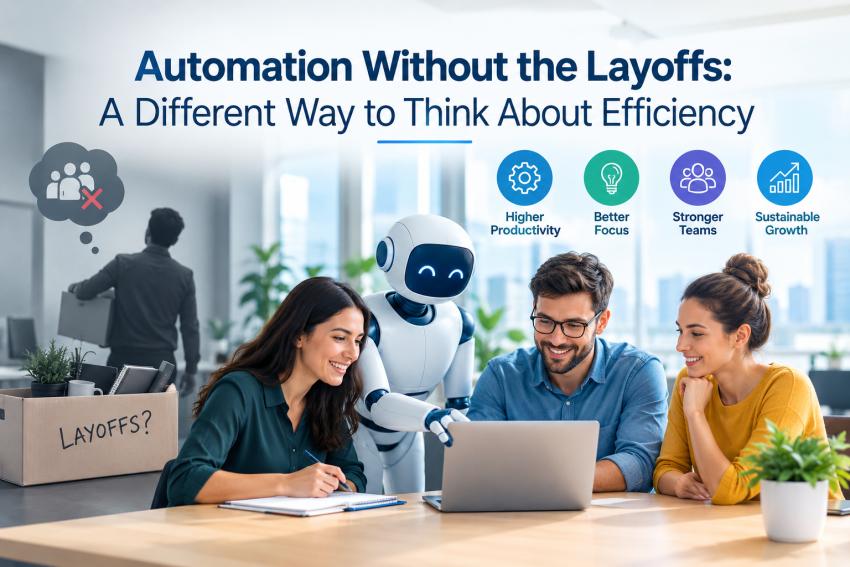
At Sapphire Software Solutions, we work with businesses every week that want to automate their operations, and almost every single one asks the same worried question first: "Will this mean cutting people?" The honest answer is no, not if automation is done right. Efficiency and headcount reduction are not the same thing, even though headlines love to treat them as one.
Why the Automation and Layoffs Story Is Not the Whole Picture
There is an assumption floating around that automation and layoffs always go together. Sometimes they do what? But that fear often comes from mixing up two very different moves: replacing a role completely, versus removing the boring parts buried inside a role.
The Real Target Is Not the Employee
Most repetitive tasks that get automated were never really anyone's actual job. They were the parts of a job that ate up the morning before someone could get to work that truly needed a human brain. When a business brings in workflow automation software development to handle that layer, it is not cutting a person out. It is cutting out part of the day nobody enjoyed anyway.
What Happens to the Hours That Get Freed Up
This is where it gets interesting. In teams that automate well, the hours saved do not disappear. They get redirected toward:
- Client relationships that need real attention
- Product quality checks that get skipped when staff are overloaded
- Problem solving that actually grows the business
- Training and upskilling that usually gets pushed aside
A customer service rep who once spent two hours a day copying data between systems can spend those two hours talking to frustrated customers and actually fixing their problems.
Rethinking Efficiency as a People Strategy
Efficiency does not have to mean fewer people doing more. It can mean the same people doing better work. That is a mindset shift long before it becomes a technology shift.
Start With the Task, Not the Headcount
Every automation project we build at Sapphire Software Solutions begins with a simple question. What is slowing this team down? Not who can be removed, but what keeps pulling people away from the work that matters most. That single question changes everything downstream, including which processes get automated first.
Bring the Team into the Decision
Nobody understands where the friction lives better than the person doing the job every day. Companies that involve their staff early usually end up with automation people actually trust and use, instead of a system built in secret that everyone quietly resents. Some simple ways to do this include:
- Running short interviews with frontline staff before scoping the project
- Asking teams to flag their most repetitive weekly tasks
- Piloting the tool with a small group before a full rollout
- Collecting feedback openly during the first month of use
Use Automation to Support Judgment, Not Replace It
Robotic Process Automation and cognitive automation services are excellent at handling repetitive, rules-based tasks such as sorting, matching, flagging, and routing. They are not built to read a room, negotiate with a vendor, or calm down an upset customer. Keeping that line clear is really the whole trick. Machines take the repetitive load. Humans keep the judgment calls.
What This Looks Like in Practice
Consider a few common examples:
A logistics company does not need to fire its dispatch team to benefit from AI in business process automation. It needs the team freed from manually reentering shipment data so they can manage exceptions and driver relationships instead.
A clinic does not need fewer front desk staff after adding an AI agent for appointment reminders. It needs staff who are no longer drowning in no show phone calls, so they can focus on the patient standing in front of them.
A retail brand does not need to shrink its support team after adding a chatbot. It needs the team to spend less time answering, "where is my order" and more time solving complicated cases.
Small and Mid-Sized Businesses Have an Advantage Here
Large corporations often automate at scale, and restructuring becomes a side effect of that scale. Smaller businesses do not carry that same pressure. A company working with a Custom Software Development Company partner can shape automation around keeping its current team, because the goal is not shareholder driven cost cutting. It is simply wanting the business to run smoother.
Choosing the Right Automation Partner Matters
Not every vendor approach automation this way, and that difference matters more than people realize. A partner who treats digital transformation services as a people's first process, not just a technical rollout, will ask about the team before asking about the tech stack. This is the approach we take at Sapphire Software Solutions, building enterprise workflow automation services and AI agent development around the people already doing the work, rather than removing them.
The Bottom Line
Automation is not inherently a job killer. It is a tool, and tools reflect the intentions of whoever is using them. Businesses that automate the task in mind, not the headcount, usually end up with teams that feel more supported, not less secure. Efficiency was never really about doing more with fewer people. It was about doing better with the people already on the team.