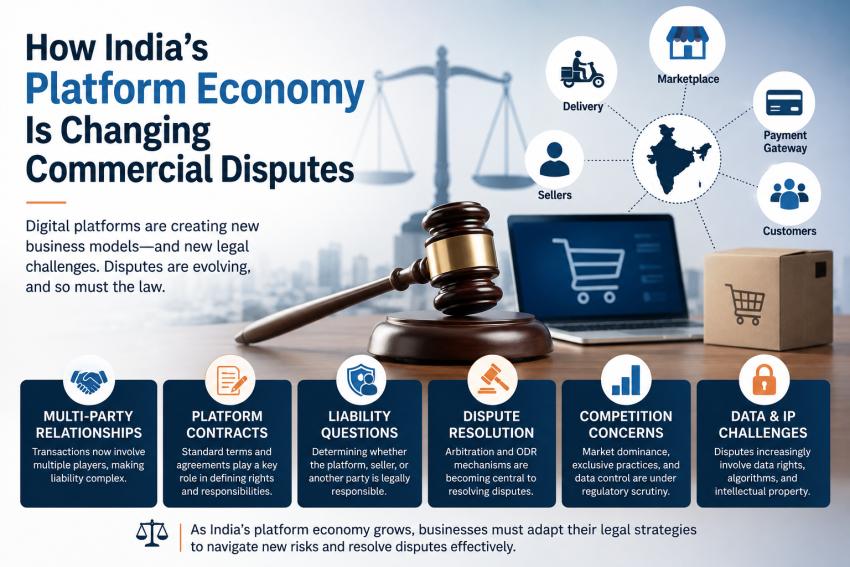
India’s platform economy has transformed how businesses sell, buy, deliver and interact with customers. E commerce marketplaces, food delivery applications, ride hailing services, fintech platforms and digital business networks now connect millions of users and businesses.
This growth has also changed the nature of commercial disputes. Earlier, a dispute usually involved two clearly identifiable parties and a direct contractual relationship. Today, a single transaction can involve a platform, seller, customer, logistics provider, payment service and technology provider.
As digital business models expand, Indian commercial law is increasingly dealing with questions of contractual liability, consumer protection, competition, data, intellectual property and dispute resolution.
The Rise of Multi Party Commercial Relationships
Traditional commercial transactions generally have a direct structure. A buyer purchases goods from a seller, or one business provides services to another. Platform based transactions are more complex.
For example, an online marketplace may connect a customer with an independent seller, while a separate logistics company handles delivery and a payment provider processes the transaction. Each participant may operate under separate terms and contractual arrangements.
This creates an important legal question: who is responsible when something goes wrong?
A delayed delivery may involve the seller, platform and logistics provider. A defective product may raise questions about the seller’s liability and the platform’s responsibilities. A failed payment may involve another contractual relationship.
The result is a greater need to identify the exact legal relationship between each participant before determining liability.
Platform Contracts Are Becoming More Important
Most platforms operate through standard terms of service, seller agreements, merchant contracts and technology agreements. These documents often contain provisions relating to payment, termination, intellectual property, confidentiality, indemnity, limitation of liability and dispute resolution.
The challenge is no longer simply whether a contract exists. Courts and arbitral tribunals may also have to consider how different contracts interact with one another.
For businesses operating through platforms, carefully drafted agreements can therefore play an important role in preventing disputes. Clauses concerning jurisdiction, arbitration, governing law, termination and liability can significantly influence how a dispute proceeds.
A commercial lawyer in india may also need to examine the platform’s complete business model rather than relying only on the wording of an individual agreement. The legal relationship between the parties, their actual conduct and applicable statutory obligations can all influence the outcome.
Who Is Liable: Platform or Seller?
One of the most important issues in platform related disputes is the distinction between an intermediary and a party directly responsible for a transaction.
Indian law does not treat every digital platform in the same manner. The nature of the platform, its contractual role and the applicable legislation can influence the question of liability.
The Consumer Protection Act, 2019 and the Consumer Protection (E Commerce) Rules, 2020 impose specific obligations on e commerce entities. These include requirements concerning information disclosure, grievance redressal and responsibilities of marketplace participants.
This makes it important to examine the actual role played by a platform in a transaction. Simply describing an entity as an intermediary may not resolve every question of liability. The facts of the transaction and the applicable statutory framework remain important.
Competition Disputes in the Platform Economy
Digital platforms can become powerful commercial gatekeepers because they control access to customers, data, visibility and transaction infrastructure.
This creates potential competition law concerns. Businesses may challenge practices involving preferential treatment, exclusive arrangements, discriminatory access, pricing practices or restrictions imposed on competitors.
The Competition Commission of India has examined several issues connected with digital markets. The rapid development of technology makes these disputes particularly complex.
Digital markets can change quickly because of network effects, algorithms, pricing strategies and access to data. A company’s commercial position may therefore change without the traditional indicators of market power being immediately obvious.
Commercial disputes involving platforms increasingly require an understanding of both contractual rights and competition regulation.
Arbitration and Digital Commercial Disputes
Arbitration remains an important dispute resolution mechanism for platform businesses. Digital businesses may have commercial relationships with parties operating across different cities or jurisdictions.
Platform agreements frequently contain arbitration clauses. However, the presence of such a clause does not automatically answer every question. Parties may still dispute whether a particular claim falls within the arbitration agreement or whether the subject matter can be referred to arbitration.
Disputes involving online marketplaces have also reached Indian courts, raising questions about the scope and applicability of arbitration agreements in technology driven commercial relationships.
This demonstrates why dispute resolution clauses require careful drafting. Where several agreements govern a single business relationship, inconsistencies between those agreements can create additional disputes.
Open Networks Are Adding Another Layer
India’s digital commerce ecosystem is also moving beyond the traditional model in which one platform controls the entire customer journey.
The Open Network for Digital Commerce, commonly known as ONDC, follows an open network model. Different participants can perform functions such as buying, selling, logistics and technology services.
This approach can create opportunities for more businesses to participate in digital commerce. It can also create new legal relationships. A single transaction may involve several independent network participants instead of one platform controlling the entire process.
Such structures may require new approaches to contractual allocation of responsibility, grievance handling and dispute resolution.
Data, Algorithms and Intellectual Property
Commercial disputes in the platform economy increasingly extend beyond traditional contractual claims.
Businesses may disagree over the ownership or permitted use of software, databases, digital content, customer information and other digital assets. Questions can also arise concerning algorithms, platform rankings and commercially sensitive information.
For businesses dependent on digital platforms, access to data can have substantial commercial value. A disagreement over data access or use can therefore become both a contractual and strategic business dispute.
Intellectual property disputes may also arise when sellers upload photographs, product descriptions, trademarks or other protected material to online marketplaces.
Why Businesses Need a Different Dispute Strategy
Platform businesses should not wait until a dispute arises to consider their legal position. Contracts should clearly identify the role of each participant and allocate responsibility for payments, delivery, refunds, intellectual property, data and regulatory compliance.
Businesses should also maintain proper digital records. Orders, invoices, communications, platform notifications, transaction histories and electronic agreements can become important evidence during commercial proceedings.
For companies managing multiple platform relationships, working with the best corporate law firms in india can help in structuring contracts and dispute resolution mechanisms around the specific nature of their business model.
The Future of Commercial Disputes in India
India’s platform economy continues to evolve. New business models, open networks and digital services will create legal questions as technology develops.
The direction is clear. Commercial disputes are moving from simple two party contractual disagreements towards complex disputes involving multiple participants, technology, regulation and digital infrastructure.
Businesses therefore need to look beyond the traditional question of who breached the contract. They must also consider who controlled the transaction, what contractual relationships existed, which statutory obligations applied, where liability was allocated and which dispute resolution mechanism governs the relationship.
As India’s digital economy expands, commercial law will increasingly have to balance innovation with accountability. Businesses that prepare for these issues at the contract and platform design stage will be better positioned to manage commercial disputes when they arise.