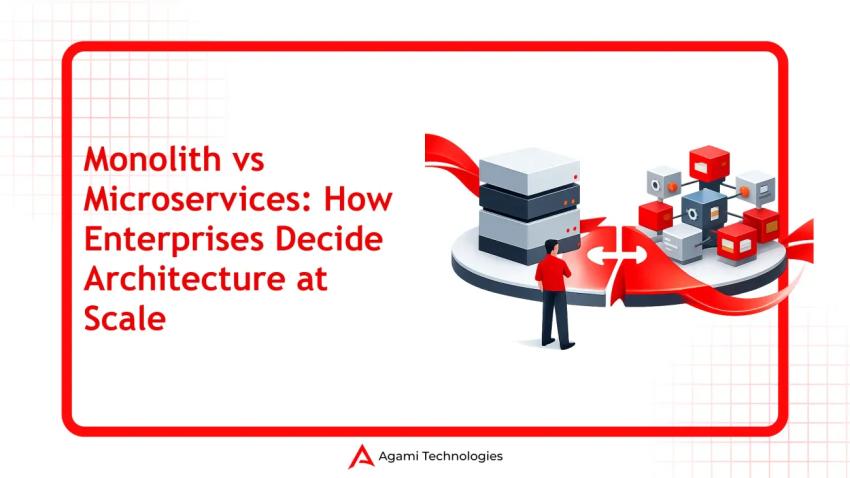
Modern businesses depend on software applications that can adapt to changing customer expectations, increasing workloads, and evolving business requirements. As applications become more complex, selecting an appropriate software architecture becomes an important strategic decision. Two widely used approaches are monolithic architecture and microservices architecture, each offering different benefits depending on an organization's goals and technical environment.
A monolithic application typically keeps major application components within a single codebase and deployment unit. This approach can be easier to develop, test, deploy, and manage during the early stages of a project. For smaller applications and teams, a monolithic structure may provide simplicity and reduce operational overhead. However, as the application grows, tightly connected components can make updates more difficult and may require the entire application to be deployed even when only one functionality has changed.
Microservices architecture takes a different approach by dividing an application into smaller, independently managed services. Each service can focus on a specific business capability and can potentially be developed, deployed, monitored, and scaled independently. This flexibility can be valuable for large enterprises that manage complex applications, multiple development teams, and rapidly changing business requirements.
However, adopting microservices also introduces additional considerations. Organizations may need stronger DevOps processes, service monitoring, API management, security controls, distributed data management, and automated deployment capabilities. Moving from a monolithic application to microservices without proper planning can increase technical and operational complexity.
Before choosing an architecture, businesses should evaluate their application size, development team structure, scalability requirements, infrastructure, security needs, deployment processes, budget, and long-term objectives. In some situations, continuing with a well-designed monolithic application may be the most practical option. In other cases, gradually introducing microservices can provide greater flexibility and support future growth.
Application modernization does not always require completely replacing an existing system. A phased strategy can allow organizations to identify specific components that would benefit from independent scaling or deployment while maintaining critical parts of the existing application. This approach can reduce disruption and allow teams to modernize according to business priorities.
Understanding the differences between monolithic and microservices architectures can help technology leaders make informed decisions about application development and modernization. A thoughtful architecture strategy can improve scalability, maintainability, development efficiency, system resilience, and the ability to respond to future business needs.
Enterprises should also consider how architecture decisions affect cloud adoption, data integration, testing, observability, and team collaboration. Establishing clear service boundaries and defining measurable modernization goals can make architectural transitions more manageable and sustainable over time.
For a deeper comparison of monolithic and microservices architecture, enterprise scalability, and modernization considerations, explore this detailed resource:
https://agamitechnologies.com/blog/monolith-vs-microservices-enterprise-architecture-scale