Artificial intelligence is changing the way businesses approach workflow automation. Traditional automation is effective for repetitive, rule-based activities, but modern enterprises often deal with processes that require information analysis, decision-making, and coordination across multiple systems.
AI agents can help address these challenges by performing specialized tasks within a larger business workflow. An agent can analyze information, retrieve data, classify requests, generate recommendations, or interact with connected applications based on defined objectives.
One important advantage of using AI agents is the ability to divide complex processes into smaller tasks. Different agents can handle different responsibilities while working together toward a common business outcome. This approach can be useful for areas such as customer service, sales operations, document processing, research, and internal support.
However, using multiple AI agents also introduces new challenges. Businesses need effective coordination between agents, reliable data exchange, appropriate permissions, and mechanisms for handling errors. Without these controls, a failure in one part of a workflow can affect the entire process.
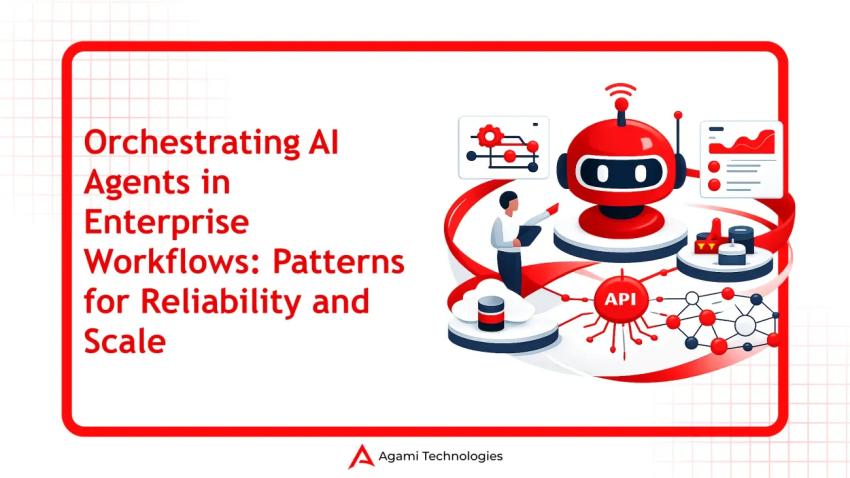
AI agent orchestration provides a structured approach to managing these interactions. It can help determine how agents communicate, how tasks are assigned, how workflow states are maintained, and what happens when an operation fails.
For a deeper look at AI agent orchestration, enterprise workflow patterns, reliability, observability, and scalability, read the following guide:
Reliability should be a major consideration when deploying AI-powered workflows. Businesses can use validation checks, retry mechanisms, fallback procedures, logging, access controls, and human approval to reduce operational risks.
Observability is equally important. Teams need to understand how workflows are performing, where errors occur, how long individual tasks take, and how different agents interact with connected systems. Monitoring and detailed logs can help identify bottlenecks and improve workflows over time.
Scalability should also be considered from the beginning. Organizations can start with a focused use case, measure its results, and gradually expand successful workflows. Modular AI agents and event-driven architectures can make it easier to introduce additional capabilities as business requirements grow.
Human oversight remains valuable even when many tasks are automated. AI can handle repetitive information processing and routine activities, while employees can review exceptions, approve sensitive actions, and make decisions that require business judgment.
Ultimately, successful enterprise AI automation is not simply about adding AI to existing processes. It requires thoughtful workflow design, reliable orchestration, monitoring, security, and continuous improvement. By starting with well-defined use cases and expanding gradually, businesses can use AI agents to create smarter, more efficient, and scalable operations.