A patent gives an inventor legal protection over an invention, but the extent of protection does not depend only on the idea itself. The wording used in the patent specification plays a central role. A well drafted specification can support meaningful protection, while unclear or incomplete drafting may restrict the rights available to the patent owner.
Understanding the connection between patent specifications and the scope of protection is important for inventors, businesses, researchers and technology driven companies. It also helps applicants make informed decisions before filing a patent application.
What Is a Patent Specification?
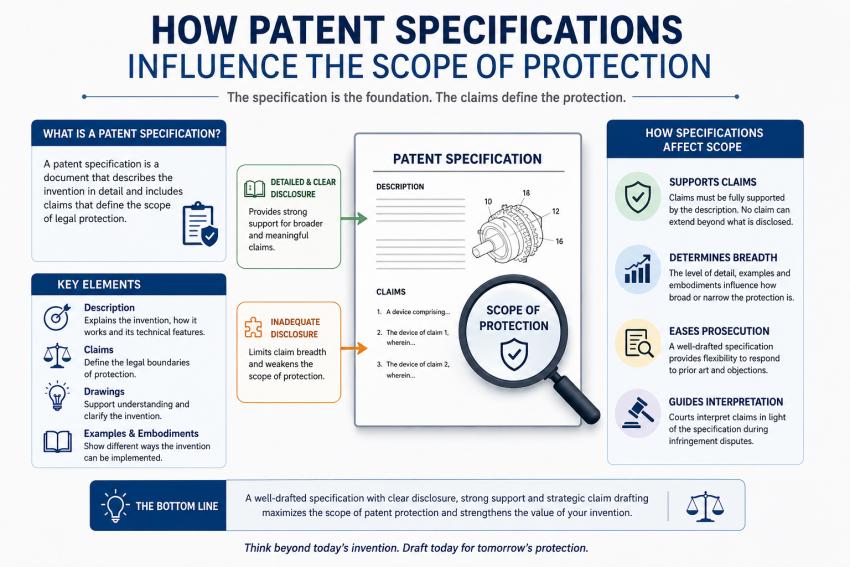
A patent specification is the technical and legal document describing an invention. It generally explains how the invention works, identifies its technical features and sets out the claims for which protection is sought.
Under Indian patent law, the specification may be provisional or complete. A complete specification must provide sufficient disclosure of the invention and include claims defining the scope of protection.
The specification therefore performs two important functions. It explains the invention to the public and establishes the foundation for determining the legal boundaries of the patent.
Why Patent Claims Matter
Claims are the most important part of a patent when determining its legal scope. They define the features of the invention for which exclusive rights are sought.
For example, suppose an invention relates to a water purification device. A claim may cover a device comprising a particular filter, sensor and control mechanism. Protection will depend on how these elements are described and combined within the claim.
A broad claim may potentially cover a wider range of products or processes. However, it must still be supported by the disclosure and satisfy the requirements of patent law. A claim drafted too broadly may face objections relating to prior art, clarity, support or other statutory requirements.
The Specification Must Support the Claims
The description and claims must work together. Claims cannot simply extend beyond what the specification teaches.
A detailed specification can provide support for different embodiments, technical variations and possible implementations of the invention. This can give the applicant greater flexibility when framing claims during prosecution.
For instance, if a specification describes only one specific material for achieving a technical result, attempting to claim every possible material may create difficulties. In contrast, a specification discussing different suitable materials and explaining their technical role may provide stronger support for broader claim language.
This is why patent drafting requires more than simply describing how an invention works. The specification should anticipate reasonable variations without unnecessarily limiting the invention.
Role of Technical Detail
Technical detail can significantly influence the eventual scope of protection. The description should explain the invention clearly enough for a skilled person to understand and perform it.
At the same time, excessive reliance on narrow technical details can unintentionally limit the scope of a claim. If the invention is described only through one particular configuration, later attempts to obtain broader protection may become difficult.
A carefully prepared specification can distinguish between essential features and optional features. This distinction becomes valuable when claims are examined or amended during the patent application process.
How Prior Art Affects Scope
Patent protection is also shaped by existing technology. During examination, the Patent Office may identify earlier publications or other prior art relevant to the claimed invention.
If a broad claim covers features already disclosed in prior art, the applicant may need to narrow it. The final scope of protection can therefore become narrower than originally intended.
A strong specification can help in this situation by providing sufficient disclosure of alternative embodiments and technical features. It may allow the applicant to develop narrower claims while retaining meaningful protection for the inventive concept.
Importance of Claim Drafting
Claim drafting requires careful consideration of language. Small differences in wording can affect the boundaries of patent protection.
Terms used in a claim may determine whether a particular product or process falls within its scope. Ambiguous language can create uncertainty and may lead to objections or disputes.
Independent claims generally establish the principal scope of protection. Dependent claims add further limitations and can provide narrower positions if broader claims face challenges.
A balanced claim structure can therefore provide different layers of protection around an invention.
Amendments During Patent Prosecution
Patent applications often undergo examination before a patent is granted. Applicants may need to respond to objections and amend claims or other parts of the application.
Amendments are not unlimited. Indian patent law places restrictions on amendments to patent specifications. In broad terms, amendments must remain connected to the original disclosure and cannot be used to introduce entirely new subject matter.
This makes the initial specification particularly important. Information omitted from the original disclosure may not always be capable of being added later. Careful drafting at the filing stage can therefore preserve options during prosecution.
Patent Specifications and Infringement
The specification can also influence how patent rights are interpreted during an infringement dispute. Courts may examine the claims along with the specification to understand the meaning and technical context of the claimed invention.
The description does not simply replace the claims. Instead, it can assist in interpreting technical terms and understanding the invention.
A patent owner therefore needs claims with sufficient breadth to protect commercially relevant applications, while ensuring the claims remain legally and technically defensible.
Importance of Professional Patent Drafting
Patent drafting combines technical understanding with legal precision. An applicant must consider the invention’s present use as well as foreseeable technical variations and commercial applications.
For complex inventions, professional assistance can help identify essential technical features, structure claims and prepare a specification capable of supporting different claim strategies. Consulting a patent lawyer in india can also help applicants understand filing requirements, prosecution issues and potential limitations under Indian patent law.
Businesses with significant intellectual property portfolios may also need broader advice on filing strategies, licensing, enforcement and portfolio management. Working with the best intellectual property law firms in india may be useful where inventions involve multiple technologies, jurisdictions or commercially important rights.
Key Factors Affecting Patent Protection
Several elements of a specification can influence the eventual scope of protection:
- Clarity: The invention and its technical features should be described clearly.
- Completeness: The specification should provide adequate information for implementation.
- Claim structure: Claims should define the intended legal boundaries precisely.
- Technical variations: Reasonable alternatives and embodiments should be considered.
- Support: The claims should be properly supported by the description.
- Prior art: Existing technology should be considered when determining appropriate claim breadth.
- Amendment strategy: The original disclosure should provide sufficient scope for permissible amendments.
Conclusion
Patent protection begins with careful drafting. The specification establishes the technical foundation for the claims, while the claims define the principal boundaries of the exclusive rights sought by the applicant.
A specification written too narrowly may limit future protection. A specification written too broadly without adequate technical support may face examination challenges. The objective is therefore to create a clear, comprehensive and strategically structured document capable of supporting appropriate claims.
For inventors and businesses, investing attention in the patent specification at the filing stage can have long term consequences. A carefully drafted specification can provide a stronger foundation for prosecution, enforcement and the commercial value of the resulting patent.