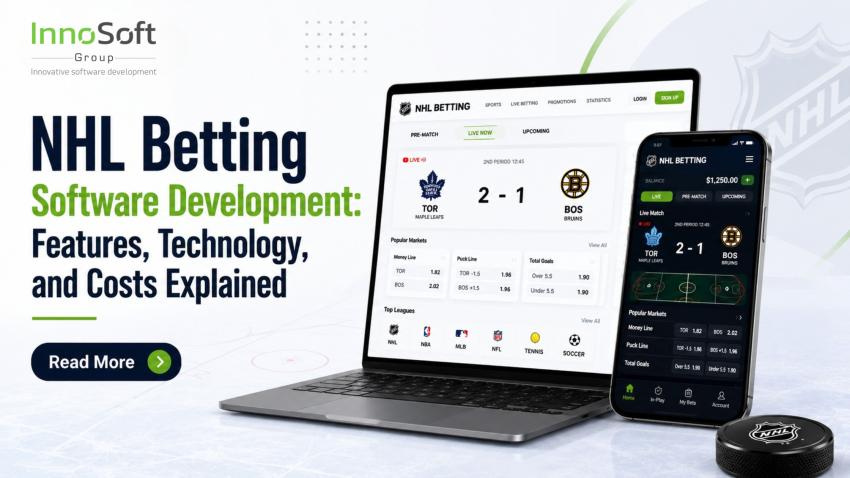
Developing an NHL betting platform requires much more than displaying hockey matches and allowing users to place wagers. The platform needs accurate odds, multiple betting markets, live match information, secure payments, user management, automated bet settlement, and an interface that makes it easy for bettors to move between games and markets. Every component needs to work together so operators can manage betting activities efficiently while users get a straightforward wagering experience.
The development process also involves decisions around architecture, data feeds, APIs, security, scalability, and administration tools. Working with experienced sports betting software developers can make these decisions easier because the technical foundation needs to support both day-to-day sportsbook operations and future growth. In this guide, Innosoft Group explains the major steps, features, technologies, integrations, and cost factors involved in building an NHL betting platform.
What Is an NHL Betting Platform?
An NHL betting platform is a digital sportsbook solution that allows users to wager on National Hockey League games and related markets. Depending on the business model, the platform can operate as a dedicated hockey sportsbook or as part of a larger multi-sport betting ecosystem.
Users can browse scheduled NHL games, compare available markets, view odds, create bet slips, place pre-match or live bets, track open wagers, and review settled bets from a single account.
From the operator's side, the platform requires considerably more functionality. Administrators need tools for managing users, betting markets, odds, payments, promotions, risk exposure, reporting, and platform settings.
A successful NHL betting platform development project therefore needs to balance three areas: the bettor experience, sportsbook management, and the technical infrastructure connecting both sides.
How Does an NHL Betting Platform Work?
An NHL betting platform sits between users, sportsbook operators, data sources, payment systems, and other third-party services.
When a bettor opens the platform, the system retrieves available games and betting markets from connected data services. Odds are displayed based on the sportsbook's configuration. The user chooses a market, adds the selection to the bet slip, enters a stake, and confirms the wager.
Before accepting the wager, the backend performs several checks. These may include account status, available balance, market availability, betting limits, odds changes, and applicable compliance requirements.
Once accepted, the wager is recorded and reflected in the user's account.
For live NHL betting, this process becomes more demanding because game conditions and odds can change quickly. Scores, penalties, periods, shots, and other events can affect available markets and pricing.
This is why architecture and real-time data handling play an important role in sports betting app development, particularly for sportsbooks that want to offer extensive in-play betting.
Key Features of an NHL Betting Platform
The quality of an NHL sportsbook depends heavily on the functionality available to bettors and operators. Rather than adding features simply to increase the feature count, each function should have a clear purpose within the betting journey.
1. User Registration and Account Management
Users need a simple way to register, log in, verify their accounts, update profile information, and manage security settings.
The account section can include:
Personal information
Account verification
Wallet balance
Deposit and withdrawal history
Open bets
Settled bets
Transaction records
Security settings
Responsible gaming controls
The exact registration and verification process should be configured according to the jurisdiction in which the sportsbook operates.
2. NHL Match Listings
Match discovery should be simple, especially when several games are scheduled close together.
The platform can organize NHL events by date, status, team, and league stage. Users should be able to quickly identify upcoming games, live events, and completed matches.
A clear match center also provides space for important information such as starting time, team names, current score, game period, and available markets.
3. Pre-Match Betting
Pre-match betting allows users to place wagers before an NHL game begins.
Operators can provide markets such as:
Moneyline
Puck line
Game totals
Team totals
Period betting
Winning margin
Player-related markets
Combination markets
The available options will depend on the sportsbook's data feeds and trading strategy.
Well-designed NHL sportsbook software should make it easy for operators to configure these markets while keeping navigation simple for bettors.
4. Live NHL Betting
Live betting can become one of the most engaging parts of an NHL sportsbook.
During a match, odds may change based on the score, remaining time, penalties, team performance, and other game events. The system must receive updates quickly and determine whether a market should remain active, change price, or temporarily suspend betting.
Users should also receive clear notifications when odds change before a wager is confirmed.
Because hockey games can move quickly, live betting requires careful synchronization between the frontend, backend, data feeds, and odds services.
5. Dynamic Bet Slip
The bet slip is a critical part of the wagering journey.
Users should be able to add and remove selections, enter stakes, see potential returns, and review the wager before confirmation.
Depending on the sportsbook model, the bet slip may support:
Single bets
Multiple bets
System bets
Quick bets
Saved selections
It should also respond appropriately when odds change or a selected market becomes unavailable.
6. Live Scores and Match Information
Users should not need to leave the sportsbook just to understand what is happening in a game.
Live scores, game periods, match clocks, team statistics, and other information can be presented alongside betting markets.
This improves usability while giving bettors context for their decisions.
Reliable data delivery is therefore one of the important NHL betting software features to consider during development.
7. Secure Wallet and Payment Management
A sportsbook needs an account balance system capable of tracking deposits, withdrawals, wagers, winnings, bonuses, refunds, and adjustments.
The wallet should maintain accurate transaction records so both users and administrators can review financial activity.
Payment options will depend on the target market and applicable regulations. Operators may integrate cards, bank transfers, digital payment methods, or other approved solutions.
8. Promotions and Bonus Management
Promotions can be managed directly through the sportsbook administration panel.
Operators may configure welcome offers, free bets, deposit-based promotions, loyalty programs, or NHL-specific campaigns.
The system should allow administrators to define eligibility conditions, validity periods, wagering requirements, and usage limits.
Clear bonus rules are equally important on the user side so bettors understand how an offer works before participating.
NHL Betting Platform Technology Stack
Selecting the right technologies depends on the platform's expected traffic, development model, supported devices, integrations, and long-term expansion plans.
There is no single NHL betting technology stack suitable for every project. However, several technology categories need to be considered.
Frontend Technologies
The frontend is responsible for everything users see and interact with.
Common web technologies may include React, Angular, Vue.js, HTML5, CSS, and JavaScript or TypeScript.
The goal is to create responsive interfaces that work across desktop computers, tablets, and mobile devices.
Particular attention should be given to odds tables, live event screens, bet slips, navigation, account pages, and transaction screens.
Backend Technologies
The backend manages sportsbook logic, user accounts, wagers, transactions, market configurations, integrations, and administrative processes.
Technologies such as Node.js, Java, Python, .NET, or other backend frameworks can be selected based on project requirements.
Backend architecture should also account for peak betting periods. A sudden increase in activity during major NHL games should not prevent users from accessing markets or placing wagers.
Databases
Databases store account details, transactions, bets, market information, configurations, and other operational data.
SQL-based systems such as PostgreSQL and MySQL are commonly considered for structured data, while other database technologies can support caching, sessions, or high-volume workloads.
The database strategy should prioritize data consistency, performance, backups, and recovery.
Cloud and Infrastructure
Cloud infrastructure can help sportsbooks allocate computing resources according to demand.
Depending on project requirements, development teams may use services from established cloud platforms, containerization technologies, load balancing, monitoring systems, and content delivery networks.
Infrastructure planning should also include disaster recovery, logging, alerts, and system health monitoring.
Importance of API Integration in NHL Betting
An NHL sportsbook rarely operates as a completely isolated application. It usually communicates with multiple external systems.
Through sports betting API integration, a platform can connect with odds feeds, sports data services, payment gateways, verification systems, CRM solutions, analytics platforms, and other business tools.
APIs can reduce the need to develop every service internally, but integration quality matters.
Development teams should evaluate:
Data update frequency
API response times
Documentation quality
Authentication methods
Request limits
Error handling
Coverage of NHL events and markets
Service availability
Technical support
When selecting a sports betting API provider, operators should also consider whether the service can support both current requirements and future expansion into additional leagues, sports, or betting markets.
Building an Odds and Data Management System
Odds are at the center of a sportsbook.
The platform needs a system capable of receiving, processing, displaying, updating, suspending, and settling markets.
For pre-match events, changes may occur less frequently. Live NHL betting requires much faster updates.
The development team needs to establish clear rules for handling data interruptions and unexpected conditions. For example, if a live data feed becomes temporarily unavailable, affected markets may need to be suspended until reliable information returns.
Operators should also have visibility into feed status through the admin panel.
Automated alerts can help administrators identify delayed feeds, failed integrations, unusual betting patterns, or other operational problems.
Admin Panel and Sportsbook Management
While users interact with the betting interface, sportsbook teams need a central environment for operating the platform.
An effective admin panel can provide tools for:
User management
Bet monitoring
Market configuration
Odds management
Payment review
Bonus management
Risk controls
Reports
Content management
Role-based staff access
System settings
A capable betting software provider should consider operator workflows during development rather than focusing only on the bettor-facing application.
Role-based permissions are particularly useful. Customer support representatives, finance teams, traders, and administrators may require different levels of access.
Risk Management and Betting Limits
Sportsbooks need mechanisms for controlling financial exposure.
Risk management tools can monitor betting activity by market, event, user, or wager type. Administrators can establish minimum and maximum stakes, payout limits, and other rules based on business requirements.
Automated monitoring can also help identify unusual patterns that require manual review.
Risk controls should work closely with odds management and user management systems so sportsbook teams have a complete view of betting activity.
Security Considerations for NHL Betting Software
Security should be considered throughout development rather than added near launch.
Important measures can include:
Encrypted data transmission
Secure password storage
Multi-factor authentication
Role-based permissions
Session management
Payment security controls
API authentication
Activity logging
Fraud monitoring
Regular security testing
Teams offering sports betting software development should also establish procedures for security updates, vulnerability management, backups, and incident response.
Protecting administrative access is particularly important because operator accounts may have permissions affecting users, transactions, markets, and system settings.
Mobile NHL Betting Experience
Many bettors expect to access sportsbooks through smartphones, making mobile usability an important development consideration.
Operators can choose between responsive web platforms, progressive web applications, native mobile applications, or cross-platform solutions.
A sports betting app development company should evaluate the target audience and business objectives before recommending a specific approach.
On smaller screens, the interface should prioritize essential actions. Bettors should be able to find a game, choose a market, add a selection, review the bet slip, and confirm the wager without unnecessary navigation.
Performance also matters. Large amounts of live data should not make the application slow or difficult to use.
Compliance and Responsible Gaming
Betting regulations differ across markets, so compliance requirements should be identified before development begins.
Depending on the jurisdiction, the platform may need functions for identity verification, age checks, transaction monitoring, geolocation, account restrictions, reporting, and record retention.
Responsible gaming features can include:
Deposit limits
Wagering limits
Session reminders
Cooling-off periods
Self-exclusion
Account history
Responsible gaming information
These controls should be accessible and easy for users to understand.
Operators should obtain appropriate legal and regulatory guidance for each market in which they intend to offer betting services.
Testing an NHL Betting Platform Before Launch
Sportsbook testing goes beyond checking whether pages load correctly.
Quality assurance teams should test complete wagering scenarios from registration through settlement.
Testing can include:
Functional Testing
Checks registration, login, deposits, withdrawals, betting markets, bet slips, promotions, and account functions.
API Testing
Confirms that sports data, odds, payment, verification, and other connected services exchange information correctly.
Performance Testing
Measures how the platform behaves when many users access games and place wagers simultaneously.
Security Testing
Checks authentication, permissions, data handling, API security, and potential vulnerabilities.
Device Testing
Confirms that the sportsbook works correctly across supported browsers, screen sizes, smartphones, and tablets.
Teams involved in sports betting API integration should also test failure scenarios instead of assuming external services will always respond correctly.
How Much Does It Cost to Develop an NHL Betting Platform?
The NHL betting platform cost can typically range from $30,000 to $150,000 or more, depending on the platform's features, complexity, integrations, and level of customization.
A basic NHL betting platform with standard betting markets and essential functionality may start at the lower end of the range. A more advanced platform with live betting, real-time odds, mobile apps, multiple payment options, custom admin tools, and third-party integrations can require a higher investment.
Key factors that influence development costs include:
Number of betting markets
Pre-match and live betting functionality
Custom or white-label development
Web, Android, and iOS applications
Sports data and odds feeds
Third-party API integrations
Payment gateway integration
Admin and risk management tools
Security and compliance features
UI/UX requirements
Testing and deployment
Ongoing maintenance and upgrades
The final cost depends on the specific business and technical requirements. Innosoft Group can evaluate your project scope and provide a development estimate based on the features, integrations, and platform model you need.
Custom Development vs. White Label NHL Betting Platform
One of the major decisions is whether to develop a custom sportsbook or start with a white-label solution.
A custom platform gives businesses greater control over functionality, branding, architecture, integrations, and future product decisions. However, it usually requires more development time and a larger initial investment.
A white-label platform can reduce the time required to enter the market because much of the underlying sportsbook infrastructure already exists.
The right choice depends on budget, launch plans, technical requirements, and long-term strategy.
Experienced betting software providers can help businesses evaluate both approaches before development begins.
Step-by-Step Process to Build an NHL Betting Platform
A structured development process helps prevent expensive changes later in the project.
Step 1: Define the Business Model
Determine whether the product will focus exclusively on NHL betting or operate as part of a broader sportsbook.
Identify target markets, devices, currencies, payment methods, and required betting options.
Step 2: Finalize Features
Create a clear feature list covering both bettor and administrator requirements.
Separate essential launch features from functions that can be introduced in later releases.
Step 3: Plan the Architecture
Define the frontend, backend, databases, infrastructure, security model, APIs, and data flow.
Architecture decisions should consider expected traffic and future product expansion.
Step 4: Select Sports Data and Odds Services
Evaluate providers based on NHL coverage, market depth, update frequency, reliability, documentation, and integration requirements.
Step 5: Design the User Experience
Create user journeys, wireframes, and interface designs for registration, game discovery, market selection, bet placement, payments, and account management.
Step 6: Develop the Platform
Build frontend and backend components while integrating required third-party systems.
Development should be divided into manageable stages so functionality can be reviewed and tested continuously.
Step 7: Test Complete Betting Workflows
Test normal and unusual scenarios, including odds changes, suspended markets, failed payments, interrupted data feeds, and high traffic.
Step 8: Prepare for Deployment
Configure production infrastructure, monitoring, backups, security controls, and operational processes.
Compliance and licensing requirements should also be addressed before the platform becomes available to users.
Step 9: Monitor and Improve
Development continues after launch.
Sportsbook teams should monitor platform performance, user behavior, API reliability, betting activity, security alerts, and operational feedback.
Updates can then be prioritized according to actual business requirements.
Why Choose Innosoft Group for NHL Betting Platform Development?
Building an NHL sportsbook requires experience across betting systems, frontend and backend engineering, odds and sports data integrations, payment systems, security, administration tools, and scalable infrastructure.
Innosoft Group works with businesses that want to build, upgrade, or expand sports betting products. As an experienced NHL sportsbook software development partner, our focus is on creating platforms that are practical for operators to manage and straightforward for bettors to use.
We can support businesses with product planning, architecture, UI/UX, web and mobile development, sportsbook integrations, testing, deployment, and ongoing technical improvements.
Instead of treating every project the same way, we begin by understanding the sportsbook's business model, target market, required betting markets, operational workflows, and expansion plans. This helps determine which components should be custom-developed and where proven third-party services can reduce unnecessary development effort.
Final Thoughts
Developing an NHL betting platform involves several interconnected systems. Odds and sports data need to remain accurate, bet placement needs to be responsive, transactions need to be properly recorded, and administrators need enough control to manage users, markets, risk, and payments effectively.
The right development approach starts with a clear product scope and a technical foundation that can support both current requirements and future growth. Businesses should pay particular attention to live data, API reliability, security, mobile usability, risk management, testing, and compliance before moving toward launch.
Innosoft Group can help turn an NHL sportsbook concept into a functional betting product, whether you need to build a new platform, add NHL betting to an existing sportsbook, integrate additional data services, or modernize your current system.
If you are planning to build an NHL betting platform, our team can help define the development roadmap, select suitable technologies, implement the required functionality, and prepare the product for launch and ongoing operation.