Robots are rapidly moving beyond controlled industrial environments into warehouses, hospitals, retail stores, homes, and other dynamic spaces. In these settings, robots must do more than detect objects. They need to understand actions, interpret human behavior, recognize interactions, and determine what should happen next.
Building this level of intelligence requires AI models to learn from realistic visual experiences. One increasingly valuable source of such information is first-person video—visual data captured from the perspective of a person or robot performing an activity.
Through egocentric video annotation, raw first-person footage can be transformed into structured training datasets that help robots learn how humans perceive, interact with, and navigate their surroundings. When combined with high-quality robot training data, these datasets can support more capable and context-aware robotic systems.
What Is Egocentric Video Annotation?
Egocentric video refers to footage captured from a first-person point of view, typically using wearable cameras, head-mounted devices, smart glasses, or cameras integrated into robotic systems.
Unlike traditional third-person footage, egocentric video shows the environment from the perspective of the individual performing an action. For example, a first-person recording of someone preparing a meal may show their hands picking up utensils, opening containers, moving ingredients, and interacting with appliances.
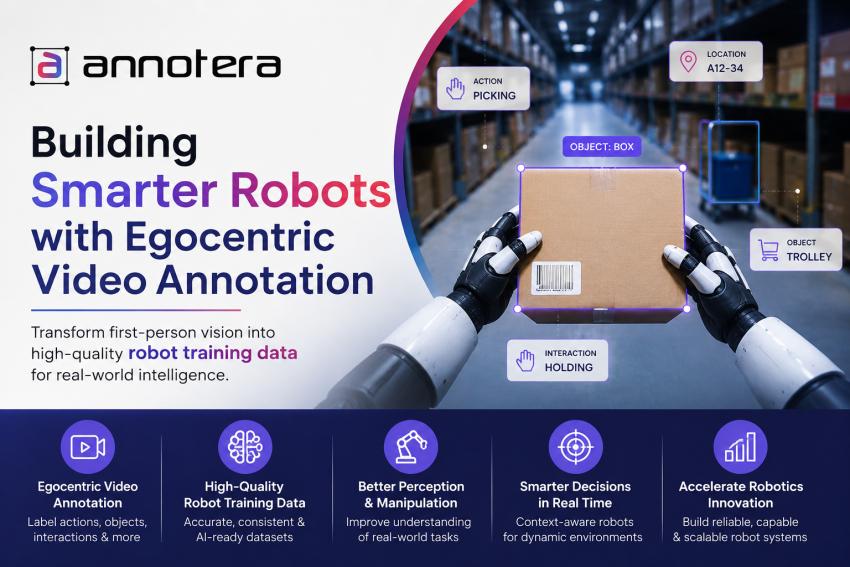
Egocentric video annotation involves labeling important information within this footage so machine learning models can understand what is happening. Depending on the robotics application, annotations may identify:
Objects and object categories
Hand-object interactions
Human actions and activities
Action start and end times
Object states and state changes
Spatial relationships
Movement trajectories
Interaction sequences
These labels turn complex visual experiences into machine-readable information that can be incorporated into robot training data.
Why First-Person Perspective Matters for Robotics
Traditional computer vision datasets often contain images or videos captured from fixed cameras. While useful for object detection and scene understanding, these perspectives may not fully represent what a robot encounters while actively interacting with its environment.
Egocentric video provides a viewpoint much closer to the operational perspective of many robots.
Consider a warehouse robot learning to pick products from shelves. It must identify the correct item, estimate its position, determine where to grasp it, avoid surrounding objects, and place it at the appropriate destination.
First-person recordings of humans performing similar tasks provide valuable examples of these interactions. Properly annotated footage can help AI systems learn relationships between perception, movement, objects, and actions.
This makes egocentric datasets particularly useful for embodied AI, where intelligent systems must connect visual understanding with physical actions.
Turning Human Demonstrations into Robot Training Data
One of the most promising applications of egocentric video is learning from human demonstrations.
Humans naturally perform thousands of everyday tasks that robots are being developed to automate. Instead of defining every possible interaction manually, developers can capture people performing tasks and convert those demonstrations into structured robot training data.
For example, imagine training a robot to organize items on a workbench. First-person footage could capture a human identifying tools, picking them up, moving them to designated locations, and adjusting their orientation.
Annotation can identify each stage of the process:
Detect → Reach → Grasp → Move → Position → Release
By training on many examples, robotic AI can begin learning patterns behind successful task execution.
This approach is particularly valuable for tasks involving multiple sequential actions, where understanding context is as important as recognizing individual objects.
Improving Hand-Object Interaction Understanding
Manipulation remains one of the most challenging areas of robotics.
A robot may successfully recognize a bottle, box, tool, or component but still struggle to determine how that object should be handled. Successful manipulation requires understanding where an object can be grasped, how it moves, and how its state changes during an interaction.
Egocentric footage naturally captures hands and objects in close proximity. Annotation can label hands, contact points, manipulated objects, interaction states, and temporal action boundaries.
For instance, the difference between simply detecting a drawer and understanding the sequence of reaching for its handle, pulling it outward, retrieving an object, and closing it again is significant.
Detailed egocentric video annotation gives models richer supervision for learning these relationships.
Supporting Better Action Recognition
Robots operating around humans must understand not only what objects are present but also what people are doing with them.
A person holding a cup may be drinking, washing it, filling it, placing it on a table, or handing it to someone else. Object detection alone cannot distinguish these situations.
Annotated first-person video can provide action labels that connect objects with activities and context.
This capability can support robots working in collaborative environments. A warehouse robot might recognize when a worker is reaching toward a package. A service robot could identify when someone is handing over an object. An assistive robot might understand when a user begins a familiar household task.
Accurate action recognition can therefore help robotic systems make more appropriate decisions.
Training Robots for Complex Real-World Environments
Real-world environments are rarely predictable.
Lighting conditions change. Objects become partially hidden. People move unexpectedly. Camera viewpoints shift rapidly. Similar objects appear in different orientations and locations.
Egocentric video naturally contains many of these challenges, making it valuable for developing robust robot training data.
Training datasets can include diverse examples of motion blur, occlusion, cluttered environments, varying viewpoints, different users, and unexpected interactions. With accurate annotation, these scenarios can help AI models learn to generalize beyond ideal laboratory conditions.
Dataset diversity is especially important for robots expected to operate autonomously in human-centered environments.
Applications of Egocentric Video Annotation in Robotics
First-person annotated datasets can support multiple areas of robotics development.
In warehouse and logistics robotics, they can help models learn picking, packing, sorting, and inventory-handling workflows.
For household and service robots, egocentric datasets can capture everyday activities such as cleaning, organizing objects, opening containers, or handling kitchen items.
In industrial robotics, human demonstrations can provide valuable examples of assembly, tool usage, inspection, and component manipulation.
Egocentric data can also contribute to assistive robotics, where understanding human activities and intentions is essential for delivering timely and context-aware assistance.
Across these applications, annotation quality directly affects how effectively AI models learn from visual demonstrations.
Why Annotation Quality Matters
First-person video presents unique annotation challenges. Rapid camera movement, overlapping hands and objects, frequent occlusions, subtle actions, and long interaction sequences can make labeling difficult.
Inconsistent annotations can introduce ambiguity into training datasets. For example, if similar actions are labeled differently across videos, a model may struggle to learn reliable patterns.
A well-designed annotation workflow should therefore include clear labeling guidelines, defined taxonomies, quality assurance procedures, and consistent handling of edge cases.
Human annotation expertise is especially important when tasks require contextual interpretation rather than straightforward object identification.
Annotera: Building High-Quality Data for Smarter Robotics
As robotics systems become more sophisticated, the quality and relevance of their training data become increasingly important.
Annotera helps AI and robotics teams transform complex visual datasets into structured, high-quality training data. From object and action labeling to temporal annotation and detailed interaction analysis, our annotation workflows can be tailored to the requirements of robotics and embodied AI projects.
With carefully managed egocentric video annotation, organizations can extract meaningful supervision from first-person visual experiences and build richer robot training data for perception, manipulation, navigation, and activity understanding.
Conclusion
The next generation of robots will need to understand the world from an active, interactive perspective. They must recognize not only objects but also actions, relationships, intentions, and changing environments.
Egocentric video offers a powerful window into how humans interact with the physical world. When that footage is accurately annotated, it can become a valuable foundation for teaching robots how to perceive situations and perform complex tasks.
For robotics teams developing intelligent systems for real-world environments, high-quality first-person training datasets can help bridge the gap between seeing an environment and understanding how to act within it.
Building a robotics or embodied AI dataset? Partner with Annotera to turn complex first-person video into accurate, scalable, and AI-ready training data.