You've tried the breathing exercises, the white noise machine, the meditation apps — but your brain still races at 2 AM like it's running a marathon. Work stress replays on loop, tomorrow's problems pile up, and every relaxation technique you read about somehow makes you more tense. Sound familiar?
Here's the thing — most people blame themselves when "calming techniques" don't work. But the real problem isn't you. It's that conscious effort to relax triggers the exact neurological response that keeps you awake. If you've been struggling with this cycle, Online Stress Relief Hypnosis Flagstaff, AZ offers a different approach that sidesteps the trap entirely. This article breaks down why your current methods backfire and what actually works when your brain won't shut off.
Why Traditional "Calm Your Mind" Techniques Backfire
When you lie in bed trying to clear your mind, you're asking your conscious brain to do something it physically can't do — turn itself off on command. The harder you concentrate on relaxing, the more alert your prefrontal cortex becomes. It's like telling someone "don't think about a pink elephant" — the instruction itself makes it impossible.
Meditation apps guide you to focus on your breath or body sensations. For some people, this works. But if your stress is high enough, focusing on anything activates the same mental circuits that keep you awake solving problems. Your brain interprets "focus on breathing" as another task to complete, another thing to get right. And when you inevitably lose focus and your thoughts drift back to work deadlines, you feel like you've failed at relaxation — which spikes stress hormones even higher.
This isn't a willpower issue. It's a design flaw in how most relaxation methods are taught. They rely on conscious control at the exact moment your conscious mind is overactive and exhausted.
The Neurological Reason Effort Makes Sleep Harder
Your brain has two modes — sympathetic (alert, problem-solving, fight-or-flight) and parasympathetic (rest, digest, repair). Sleep happens in parasympathetic mode. But you can't force yourself into that state through conscious effort because effort itself is a sympathetic activity.
Every time you think "I need to fall asleep" or "why isn't this working," you're sending stress signals to your amygdala. Your body reads those thoughts as evidence that something is wrong, which keeps cortisol levels elevated. This is why the more you want sleep, the more elusive it becomes. You're stuck in what sleep researchers call "performance anxiety around sleep" — and it's self-reinforcing.
Chronic insomniacs often develop conditioned arousal. The bed becomes a place where you lie awake and stress about not sleeping, so your brain starts releasing wake-up chemicals the moment you lie down. No amount of conscious relaxation technique can override that automatic response because it's happening below your awareness.
How Online Stress Relief Hypnosis Bypasses the Trying Trap
Hypnosis works differently because it doesn't ask you to do anything. You're not trying to focus or control your thoughts. Instead, the hypnotist's voice guides your subconscious into a deeply relaxed state without your conscious mind needing to participate. It's like taking the emergency brake off — your brain naturally drifts toward rest when it's not fighting to stay alert.
During hypnosis, your brainwaves shift from beta (active thinking) to alpha and theta (deep relaxation). This happens automatically as you listen, not because you're working to make it happen. The guided suggestions bypass your critical conscious mind and speak directly to the part of your brain that regulates stress responses. That's why people often say hypnosis "just happened" without them noticing — because it did.
For racing thoughts specifically, hypnosis retrains your brain's association with bedtime. Instead of bed triggering anxiety about sleep, it becomes a cue for deep relaxation. The subconscious learns through repeated sessions that lying down means safety and rest, not performance pressure. And unlike meditation, you don't need perfect focus — hypnosis works even when your mind wanders.
When Online Sessions Work Better Than In-Person
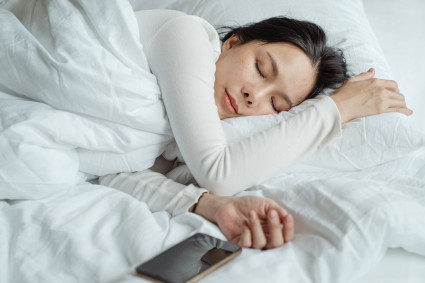
Online hypnosis has one massive advantage for insomnia — you can do it in the exact environment where you struggle. You're already in bed, in your own space, without the logistical stress of commuting to an appointment when you're already exhausted. The hypnotist's voice becomes part of your nightly routine, which helps build that new sleep association faster.
Some people worry they won't "go deep enough" online or that they need face-to-face contact for it to work. But hypnosis depth isn't what matters for insomnia. What matters is consistent exposure to the guided relaxation while your brain is primed to learn new patterns. Online sessions give you that repetition without the friction of scheduling and travel.
That said, online therapy isn't magic. If your insomnia is caused by sleep apnea, medication side effects, or untreated pain, hypnosis won't fix the root cause. It's most effective for stress-driven insomnia where your mind is the main thing keeping you awake. If you've ruled out medical causes and traditional relaxation methods keep failing, that's when hypnosis makes the most sense.
What Makes Someone "Hypnotizable" for Sleep Issues
The myth of "not being hypnotizable" comes from stage hypnosis where volunteers do embarrassing things for entertainment. That requires high suggestibility and a willingness to perform. Sleep hypnosis requires neither. You don't need to be a "good hypnosis subject" — you just need to be tired enough to let your guard down.
The people who struggle most with hypnosis for sleep are the ones who try to control the process. If you lie there analyzing whether you're "doing it right" or waiting for a specific feeling to prove it's working, your conscious mind stays active. Hypnosis works best when you let yourself drift and stop monitoring your own experience. That's hard for high-achievers who are used to forcing results through effort.
One question predicts success: Can you watch a boring movie and zone out without realizing you've missed five minutes? If yes, your brain already knows how to enter a light trance state. Hypnosis just guides that natural process toward sleep instead of Netflix.
Adjusting Expectations Before Your First Session
Don't expect to fall asleep instantly during your first hypnosis session. Your brain needs to learn that the hypnotist's voice means safety, not performance pressure. The first few times, you might feel relaxed but still aware. That's normal — you're building a new neural pathway.
Most people notice a difference after 3-5 sessions. You'll start drifting off faster, or you'll catch yourself not remembering the end of the recording because you fell asleep midway through. That's the subconscious association forming. Consistency matters more than intensity here.
If after two weeks you're not seeing any change, it's worth checking: Are you using the recording right before bed, or earlier in the evening? Timing matters because your brain needs to connect the hypnosis with sleep, not with other activities. Also, are you listening in bed or somewhere else? Context cues help reinforce the association.
Stop Stacking Methods That Make You More Stressed
If your stress-relief routine involves journaling, meditation, supplements, evening yoga, and screen-time limits — and you feel guilty every time you skip a step — the routine itself has become a stressor. When relaxation feels like homework with a checklist, you've defeated the purpose.
Hypnosis works well for people who are too exhausted to "do the work" of multi-step routines. You lie down, press play, and let the recording do the heavy lifting. No setup, no perfect posture, no tracking whether you did it right. It's the opposite of high-maintenance stress relief.
That doesn't mean you need to abandon everything else. But if your current routine isn't helping after months of effort, simplifying to one method that requires zero active participation often breaks the cycle faster than adding more techniques.
Honestly, most people with racing-thought insomnia don't need more tools — they need to stop trying so hard. Hypnosis works because it gives your brain permission to quit the effort and just rest. If you've been fighting this battle for months or years, that kind of permission might be exactly what shifts things. Finding the right support, like Flagstaff Hypnotherapy, can make all the difference in finally getting that deep rest you've been chasing.
If you're still lying awake at 2 AM scrolling through articles about sleep solutions, it might be time to try something that doesn't require you to fix yourself through sheer willpower. The issue isn't that you're broken — it's that the methods you've tried don't match how your brain actually works under stress. Online Stress Relief Hypnosis Flagstaff, AZ addresses that mismatch by working with your subconscious instead of against it.
Frequently Asked Questions
Can hypnosis make insomnia worse if it doesn't work?
No. Worst case, you listen to a calming recording and don't fall asleep — same outcome as lying awake without hypnosis. Hypnosis doesn't create new sleep anxiety; it just might not resolve existing anxiety if the root cause isn't stress-related.
How long does each session take?
Most sleep hypnosis recordings run 20-30 minutes. You don't need to stay awake for the whole thing — falling asleep midway through is actually the goal. The subconscious still absorbs the suggestions even after your conscious mind checks out.
Will I need hypnosis forever to sleep?
Not usually. After a few weeks of consistent use, your brain builds the association between bedtime and relaxation. Many people taper off once they're sleeping normally again, though some keep using recordings occasionally as a maintenance tool.
What if I've tried guided meditations and they didn't work?
Meditation requires active focus, which backfires for some people with high stress. Hypnosis is passive — you're not trying to focus or clear your mind. The structure is different enough that people who struggle with meditation often respond better to hypnosis.
Can I use hypnosis if I'm on sleep medication?
Yes, but talk to your doctor before changing medication routines. Some people use hypnosis alongside meds initially, then taper the medication under medical supervision as their sleep improves. Hypnosis doesn't interact with drugs, but don't quit meds without your doctor's guidance.