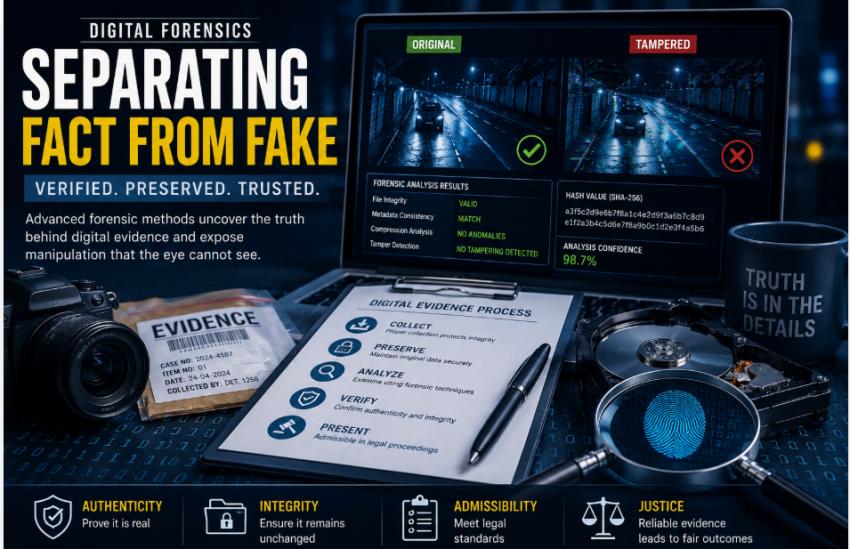
Technology has changed the way investigations are conducted. Security cameras monitor public places, smartphones capture important moments instantly, and businesses store critical records electronically. As a result, digital evidence has become one of the most valuable resources during criminal investigations, corporate inquiries, insurance disputes, and legal proceedings.
However, digital information is only useful when its authenticity can be verified. Modern editing software and artificial intelligence have made it possible to alter videos, images, documents, and audio files with remarkable precision. Because these changes are becoming increasingly difficult to detect with the naked eye, digital forensics now plays a vital role in establishing trust in electronic evidence.
Understanding Digital Forensics
Digital forensics is the scientific process of collecting, preserving, examining, and presenting electronic evidence. The objective is to ensure that digital information remains accurate, reliable, and suitable for investigative or legal purposes.
Unlike ordinary computer analysis, digital forensic investigations follow structured procedures designed to protect the integrity of evidence throughout its lifecycle.
Professionals working in this field investigate information stored across computers, smartphones, cloud platforms, surveillance systems, email servers, and removable storage devices.
Why Preserving Original Evidence Matters
The original version of a digital file contains valuable technical information that may disappear if the file is modified or converted.
Many people unknowingly damage evidence by:
Editing recordings
Converting file formats
Compressing videos
Renaming files repeatedly
Using third-party editing applications
Although these actions may appear harmless, they can change technical information that investigators rely upon during forensic examinations.
Keeping the original file intact is always considered the safest approach.
Scientific Methods Used During Examination
Digital forensic specialists do not rely solely on visual observation.
Instead, they use technical methods that help verify whether electronic evidence has remained unchanged.
Common examination techniques include:
Hash value verification
Metadata inspection
File structure analysis
Frame-by-frame examination
Compression artifact analysis
Timeline reconstruction
Device correlation
Together, these methods provide a comprehensive understanding of the evidence.
Metadata Often Reveals Hidden Facts
Every electronic file contains information that most users never notice.
Metadata may reveal:
Recording date
Device model
Camera settings
File creation history
Modification timestamps
Software used during export
Geographic information where available
Investigators compare this information with witness statements and other evidence to identify inconsistencies.
Even when a recording appears genuine, metadata may indicate that it has been edited or processed after its original creation.
Why Documentation Is Essential
Maintaining accurate records throughout an investigation is just as important as preserving the evidence itself.
Every transfer should be documented carefully, including:
Who collected the evidence
When it was collected
Where it was stored
Who accessed it
When it was examined
These records demonstrate that the evidence remained protected throughout the investigation.
Proper documentation significantly improves confidence in the integrity of electronic records.
Digital Evidence Extends Beyond Videos
Modern investigations rarely depend upon a single source of information.
Investigators frequently analyze:
Email communications
Cloud storage
Mobile devices
Chat applications
System logs
Internet history
Documents
Backup files
Each source contributes additional context that helps establish an accurate sequence of events.
For email-based investigations, an Email Header Analyzer Tool helps interpret routing paths, authentication details, originating servers, and delivery records that assist investigators during technical examinations.
Artificial Intelligence Has Increased the Need for Verification
Artificial intelligence has introduced impressive capabilities for generating realistic digital content.
Today, software can:
Generate synthetic voices
Replace faces
Create convincing videos
Remove objects
Modify backgrounds
Produce highly realistic visual content
Because manipulated media is becoming more sophisticated, organizations increasingly depend upon forensic verification before relying on electronic evidence.
Scientific examination provides confidence that digital information genuinely reflects the original event.
Best Practices for Organizations
Businesses and investigators can strengthen digital evidence by following several important practices.
Preserve original files immediately.
Restrict unnecessary access.
Document every transfer.
Avoid editing original recordings.
Store evidence securely.
Verify file integrity regularly.
Use professional forensic tools for examination.
These simple practices reduce the possibility of accidental modification while improving the reliability of future investigations.
Learning More About Electronic Evidence
As digital evidence becomes increasingly common, understanding how authenticity is established has become valuable for investigators, legal professionals, compliance teams, businesses, and individuals alike.
For readers interested in the legal requirements surrounding electronic recordings,offers a detailed explanation of how courts evaluate digital evidence and why proper forensic verification plays such an important role.
Conclusion
Digital evidence continues to shape modern investigations across every industry. Yet technology alone cannot establish trust. That confidence comes from careful preservation, scientific examination, and proper documentation.
Organizations that adopt strong digital forensic practices are better prepared to investigate incidents, protect valuable information, and support fair legal outcomes.
As electronic evidence continues to grow in importance, understanding how it is collected, preserved, and verified will remain an essential skill for professionals responsible for handling digital information.