Modern car wash systems rely on precise industrial automation to manage chemicals, water pumps, and mechanical brushes. Older locations utilize localized controller boards that communicate over serial networks. Upgrading these locations requires connecting serial hardware to modern local area networks (LAN).
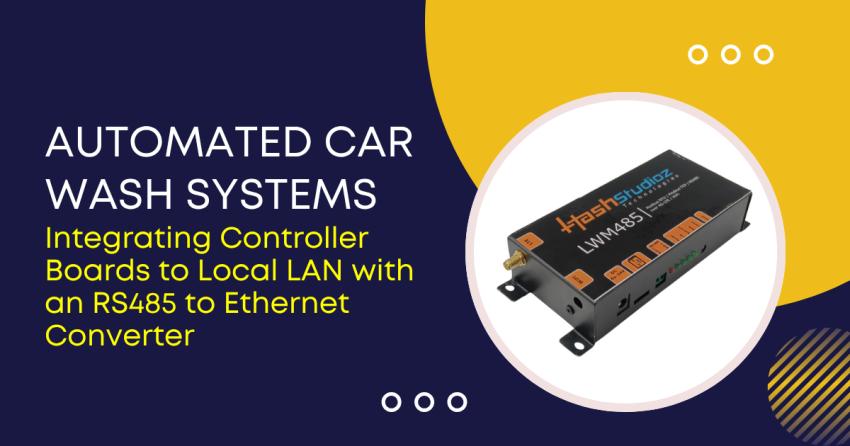
Operators achieve this network integration by using an RS485 to Ethernet Converter. This hardware transition allows central offices to monitor chemical levels, diagnostic fault codes, and daily wash counts in real time. The following technical analysis explains how to integrate legacy car wash controllers into a modern network infrastructure.
The Need for Network Integration
Traditional car wash setups use isolated controller boards at each wash bay to manage local operations. These boards read physical inputs from proximity sensors, coin validators, and water temperature gauges. The controllers then execute pre-programmed logic to activate high-pressure water pumps and chemical injection valves.
According to industrial automation field statistics, over 65% of existing car wash systems built before 2018 rely on standalone RS485 serial communication lines. These isolated setups require technicians to stand next to the controller box to change basic timing cycles or download daily usage logs.
Modern business operations require centralized data visibility. Connecting these local controller boards to a local LAN helps management track utility consumption and machinery health from a central computer. Operators use specialized conversion hardware to eliminate manual data collection processes. This connection bridges the physical gap between old workshop machinery and modern IT environments.
Understanding RS485 and Ethernet Protocols
Integrating these systems requires an understanding of both hardware communication standards. The RS485 protocol defines the electrical characteristics of drivers and receivers for use in balanced digital multipoint systems. This standard uses differential signaling over a twisted pair of wires.
Differential signaling protects data transmission from the electrical noise generated by large car wash water pumps. RS485 networks support long cable runs up to 4,000 feet, which easily spans across a large commercial car wash property. However, the protocol does not support direct internet protocol (IP) addressing.
In contrast, Ethernet networks use the TCP/IP suite to route data across local networks and the internet. Ethernet networks transmit data packets at much higher speeds but have a strict distance limit of 328 feet per cable segment. An RS485 to Ethernet Converter acts as a protocol translator between these two distinct networking systems. The converter receives serial data bytes, packages them into TCP/IP packets, and routes them to the local network switch.
Hardware Architecture and Converter Selection
A successful network conversion depends on selecting the proper industrial-grade hardware. Car wash environments present severe technical challenges, including high humidity, chemical vapors, and extreme temperature swings. Commercial office-grade network adapters fail rapidly under these harsh conditions.
Engineers must select an RS485 to Ethernet Converter that features an IP30 or higher rated metal enclosure. The converter must also provide at least 1.5 kilovolts (kV) of optical isolation on the serial port. Optical isolation protects the network switch from high-voltage electrical surges caused by failing pump motors.
The device needs a wide operational temperature range from -40°C to 85°C to survive unconditioned equipment rooms. The conversion hardware must also support Virtual COM port software. This software allows existing car wash management applications to read the new network data without changing their original serial source code.
Deploying an RS485 Sensor Ethernet Gateway
Car wash automation systems utilize various sensors to track chemical tank volumes, water pressure, and system temperatures. These sensors typically communicate using the Modbus RTU protocol over an RS485 bus. To route this sensor data to a local server, technicians install an RS485 Sensor Ethernet Gateway.
The gateway acts as a master device on the serial network. It polls each connected sensor at regular intervals, collects the raw measurement data, and stores the values in internal registers. The gateway then converts these registers into Modbus TCP packets for transmission over the local LAN.
Using a dedicated RS485 Sensor Ethernet Gateway reduces data traffic congestion on the main network. The gateway manages the slow serial polling cycles locally. It only sends consolidated data packets over the fast Ethernet link when a local server requests an update or a sensor detects a critical fault. This edge-data management prevents old serial controllers from slowing down modern network switches.
Wiring and Electrical Configuration
Proper physical installation prevents data corruption and intermittent network drops. Technicians must use high-quality Category 5e or Category 6 shielded twisted-pair (STP) cabling for the RS485 serial bus. The shielding protects the data signals from electromagnetic interference caused by nearby high-voltage power lines.
The technician connects the positive serial terminal of the controller board to the positive terminal of the RS485 to Ethernet Converter. They then repeat this step for the negative terminals. The technician must ground the cable shield at only one single point to prevent dangerous ground loops.
A standard RS485 bus requires a 120-ohm termination resistor at each physical end of the cable run. These resistors match the characteristic impedance of the cable, preventing signal reflections from corrupting data packets. The technician sets the onboard DIP switches on the converter to enable the built-in termination resistor if the device sits at the end of the line.
Software Mapping and Protocol Configuration
Once the physical wiring is complete, the engineer must configure the software settings of the RS485 to Ethernet Converter. The installer connects a laptop to the converter using a standard Ethernet patch cable. They then open the web-based management utility by typing the default IP address into a browser.
The engineer assigns a permanent static IP address to the converter to prevent the local router from changing it automatically. Next, they match the serial port configuration to the exact settings of the car wash controller board:
Baud Rate: Typically set to 9600 or 19200 bits per second.
Data Bits: Set to 8 bits for standard industrial automation.
Parity: Configured as None, Even, or Odd depending on the manufacturer.
Stop Bits: Usually set to 1 bit.
The engineer selects the appropriate operating mode within the software console. For most car wash applications, they select "TCP Server" mode. This setting allows the central management software to open a persistent network connection to the converter using a specific TCP port number, such as port 502 for Modbus communications.
Troubleshooting Network Conversion Issues
Industrial network conversions often encounter configuration errors during initial testing. Technicians should follow a structured diagnostic process to identify and resolve these communication faults quickly. The first step involves checking the physical status LEDs on the RS485 to Ethernet Converter.
If the Link LED remains dark, the Ethernet cable is faulty or disconnected from the local switch. If the serial data LEDs flash but the central server receives no data, the baud rate or parity settings probably contain a mismatch. The technician uses a software packet sniffer to verify that TCP/IP packets are moving across the network.
When a specific sensor stops responding, the technician verifies the terminal voltage using a digital multimeter. A healthy RS485 bus shows a small direct current (DC) differential voltage between 0.2 and 6 volts between the positive and negative terminals. If the voltage drops to zero, the wires are shorted together or a controller board has suffered an internal hardware failure.
Maintenance and Long-Term Reliability
Maintaining a connected car wash network requires regular hardware inspections and software updates. Technicians should check the equipment enclosures every six months for signs of moisture entry or chemical corrosion. They must tighten screw terminals to prevent loose connections caused by machinery vibrations.
Network administrators should change the administrator passwords on all network converters during initial installation. Leaving default passwords active allows unauthorized users to disrupt car wash operations. Administrators must also apply firmware updates provided by the manufacturer to patch software bugs and security vulnerabilities.
The local LAN should isolate all industrial automation hardware on a separate Virtual Local Area Network (VLAN). This network segregation prevents customer Wi-Fi traffic or office computers from accessing the machinery controller boards. Implementing these security steps protects the automated car wash system from unexpected network downtime.
Conclusion
Integrating legacy car wash controller boards into a local LAN provides immediate operational benefits for car wash business owners. This conversion strategy allows facilities to track utility metrics, monitor equipment health, and manage chemical levels automatically. Utilizing a heavy-duty RS485 to Ethernet Converter solves the technical challenge of connecting old serial devices to modern IT equipment.
Implementing a dedicated RS485 Sensor Ethernet Gateway allows operators to collect critical sensor data without overloading local network switches. Following correct installation steps, such as using shielded cables and installing 120-ohm termination resistors, ensures reliable system operation. This technical upgrade helps car wash businesses maximize their operational efficiency and minimize machinery downtime through continuous data monitoring.