As robotics systems become increasingly intelligent, their ability to accurately identify and interpret objects in the physical world has become a critical success factor. From autonomous mobile robots navigating warehouses to industrial robots performing precision assembly tasks, object recognition serves as the foundation for safe and effective robotic operations.
However, even the most advanced AI models cannot achieve reliable object recognition without high-quality training data. This is where precise annotation plays a pivotal role. Through accurate labeling of images, videos, LiDAR point clouds, and sensor data, robotics companies can significantly enhance machine perception and improve real-world performance.
At Annotera, we specialize in robotic data annotation services that help organizations build robust AI models capable of understanding complex environments and making intelligent decisions.
Why Object Recognition Matters in Robotics
Object recognition enables robots to identify, classify, track, and interact with objects in their surroundings. Whether a robot is picking products from warehouse shelves, inspecting manufacturing defects, or assisting with autonomous delivery, it must first understand what it is seeing.
According to the International Federation of Robotics (IFR), the global operational stock of industrial robots surpassed 4 million units worldwide, reflecting rapid adoption across manufacturing, logistics, healthcare, and service industries. As deployment scales, the demand for highly accurate robotic perception systems continues to grow.
Object recognition supports critical robotic functions such as:
- Navigation and obstacle avoidance
- Object detection and tracking
- Robotic grasping and manipulation
- Inventory management
- Quality inspection
- Human-robot interaction
- Autonomous decision-making
Poor recognition accuracy can lead to navigation failures, safety incidents, operational inefficiencies, and costly downtime.
The Data Challenge Behind Robotic Vision
Unlike controlled laboratory environments, real-world settings are highly dynamic and unpredictable. Robots encounter:
- Varying lighting conditions
- Occluded objects
- Motion blur
- Reflective surfaces
- Cluttered environments
- Diverse object shapes and sizes
- Weather-related visibility issues
Training AI models to handle these complexities requires large volumes of accurately labeled data representing countless real-world scenarios.
As AI pioneer Andrew Ng famously stated:
"Data is food for AI."
For robotics applications, the quality of that "food" directly determines how effectively machines learn to recognize and interact with objects.
What Is Precise Annotation?
Precise annotation involves the detailed labeling of visual and sensor data to teach AI systems how to recognize specific objects, behaviors, and environmental features.
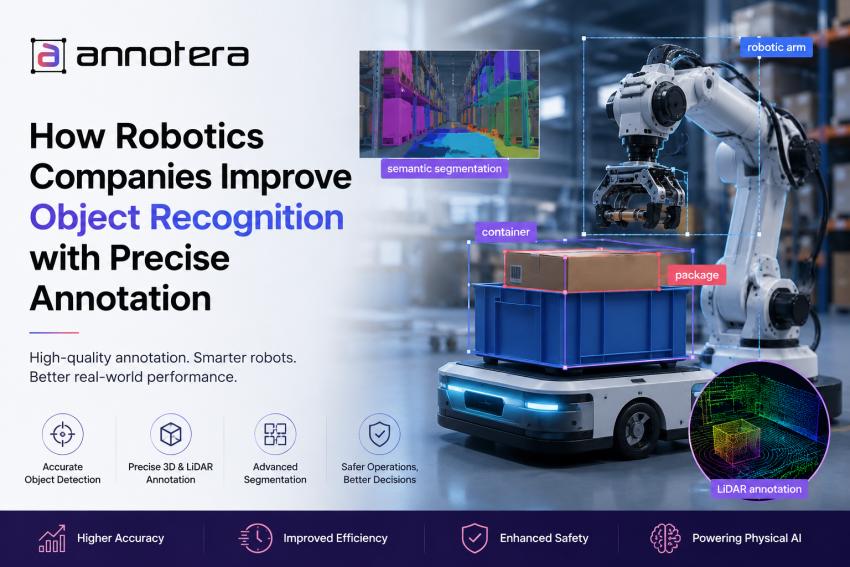
Common annotation techniques used in robotics include:
Bounding Box Annotation
Bounding boxes identify the location of objects within images or video frames. They are widely used for object detection tasks in warehouses, factories, and autonomous systems.
Polygon Annotation
Polygon annotation creates highly detailed object boundaries, making it ideal for irregularly shaped objects where pixel-level accuracy is essential.
Semantic Segmentation
This method labels every pixel in an image according to object class, enabling robots to distinguish between roads, machinery, humans, shelves, and obstacles.
Instance Segmentation
Instance segmentation separates individual objects within the same category, helping robots recognize multiple items simultaneously.
3D Point Cloud Annotation
LiDAR-generated point clouds provide depth information for autonomous robots. Accurate point cloud labeling allows robots to understand spatial relationships and navigate safely.
Sensor Fusion Annotation
Modern robotic systems often combine camera, LiDAR, radar, and inertial sensor data. Sensor fusion annotation aligns these datasets to provide a comprehensive understanding of the environment.
How Precise Annotation Improves Object Recognition
1. Increases Detection Accuracy
Well-labeled datasets help AI models learn the exact visual characteristics of objects. Accurate annotations reduce ambiguity and improve classification confidence.
For example, warehouse robots must distinguish between similar-looking packages, containers, and pallets. Precise annotations ensure the AI model can reliably identify each object type even under challenging conditions.
2. Enhances Performance in Complex Environments
Real-world environments often contain overlapping objects, shadows, and visual clutter. Detailed annotations expose models to these complexities during training.
As a result, robots become more capable of operating in crowded warehouses, busy manufacturing floors, and dynamic public spaces.
3. Improves Grasping and Manipulation
For robotic arms and pick-and-place systems, object recognition extends beyond identification. The robot must also understand object boundaries, orientation, and position.
High-quality annotation provides the spatial context necessary for accurate grasp planning and manipulation.
4. Supports Better Generalization
A robot trained on diverse, accurately annotated datasets can perform effectively across new environments and scenarios.
Research from industry leaders consistently demonstrates that dataset quality often has a greater impact on model performance than simply increasing model size. Accurate annotations help create representative training datasets that improve generalization capabilities.
5. Reduces Safety Risks
In collaborative environments where robots work alongside humans, reliable object recognition becomes a safety requirement.
Precise annotation helps robots identify workers, vehicles, equipment, and obstacles in real time, reducing the likelihood of accidents and operational disruptions.
The Growing Importance of Human Expertise
Despite advances in automated labeling tools, human expertise remains essential for achieving annotation accuracy.
Human annotators can:
- Resolve ambiguous scenarios
- Identify edge cases
- Verify automated labels
- Maintain consistency across datasets
- Apply domain-specific knowledge
This human-in-the-loop approach is particularly valuable for robotics applications where small annotation errors can significantly affect model performance.
According to a report by McKinsey, organizations deploying AI systems increasingly recognize that data quality and governance are among the most critical factors influencing successful AI outcomes.
Why Robotics Companies Choose Data Annotation Outsourcing
Building an internal annotation team can be expensive and difficult to scale. As robotics projects generate millions of images and sensor records, many organizations turn to data annotation outsourcing partners to manage growing labeling requirements.
Benefits include:
Faster Dataset Production
Dedicated annotation teams accelerate project timelines and reduce bottlenecks.
Access to Specialized Expertise
Experienced annotators understand robotics-specific requirements, including LiDAR annotation, segmentation, and sensor fusion workflows.
Cost Efficiency
Outsourcing eliminates the need for extensive in-house staffing, infrastructure, and training investments.
Scalable Operations
Annotation volumes can expand quickly as robotics programs grow, making external support highly valuable.
Partnering with a trusted data annotation company allows robotics organizations to focus on model development and product innovation while ensuring data quality remains consistently high.
The Future of Object Recognition in Physical AI
The rise of physical AI is transforming how machines perceive and interact with the real world. Unlike traditional software-based AI systems, physical AI must continuously process sensory information and make decisions in dynamic environments.
As robotics capabilities advance, the need for increasingly sophisticated annotation strategies will continue to grow. Future systems will rely on richer multimodal datasets combining vision, LiDAR, audio, spatial mapping, and contextual understanding.
Organizations that invest in high-quality robotic data annotation today will be better positioned to develop safer, smarter, and more reliable robotic solutions tomorrow.
Conclusion
Object recognition serves as the backbone of modern robotics, enabling machines to navigate environments, identify objects, and perform complex tasks with precision. Yet even the most advanced AI algorithms depend on accurately labeled training data to achieve reliable performance.
Through precise annotation techniques such as bounding boxes, segmentation, point cloud labeling, and sensor fusion annotation, robotics companies can significantly improve perception accuracy, operational safety, and real-world effectiveness.
As a trusted data annotation company, Annotera helps organizations unlock the full potential of physical AI through scalable, high-quality robotic data annotation solutions. Whether you're building autonomous mobile robots, warehouse automation systems, industrial robots, or next-generation intelligent machines, accurate annotation remains the foundation of successful object recognition and AI performance.