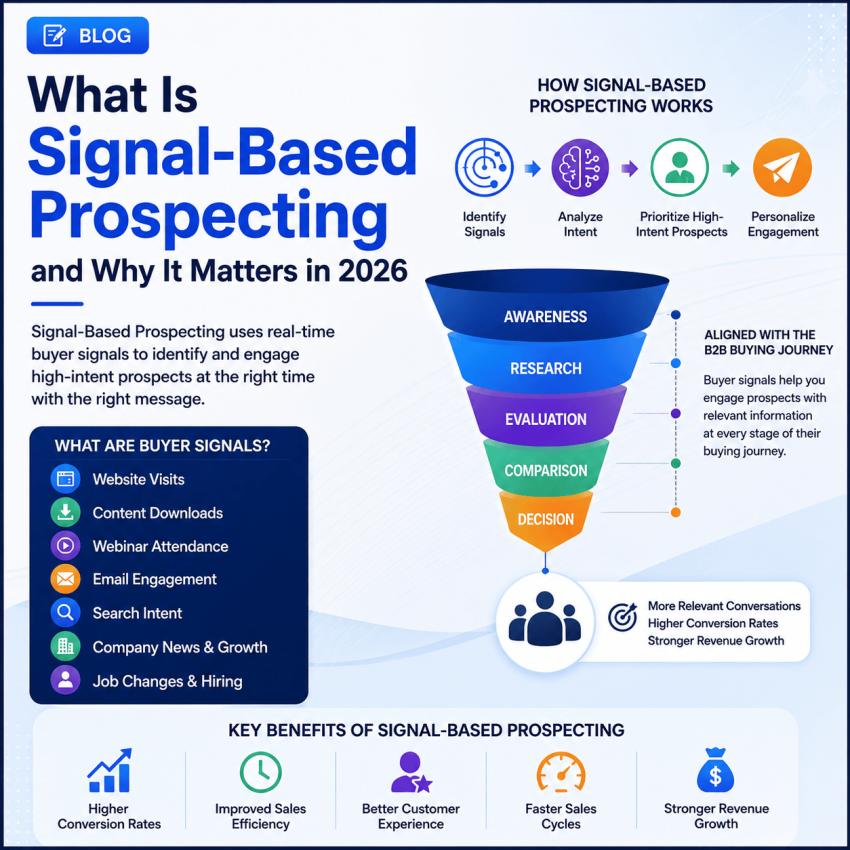
The world of B2B sales is changing rapidly. Traditional prospecting methods that rely on cold lists, mass emails, and generic outreach are becoming less effective as buyers expect more personalized and timely interactions. In 2026, successful sales teams are shifting their focus toward Signal-Based Prospecting, a smarter approach that uses real-time buyer signals to identify and engage prospects who are more likely to convert.
Instead of guessing who might be interested in your product or service, Signal-Based Prospecting helps sales teams understand which prospects are actively showing buying intent. This allows businesses to prioritize the right opportunities, improve outreach effectiveness, and create more meaningful conversations with potential customers.
What Is Signal-Based Prospecting?
Signal-Based Prospecting is a sales strategy that uses behavioral, demographic, and intent-based signals to identify prospects who are most likely to be interested in a product or service.
These signals can come from various sources, including:
- Website visits
- Content downloads
- Product page engagement
- Social media interactions
- Job changes
- Company growth announcements
- Technology adoption
- Search intent data
- Email engagement metrics
Rather than contacting prospects randomly, sales teams use these indicators to determine when and how to engage potential buyers.
This approach helps businesses move from reactive selling to proactive engagement, making outreach more relevant and effective.
Why Traditional Prospecting Is Losing Effectiveness
For years, sales teams relied heavily on purchased contact lists and high-volume outreach campaigns. While these methods can still generate results, they often produce low response rates and create a poor experience for prospects.
Today's buyers conduct extensive research before speaking with a sales representative. By the time they engage with a vendor, they have often already identified their challenges, evaluated potential solutions, and narrowed down their options.
This shift means that timing has become more important than ever. Reaching out when a prospect is actively researching solutions can dramatically increase the likelihood of starting a productive conversation.
Signal-Based Prospecting enables sales teams to recognize these opportunities and engage prospects at the right moment.
How Signal-Based Prospecting Works
A successful Signal-Based Prospecting strategy begins with collecting and analyzing relevant buyer signals.
When a prospect visits your pricing page multiple times, downloads a case study, attends a webinar, or researches a specific business problem, these actions indicate interest.
Sales teams can use technology and automation platforms to track these activities and prioritize prospects based on their level of engagement.
Instead of spending hours manually searching for leads, representatives receive actionable insights that help them focus on high-intent opportunities.
The result is a more efficient sales process and higher conversion rates.
The Growing Importance of Buyer Intent Data
In modern B2B sales, intent data has become one of the most valuable resources available to revenue teams.
Buyer intent data helps organizations understand what prospects are researching, which topics they are interested in, and how close they may be to making a purchasing decision.
By combining intent signals with prospect information, businesses can create highly targeted outreach campaigns that address specific pain points and business challenges.
This level of personalization significantly improves engagement rates and builds trust with potential buyers.
Understanding the Modern B2B Buying Process
To fully appreciate the value of Signal-Based Prospecting, it's important to understand the modern b2b buying joureny.
Today's buyers rarely make purchasing decisions after a single interaction. Instead, they move through multiple stages that include awareness, research, evaluation, comparison, and decision-making.
Throughout this journey, prospects leave behind valuable digital signals that reveal their interests and intentions. Organizations that can identify and act on these signals gain a significant competitive advantage because they can provide relevant information at exactly the right stage of the decision-making process.
This creates a more personalized buying experience while increasing the chances of conversion.
How Signal-Based Prospecting Supports Better Lead Generation
Generating high-quality leads remains one of the biggest challenges for sales and marketing teams.
Traditional lead generation often focuses on quantity rather than quality, resulting in large volumes of contacts that may never become customers.
Modern b2b lead generation strategies increasingly rely on signals to identify prospects who are actively searching for solutions. By focusing on engagement patterns, buying intent, and behavioral data, businesses can attract and prioritize leads with a higher likelihood of converting into revenue.
This approach not only improves lead quality but also helps sales teams use their time more effectively.
Key Benefits of Signal-Based Prospecting
Higher Conversion Rates
Sales representatives engage prospects who have already demonstrated interest, increasing the likelihood of meaningful conversations and successful outcomes.
Improved Sales Efficiency
Instead of spending time on unqualified leads, teams focus their efforts on prospects showing genuine buying intent.
Better Customer Experience
Prospects receive relevant information based on their needs and interests rather than generic sales pitches.
Faster Sales Cycles
When outreach is aligned with buyer intent, prospects move through the sales funnel more quickly.
Stronger Revenue Growth
Higher-quality opportunities lead to better conversion rates, larger deal sizes, and more predictable revenue generation.
Why Signal-Based Prospecting Matters in 2026
As competition continues to increase and buyers become more informed, sales teams can no longer rely solely on traditional prospecting methods.
Signal-Based Prospecting provides a data-driven approach that helps businesses identify opportunities earlier, personalize outreach more effectively, and engage prospects when they are most likely to respond.
Organizations that adopt signal-based strategies will be better positioned to build stronger relationships, improve sales productivity, and create sustainable growth in an increasingly competitive market.
Conclusion
Signal-Based Prospecting is no longer a future trend—it's becoming a core component of modern sales success. By leveraging buyer signals, intent data, and engagement insights, businesses can identify the right prospects at the right time and deliver more relevant outreach.
As B2B sales continue to evolve in 2026, organizations that embrace Signal-Based Prospecting will gain a significant advantage over competitors still relying on outdated prospecting techniques. The ability to understand buyer behavior and act on real-time signals will play a critical role in driving higher conversions, stronger customer relationships, and long-term revenue growth.
FAQs
1. What is Signal-Based Prospecting?
Signal-Based Prospecting is a sales strategy that uses buyer intent and behavioral data to identify prospects who are most likely to be interested in a product or service.
2. Why is Signal-Based Prospecting important?
It helps sales teams focus on high-intent prospects, improving efficiency, engagement, and conversion rates.
3. What are examples of buyer signals?
Examples include website visits, content downloads, webinar attendance, email engagement, technology adoption, and company growth announcements.
4. How does Signal-Based Prospecting improve sales performance?
It enables sales teams to contact prospects at the right time with more relevant messaging, leading to better outcomes.
5. Is Signal-Based Prospecting suitable for small businesses?
Yes. Businesses of all sizes can use buyer signals to prioritize opportunities and improve sales productivity.
6. How is Signal-Based Prospecting different from traditional prospecting?
Traditional prospecting often relies on cold outreach, while Signal-Based Prospecting uses real-time data to identify interested prospects.
7. What tools are commonly used for Signal-Based Prospecting?
Sales intelligence platforms, intent data providers, CRM systems, and AI-powered prospecting solutions are commonly used to collect and analyze buyer signals.