Customer expectations in the United States have changed fast.
People no longer tolerate long hold times, disconnected conversations, or repetitive support experiences.
As a result, enterprises are under pressure to deliver faster resolutions, personalized interactions, and always-on service across voice, chat, SMS, email, and AI-driven channels.
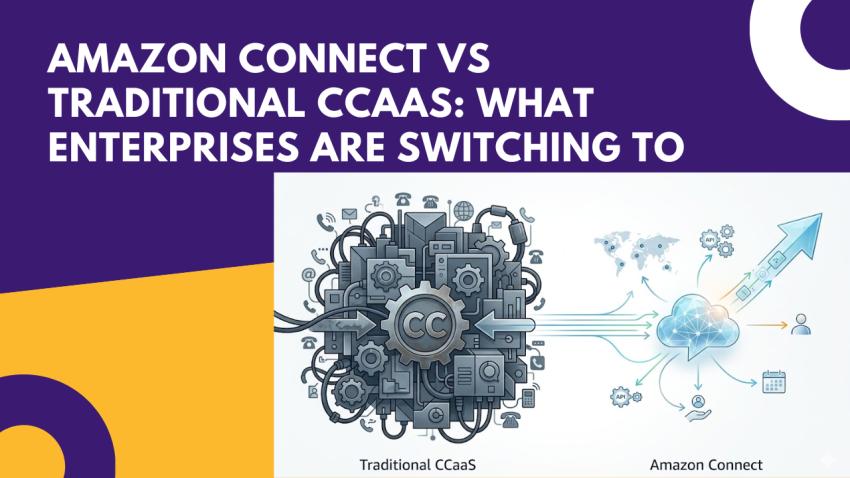
That shift is exactly why businesses are moving away from traditional CCaaS platforms and embracing cloud-native solutions like Amazon Connect.
For years, traditional Contact Center as a Service platforms dominated enterprise customer support. They offered stability, voice infrastructure, and workforce management. But today’s enterprise priorities are different. Organizations want agility, AI automation, scalability, lower operational costs, and deeper customer insights in real time.
That is where Amazon Connect is changing the game.
As enterprises modernize customer experience strategies in 2026, the debate is no longer about whether cloud contact centers are necessary. The real question is this:
Should enterprises stay with legacy CCaaS providers or move to Amazon Connect AWS for a more flexible, AI-powered future?
Why Traditional CCaaS Platforms Are Losing Momentum
Traditional CCaaS systems were designed for a different era. Most were built around voice-first support models and later expanded into digital channels. While many vendors added AI and automation features over time, enterprises often still deal with fragmented systems, expensive licensing, and slow innovation cycles.
Common enterprise frustrations include:
- High per-seat licensing costs
- Complex integrations
- Limited customization
- Siloed reporting tools
- Slow deployment timelines
- Difficult scalability during seasonal spikes
- Rigid workflows
Many enterprise IT leaders also struggle with vendor lock-in. Once a traditional CCaaS environment is deeply integrated, switching becomes expensive and operationally risky.
This is one reason cloud-native customer experience platforms are gaining serious traction across the USA enterprise market.
Amazon Connect provides omnichannel support, AI-powered self-service, intelligent routing, real-time analytics, and generative AI capabilities within a unified environment.
That combination is reshaping enterprise contact center strategies.
What Makes Amazon Connect Different?
Unlike traditional CCaaS platforms that evolved from legacy telephony infrastructure, Amazon Connect was built directly in the cloud.
That distinction matters.
Amazon Connect allows enterprises to scale customer support operations rapidly without maintaining legacy hardware or overpaying for unused capacity. Organizations can pay for what they use while integrating directly with AWS services, AI tools, CRMs, analytics platforms, and automation workflows.
Key enterprise advantages include:
1. AI-Native Customer Experience
AI is no longer optional in enterprise customer support.
Amazon Connect integrates advanced AI features directly into the platform, including:
- AI-powered virtual agents
- Real-time agent assistance
- Automated call summaries
- Conversational analytics
- Intelligent routing
- Sentiment analysis
- Voice authentication
Generative AI support for both agents and customers across multiple communication channels is becoming a major differentiator for enterprise customer experience teams.
Traditional CCaaS vendors often require additional third-party AI products, separate licensing, or complex integrations to achieve similar functionality.
Enterprises want simplicity. Amazon Connect delivers it.
2. True Omnichannel Support
Modern customers switch channels constantly.
They may begin with chat, move to voice, then continue over email or SMS. Legacy CCaaS systems often struggle to maintain continuity across these touchpoints.
Amazon Connect centralizes communication channels into one ecosystem. Voice, chat, SMS, email, tasks, and web calling can all operate within the same platform and routing environment.
That creates smoother customer journeys and eliminates unnecessary friction for support teams.
3. Faster Deployment and Scalability
Traditional enterprise contact center deployments can take months.
Amazon Connect significantly reduces implementation complexity because it is cloud-native and highly configurable.
Enterprises can scale agents up or down quickly during seasonal demand spikes, product launches, or crisis situations.
This flexibility has become especially important for:
- Healthcare organizations
- Financial services
- Ecommerce brands
- Insurance providers
- SaaS companies
- Retail enterprises
Businesses no longer want infrastructure limitations slowing down customer experience innovation.
4. Lower Operational Costs
Cost optimization remains a major reason enterprises are evaluating CCaaS alternatives.
Traditional systems often include:
- Expensive licensing structures
- Long-term contracts
- Hardware dependencies
- Additional maintenance costs
- Separate AI licensing fees
Amazon Connect’s pay-as-you-go pricing model appeals to enterprises seeking better financial control.
Many organizations switching to cloud contact center solutions report operational efficiency improvements after consolidating tools, analytics, and workflows into unified platforms.
Why Enterprises Are Actually Switching
The migration toward Amazon Connect is not only about technology.
It is about business outcomes.
Enterprises want:
- Better customer satisfaction
- Faster resolution times
- AI-driven efficiency
- More personalized interactions
- Easier integrations
- Faster innovation cycles
- Improved workforce productivity
Amazon Connect has evolved into a major AI-powered customer experience platform with large-scale enterprise adoption.
That momentum is accelerating as organizations modernize customer engagement strategies.
The Human Side of the Shift
Behind every enterprise migration is a real operational challenge.
Support agents are overwhelmed by disconnected systems. Customers are frustrated by repetitive interactions. Managers are buried in manual reporting. IT teams are tired of maintaining outdated infrastructure.
This is why enterprises are moving toward unified cloud contact center platforms.
Companies are prioritizing platforms that simplify operations while improving customer relationships.
Where Tollanis Fits Into the Modern Contact Center Strategy
Technology alone does not guarantee success.
Many enterprises struggle with implementation, workflow optimization, AI integration, compliance alignment, and migration planning.
That is where Tollanis Solutions plays a critical role.
Tollanis helps organizations modernize customer experience operations through intelligent cloud communication strategies, automation frameworks, and scalable contact center transformation.
As a trusted partner for amazon connect aws solutions, Tollanis supports enterprises in designing agile, AI-driven customer engagement ecosystems that align with modern CX expectations.
From migration planning to workflow automation and omnichannel optimization, Tollanis helps enterprises move beyond outdated contact center limitations.
Challenges Enterprises Should Still Consider
Amazon Connect is powerful, but enterprises still need strategic planning.
Potential considerations include:
- Internal AWS expertise requirements
- Workflow customization planning
- Governance and compliance alignment
- Integration architecture
- Change management for support teams
Amazon Connect offers exceptional flexibility but requires thoughtful implementation planning for highly customized enterprise environments.
That is why experienced implementation partners matter.
The Future of Enterprise Contact Centers
The future of customer support belongs to AI-enabled, cloud-native, omnichannel ecosystems.
Traditional CCaaS vendors are adapting, but many enterprises believe Amazon Connect aligns more closely with modern digital transformation goals.
The shift is no longer experimental.
It is operational.
Enterprises across the USA are choosing platforms that combine automation, intelligence, scalability, personalization, and cost efficiency into one unified experience.
That is why amazon connect aws continues gaining momentum among organizations focused on long-term customer experience innovation.
The enterprises winning customer loyalty in 2026 will not necessarily be the ones with the largest support teams.
They will be the ones delivering the fastest, smartest, and most human customer experiences at scale.