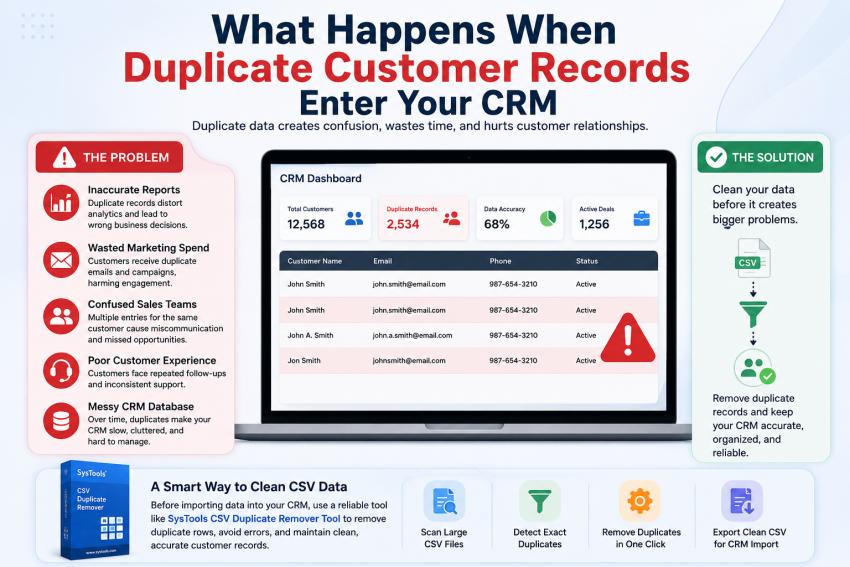
Every business depends on clean and organized customer data to manage daily operations smoothly. Whether a company uses a CRM for sales tracking, lead management, customer support, email campaigns, or business reporting, accurate records play a major role in maintaining efficiency and making better decisions.
However, duplicate customer records are one of the most common data problems businesses face today. In many cases, duplicates enter the CRM without anyone noticing initially. This often happens when multiple employees add the same customer separately, CSV files are imported multiple times, website forms generate repeated entries, database migrations create overlapping records, or old customer lists are merged incorrectly.
At first, duplicate records may not seem like a serious issue. But over time, duplicate customer data slowly starts affecting reporting accuracy, sales communication, marketing campaigns, and overall CRM performance across the business.
How Duplicate Customer Records Usually Enter a CRM
In many companies, duplicate records slowly build up without anyone noticing immediately.
For example, one customer may exist in the CRM as:
- John Smith
- John A. Smith
- J. Smith
- john.smith@email.com
- johnsmith@company.com
Different teams may unknowingly create multiple entries for the same person.
This becomes even more common after:
- importing CSV files
- combining databases
- migrating CRM systems
- syncing marketing tools
Once duplicate records start increasing, the CRM database becomes difficult to manage properly.
Duplicate Records Create Inaccurate Reports
One of the biggest problems duplicate customer records create is incorrect reporting.
CRM reports help businesses make decisions related to:
- sales performance
- customer engagement
- lead conversion
- revenue forecasting
But duplicate entries can completely distort this data.
For example:
- one customer may appear as multiple leads
- conversion numbers become inflated
- sales reports become unreliable
- marketing performance becomes inaccurate
Eventually, businesses start making decisions based on incorrect information.
Sales Teams Become Confused
Duplicate records often create confusion for sales teams. Two employees may contact the same customer without realizing another team member already reached out earlier. This can lead to:
- repeated follow-ups
- embarrassing communication
- missed opportunities
- poor customer experience
In some cases, customers receive multiple calls or emails from the same company within a short period, which looks highly unprofessional.
Duplicate Emails Damage Marketing Campaigns
Marketing teams also suffer heavily from duplicate CRM data. When repeated customer records exist, businesses may accidentally:
- send duplicate emails
- trigger repeated automation campaigns
- inflate subscriber counts
- create inaccurate engagement reports
Customers receiving the same email multiple times often:
- ignore future emails
- unsubscribe
- mark messages as spam
Over time, this can damage email marketing performance and sender reputation.
Customer Support History Becomes Messy
Customer service teams rely on CRM history to understand previous interactions.
But duplicate customer records often split communication history across multiple entries.
This means:
- support agents miss important details
- customer issues get repeated
- service quality decreases
Instead of seeing one organized customer timeline, teams deal with fragmented and confusing records.
Why Duplicate CRM Data Gets Worse Over Time
Duplicate records rarely stay limited to just a few entries. As businesses continue:
- importing CSV files
- syncing platforms
- collecting leads
- migrating systems
the duplicate problem grows rapidly. Eventually businesses end up with:
- messy CRM databases
- repeated customer profiles
- unreliable reports
- poor lead organization
The longer duplicates remain untreated, the harder cleanup becomes later.
CSV Imports Are One of the Biggest Causes
Many duplicate CRM problems actually begin with poorly managed CSV imports.
Businesses often import:
- customer lists
- lead databases
- marketing contacts
- exported reports
without properly checking duplicate rows beforehand.
Even small CSV mistakes can create thousands of repeated CRM records after import.
This is why cleaning CSV data before importing it into a CRM is extremely important.
How Businesses Can Prevent Duplicate CRM Records
The best approach is prevention before cleanup becomes overwhelming.
Businesses should:
- verify imported CSV files
- standardize customer naming
- monitor duplicate entries regularly
- validate email addresses
- review imported contact lists carefully
Simple cleanup habits can prevent large CRM problems later.
My Personal Recommendation for CSV Cleanup
In many practical situations, duplicate CRM records start from messy CSV imports. Personally, I have found that cleaning CSV files before importing them into a CRM saves enormous time later. For larger datasets, using a dedicated solution like the SysTools CSV Duplicate Remover Tool can make the cleanup process much easier, especially when dealing with repeated rows, duplicate customer records, and large CSV databases.
Instead of manually reviewing thousands of entries inside Excel, automated cleanup helps organize the data more accurately before CRM import.
Why Clean CRM Data Matters More Than Most Businesses Think
A CRM is only as reliable as the data inside it. Even the best CRM platform becomes difficult to manage when duplicate customer records continue growing unchecked. Clean customer databases help businesses:
- improve reporting accuracy
- organize sales pipelines
- avoid duplicate communication
- improve customer experience
- maintain better marketing performance
In short, organized data creates better business decisions.
Final Thoughts
Duplicate customer records may not look dangerous initially, but they slowly affect reporting, marketing, customer communication, and overall CRM performance. Most businesses notice the problem only after:
- customer complaints
- messy reports
- duplicate emails
- inaccurate analytics
By regularly cleaning imported CSV data, reviewing customer databases, and preventing duplicate entries early, businesses can maintain a far healthier CRM system over time. Sometimes improving CRM performance is not about changing the software at all — it is simply about cleaning the data properly before the problem grows too large.