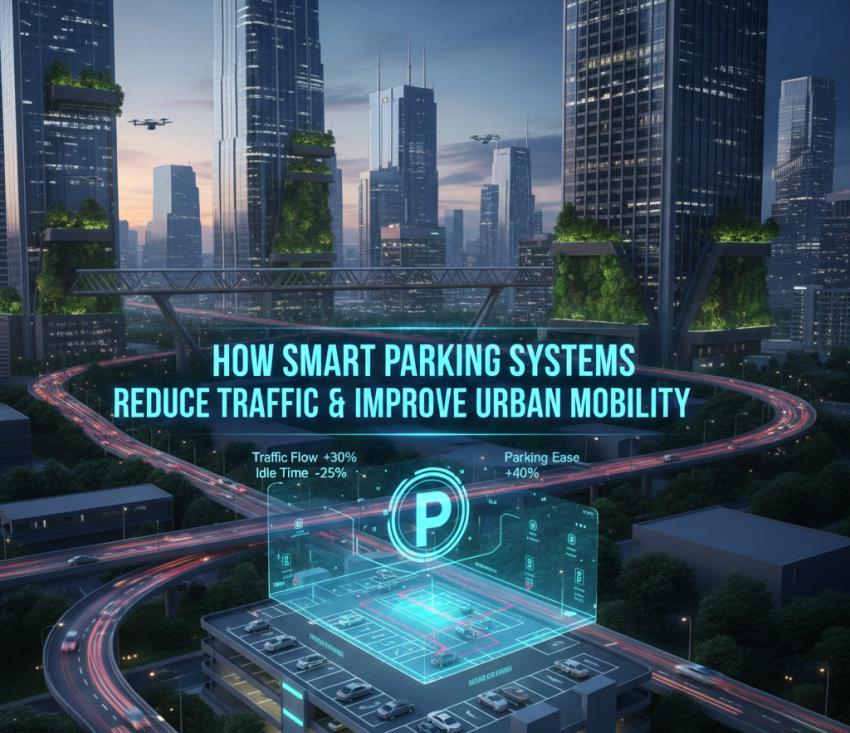
One of the most significant obstacles faced by modern cities is traffic congestion. In the face of expanding urban populations and rising vehicle ownership, securing a parking spot is a daily challenge for commuters. Drivers may waste minutes, if not hours, circling streets in search of an available parking spot, and in the process generate unnecessary traffic jams as well as fuel consumption and stress. That’s where smart parking systems come into play.
Smart parking integrates digital technology, sensors or applications, intending to benefit users and administrators by monitoring and sometimes controlling available parking spaces. "Instead of the guessing we do about where the spot is and then using a clunky smartphone GPS." Instead, drivers know where a spot is before they get there d
The Traffic Problem Hidden in Parking
It is reported that city traffic is to some extent caused by cars looking for parking slots. When many drivers cruise the same neighbourhoods seeking open spaces, roads get crowded, intersections bog down, and emissions go up. Conventional parking lacks visibility and centralisation, and the problem is further aggravated during rush hours.
Smart parking solutions offered by IoT devices ultimately make ‘finding a parking spot’ predictable instead of unpredictable.
How Smart Parking Systems Work
At the heart of smart parking systems are IoT sensors, cameras, and connected platforms that track parking space availability in real time. This information is published on mobile applications, digital station signs and in-car GPS platforms. Drivers can find and head straight to an open spot.
Some setups and configurations can also facilitate reservations, money-free payment, automatic entry/egress, etc., thus minimising queues and manual labour. Reducing idling and circling time leads to less congestion, of course.
Reducing Traffic Congestion
Smart parking also addresses traffic at its root: the time it takes to find a spot. Less wasted movement on city roadways when drivers know where to go. This helps the traffic to flow in both directions, including at crowded areas such as business districts, shopping streets, and places for events.
With parking data plugged into city traffic management systems, they can push vehicles elsewhere, smooth peak demand, and disperse congestion to other areas. This will naturally smooth traffic flows and optimise the usage of the roads.
Improving Urban Mobility
Urban mobility is not only about moving cars faster, but it’s about moving people smarter. And smart parking can be part of achieving this by making other transportation options more attractive to drivers. For transparent parking availability and pricing, commuters would be more likely to plan or take public transport as opposed to driving a car when parking demand is high.
In many cities, smart parking is also connected with EV infrastructure. Ranging from integrated charging slot availability that’s conducive for EV charging app development, electric vehicle owners can confidently travel without fear of running out of charge.
Benefits for Cities and Citizens
For city management, smart parking helps in understanding parking behaviour, demand swarm and the busiest time of the day. These observations assist in appropriate infrastructure planning and policy formulation. Businesses get something out of it, too: Easier parking leads to more foot traffic and happier customers.
With smart parking solutions, at a technology level, we tend to start developing what is essentially custom software that fits exactly the needs and regulations in place within their city, country or scale. More sophisticated platforms can even leverage generative AI to forecast parking demand, adjust prices and use of space.
The Role of AI and Automation
Programming and artificial intelligence are becoming increasingly instrumental in creating more intelligent parking systems. And with AI-based analytics, we can predict congestion and recommend areas to park, as well as automate enforcement. With solutions like AI Copilot development services, city operators receive actionable intelligence to expand the capacity of their surveillance system and respond in real-time to events so they can make more informed decisions on where they need to deploy limited resources.
Furthermore, we are experimenting with ChatGPT integration as a conversational interface for users to query parking availability and rates by questions such as whether there is parking right now or how to get there.
A Smarter Way Forward
Smart parking systems are more than just a comfort --- they become essential in future-proofing your cities. Between them, they also play a role in cleaning our air, cutting negative externalities and adding to the health of society by enabling people to move around city centres quickly and freely.
As long as cities keep growing, smart parking is inevitable. It’s a step that really needs to be taken if we’re ever going to have sustainable, efficient and actually-smart urban mobility.