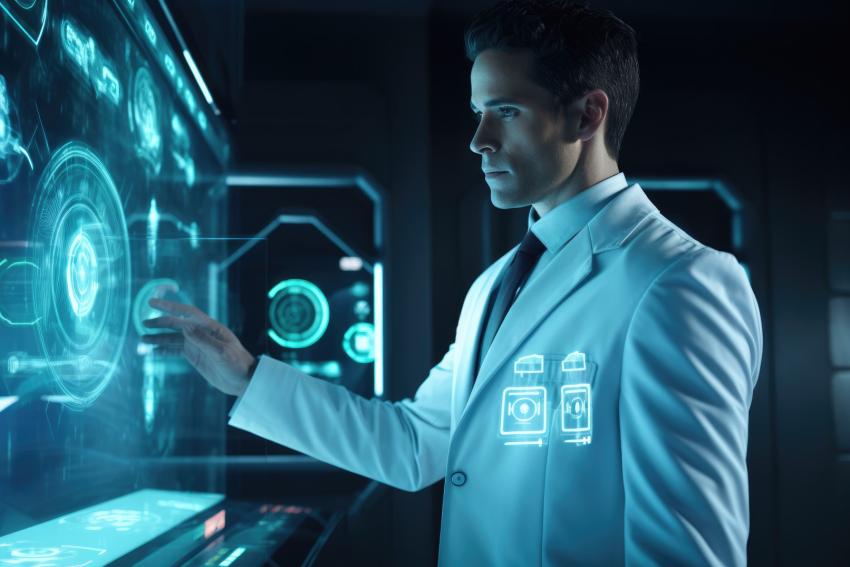
Imagine a world where more accurate diagnoses and personalized treatments are made possible with less human intervention.
That isn’t a science fiction story!
With artificial intelligence in healthcare, every clinical task, ranging from identifying subtle changes to alerting clinicians to critical patient conditions, is undergoing drastic changes in the healthcare sector.
According to Precedence Research, the global AI in healthcare market was estimated at $26.69 billion and is predicted to increase to $613.81 billion by 2034, with a CAGR of 36.83% from 2025 to 2034.
The reasons behind the prolific growth of AI in healthcare and the medical field suggest that the current system is seamless and more accessible to everyone.
If you’re running a healthcare clinic and want to leverage AI, this blog is meant for you. By the end of this blog, you will learn about the remarkable effects of AI in healthcare. Before moving forward, let’s have a brief introduction to help you clear the basics.
What is AI in Healthcare?
According to Wikipedia, the term AI in healthcare describes the incorporation of ML algorithms with other cognitive technologies. This helps healthcare professionals enhance hospital operations, improve patient experience, and reduce expenses. On the other hand, patients receive on-time medicine, reports, and updates about the symptoms of any clinical condition.
This is an essential tool to analyze the vast volumes of patient and raw medical data to develop accurate treatment plans. Additionally, it can quickly analyze data from multiple sources, identify potential issues, and recommend solutions tailored to specific situations.
According to HealthcareDive, AI can save $360 billion a year by redefining the doctor-patient relationship. This study demonstrates that emerging technologies and their applications are consistently transforming the healthcare industry.
Imagine an insurance company is reading a patient's email with an attached claim to check if the patient is eligible for the claim. Here, AI-based integrated automation platforms automate the claims process by ingesting, extracting, and analyzing data from claims. Once done, the insurance company conveys the message to the patient about their eligibility. This is the power of AI and how it works for the medical industry.
5 Reasons Why AI in Healthcare is Here to Stay
According to a report published by the National Institute for Health and Care Research, AI can accurately predict when patients need to be transferred to the hospital based on clinical conditions such as mobility, blood oxygen levels, and chest pain. This is only the tip of the iceberg! Artificial intelligence in medicine is consistently accelerating the pace of development, providing patients and healthcare professionals with improved treatment options. Below, we will discuss the key reasons why AI in healthcare is the present and will be the future:
1. Proper Clinical Documentation
COVID has shown its devastating nature since it started disrupting everyday lives. As a result, the healthcare providers have dealt with burnout. Still, they provided superlative patient care with limited resources. Here, documentation played a pivotal role as the COVID-19 pandemic affected patients’ histories that needed to be stored.
However, hospitals relied on paper-based record systems. As a result, the documents were misplaced, disrupting the service. Here, a cloud-based clinical speech recognition application can help healthcare providers by allowing them to capture patients’ voices efficiently. As a result, there will be no need for a manual documentation process.
Let’s hear it from the CEO of a healthcare app development company, “During the peak time of COVID, we received lots of messages from our healthcare clients to help them with a solution that eliminates the manual documentation process. We developed multiple AI-powered healthcare applications for them that mimic human activities related to day-to-day healthcare. As a result, healthcare services associates can efficiently cater to patients without fear of losing essential documents.
2. Advanced Digital Consultation
The systems of AI healthcare undergo a machine learning process from the use cases. Moving forward, this enables the system to ask relevant questions to patients based on their previous and current health records. With features like natural language processing, automatic speech recognition, text-to-speech, etc. make AI easy to understand complex scenarios.
3. Efficient Diagnosis
According to BMJ Quality & Safety, a significant number of diseases are responsible due to misdiagnosis issues. Amidst this, 10% of patients with infections, vascular diseases and cancers are misdiagnosed. With AI, these things can be improved by streamlining patient medical history, decision-making and detecting high-risk conditions. For example, AI-based apps developed by an IoT software solution company can detect the early stages of cancer and provide probable treatment options.
4. Development of Medicines
The power of AI in healthcare extends beyond providing solutions through chatbots, telemedicine, and customized apps. It can be used in drug development by training them to leverage vast databases to detect potential medications based on the critical conditions. With significant advancements in AI, several medicines for diseases such as type 2 diabetes, cancer, and cirrhosis can be accurately developed.
5. Virtual Patient Care
Healthcare providers may be unable to attend to patients who need urgent care due to other medical commitments. This is becoming a significant issue for patients who require ongoing care and regular check-ups. On that note, telemedicine and healthcare AI chatbots are solving the issues by providing consistent support. For example, if a patient enters their issues on the chatbot, it will reply immediately with effective solutions after analyzing the patient's clinical condition.
However, ensure that the chatbots are following the latest development principles to provide seamless services. You can consult with an innovative AI solutions provider that will develop a cutting-edge healthcare application for your clinic. Therefore, you can concentrate on other essential tasks.
What are the Use Cases of AI in Healthcare?
“AI has allowed me, as a physician, to be 100% present for my patients.” Dr. Matthew Hitchcock, a family physician in Chattanooga, Tenn., is utilizing an AI tool to transcribe patient notes and summarize them accordingly. Earlier, Mr. Hitchcock spent two hours manually taking notes from patients. Now, it’s like walking in the park with the AI tool. This is not the story of Hitchcock alone; a significant number of healthcare providers are leveraging AI to bolster their actions.
Here are the top 5 use cases of AI in medical sciences-
Medical Imaging - AI analysis reports of X-rays, CT scans, and MRIs help physicians achieve improved results. For instance, AI tools can spot the areas of abnormal tissue growth.
Natural Language Processing - AI tools automate functions during a patient check-up through voice recognition. Additionally, they can help extract insights during operation.
Personalized Drugs - An AI algorithm provides meaningful insights into drugs based on their previous medical history. This helps practitioners prescribe medicines according to the AI-generated report.
Task Automation - AI voice agents in healthcare enhance efficiency by automating tasks such as scheduling patient communication. Therefore, it improves the patient experience. Also, the hospitals are witnessing a 25-30% reduction in costs after incorporating AI voice agents.
Remote Patient Monitoring - AI-powered devices worn by patients enable doctors to monitor patients’ clinical conditions. Additionally, they can intervene if the patients are not adhering to exercise, treatment, dietary and other plans.
Key AI Technologies Used in Healthcare
Several AI technologies are utilized throughout the healthcare sector. These technologies are either used solo or combined to get the desired results.
1. Natural Language Processing
This technology enables systems to understand, assess, define and generate human language. Generally, NLP is used to assess unorganized data in research papers, medical records and clinical notes. Moving forward, it extracts the valuable information to improve patient care, while streamlining administrative processes.
Additionally, NLP systems can be utilized to extract crucial information from EHRs to generate comprehensive patient summaries. This assists in automating clinical documentation to keep the healthcare experts updated with the latest research findings.
2. Machine Learning
In the healthcare sector, machine learning algorithms are utilized to identify patterns and trends in complex medical data. This leads to improved diagnostics and patient outcomes. As the ML algorithms consistently learn over new data, it may provide accurate results over time.
3. Computer Vision
This is used to process and interpret raw data from images. Once applied to medical images, such as X-rays, CT scans, and MRIs, this technology enhances diagnostic accuracy by detecting the clinical conditions of a patient.
AI in Drug Discovery
According to Precedence Research, the global AI in drug discovery market size is expected to reach around $16.52 billion by 2034, growing at a CAGR of 10.10%. As a result, it facilitates the discovery of new molecules and the development of personalized medications.
The primary objective of drug discovery is to discover medicines that can prevent specific diseases. To find a chemically synthesized molecule, researchers conduct large-scale screens of molecular libraries, which have the potential to become a drug. Once done, experts conduct multiple testing rounds to get a promising compound.
AI technology providers Google DeepMind and IBM Watson Health offer advanced machine learning models that assess vast datasets to predict drug efficiency and identify potential drug candidates.
Pfizer is leveraging AI tools to streamline the drug development process by integrating AI-driven insights into their research. Such insights play a pivotal role across the drug development cycle. “We must focus on storing and searching data,” Boris Braylan, Vice President and Head of Information Management at Pfizer, has stated.
What are the Challenges of AI in Healthcare?
Despite the abundance of opportunities, the deployment of AI-enabled solutions remains limited. Here are the top challenges-
1. Less Amount of Medical Data
High-quality datasets are required for technical and clinical validation of AI models. However, medical data fragmentation across multiple EHRs creates a bottleneck in collecting patient information. Sometimes, it doesn’t adhere to healthcare data privacy strategies. As a result, the patients receive late care.
2. Lack of Research Materials
To date, there are no adequate research materials available to help a healthcare expert gain knowledge from it. Eight out of the ten studies are based on historical patient records. This creates a hindrance for physicians who want to provide accurate and timely services to patients.
3. Limited Data Sharing Options
The lack of interoperability has limited data-sharing options among different healthcare providers. In other words, this is the gap between operational and theoretical AI. Suppose a healthcare organization is building a tailor-made, interoperable solution. In that case, the brand should consult with an AI development company, as a skilled development team can build and engineer the core AI model as needed.
How Top Healthcare Companies are Harnessing the Power of AI?
Johnson & Johnson - This renowned brand is developing digital solutions that utilizes AI algorithms to cut a specific portion of a long video within minutes. This helps surgeons re-watch significant moments from the operation procedures.
CureMetrix - The experts from this brand utilize a specialized AI tool for radiology. With deep learning algorithms, diagnostic precision is enhanced.
Novartis - In an interview with Yahoo Finance's Julie Hyman and Brian Sozzi, Mr. Vasant Narasimhan, CEO of Novartis, explained how the company is using AI to expedite the drug development process and make breakthroughs in medicine.
The Promise of AI is Here to Keep Its Words!
AI in healthcare is no longer just a buzzword! Instead, it’s a necessity that reshapes the understanding of disease and health, while providing solutions accordingly! Powerful analytical engines and connected digital ecosystems are the mitochondria of AI, from where the primary forces come into play! To take your healthcare clinic to new heights, consider embracing AI and its applications. Sooner or later, the results will bring the desired values.