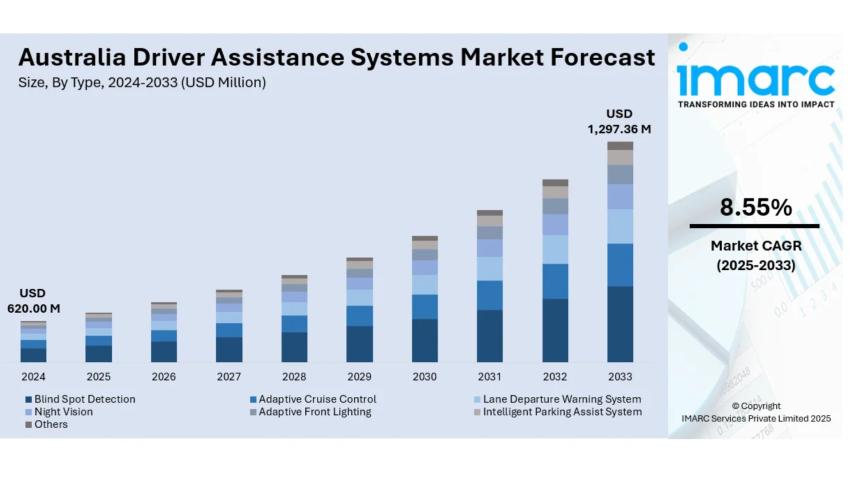
The latest report by IMARC Group, titled “Australia Driver Assistance Systems Market: Industry Trends, Share, Size, Growth, Opportunity and Forecast 2025-2033,” offers a comprehensive analysis of the Australia driver assistance systems market growth. The report includes competitor and regional analysis, along with a detailed breakdown of industry segments. The Australia driver assistance systems market size reached USD 620.00 Million in 2024. Looking forward, IMARC Group expects the market to reach USD 1,297.36 Million by 2033, exhibiting a strong growth rate during 2025–2033.
Report Attributes:
Base Year: 2024
Forecast Years: 2025–2033
Historical Years: 2019–2024
Market Size in 2024: USD 620.00 Million
Market Forecast in 2033: USD 1,297.36 Million
Market Growth Rate 2025–2033: 8.55%
Australia Driver Assistance Systems Market Overview
- The Australia driver assistance systems market is seeing quick growth in the use of advanced safety tech to deal with more road accidents and deaths.
- Car makers are adding features like lane departure warning, adaptive cruise control, and automatic emergency braking to meet what customers want and follow rules.
- Government rules are pushing car companies to include safety systems like Automatic Emergency Braking (AEB) and Acoustic Vehicle Alerting Systems (AVAS) in new cars, keeping up with worldwide safety standards.
- The market is growing because more electric and self-driving cars are being sold, and businesses are updating their fleets for commercial and delivery use.
- People are choosing cars with high-tech features more and more, which is making these driver assistance tools available in both regular and luxury cars.
Key Features and Trends of Australia Driver Assistance Systems Market
- Automakers are adding advanced driver assistance systems (ADAS) to more affordable cars, not just luxury ones. This makes safety features available to more people.
- Cars now use smart sensors like ultrasonic, image, lidar, and radar to detect things around them and help avoid accidents in real time.
- There's a big increase in people wanting features like 360-degree cameras, blind-spot alerts, and smart parking help in both regular and commercial vehicles.
- Car makers are working on better supply chains and teaming up with other companies to speed up the spread of ADAS and meet safety rules on time.
- People are also choosing cars based more on safety tech, which is helping the market grow faster.
Growth Drivers of Australia Driver Assistance Systems Market
- More people are worried about road safety and there are more accidents happening.
- The government is setting strict rules that require new cars to have certain safety features.
- More Australians are buying electric and self-driving cars.
- Companies are updating their vehicle fleets and spending money on better safety technology.
- Customers are asking for more automatic and connected car features.
Innovation & Market Demand of Australia Driver Assistance Systems Market
- Companies are using AI-powered sensors to detect dangers quickly and adjust responses in real time.
- The market is adopting modular ADAS systems that can be easily added to different kinds of vehicles.
- Car manufacturers are working with tech companies to make sensors more accurate and cut down on false alarms in safety features.
- Industry experts are using big data and analysis to better predict when parts need repair and improve how well a group of vehicles performs.
- The demand for connected and self-driving cars is pushing constant improvements in driver aid systems.
Australia Driver Assistance Systems Market Opportunities
Expansion of ADAS features into light and heavy commercial vehicles is opening new revenue streams.
Government incentives and rebates for vehicles with high ANCAP safety ratings are encouraging consumer adoption.
The rise of smart cities and connected infrastructure is supporting the integration of V2X (vehicle-to-everything) communication.
Increased investment in R&D is enabling the development of next-generation ADAS technologies tailored to Australian road conditions.
Partnerships between automakers, tech firms, and government agencies are fostering a robust innovation ecosystem.
Australia Driver Assistance Systems Market Challenges
Ensuring interoperability and standardization across diverse ADAS technologies and vehicle platforms.
Addressing the cost barriers for widespread adoption in entry-level and budget vehicles.
Managing cybersecurity risks associated with connected vehicle systems.
Educating consumers and fleet operators on the benefits and proper use of advanced driver assistance features.
Navigating evolving regulatory requirements and compliance timelines.
Australia Driver Assistance Systems Market Analysis
The market is demonstrating strong momentum, with both passenger and commercial segments contributing to growth.
Regional analysis highlights significant adoption in New South Wales, Victoria, and Queensland, driven by urbanization and infrastructure investments.
Segment analysis shows increasing penetration of ADAS in electric, hybrid, and hydrogen vehicles.
Competitive dynamics are intensifying as global and local OEMs compete on technology, safety, and value.
Ongoing government support and consumer awareness campaigns are sustaining market expansion.
Australia Driver Assistance Systems Market Segmentation
By Type:
- Blind Spot Detection
- Adaptive Cruise Control
- Lane Departure Warning System
- Night Vision
- Adaptive Front Lighting
- Intelligent Parking Assist System
- Others
By Technology:
- Ultrasonic Sensor
- Image Sensor
- Lidar Sensor
- Radar Sensor
By Vehicle Type:
- Passenger Cars
- Light Commercial Vehicles
- Heavy Commercial Vehicles
By Region:
- Australia Capital Territory & New South Wales
- Victoria & Tasmania
- Queensland
- Northern Territory & Southern Australia
- Western Australia
Australia Driver Assistance Systems Market News & Recent Developments
March 2025: Mandatory Autonomous Emergency Braking (AEB) for all new vehicles under ADR 98/00 comes into effect, aligning Australia with global safety standards.
November 2025: Introduction of Acoustic Vehicle Alerting Systems (AVAS) for all new electric, hybrid, and hydrogen vehicles under ADR 113/00 to enhance pedestrian safety.
Australia Driver Assistance Systems Market Key Players
Major automotive OEMs
Tier-1 ADAS technology suppliers
AI sensor and software developers
Regional automotive technology integrators
Key Highlights of the Report
Market Performance (2019–2024)
Market Outlook (2025–2033)
COVID-19 Impact on the Market
Porter’s Five Forces Analysis
Strategic Recommendations
Historical, Current and Future Market Trends
Market Drivers and Success Factors
SWOT Analysis
Structure of the Market
Value Chain Analysis
Comprehensive Mapping of the Competitive Landscape
Note: If you need specific information that is not currently within the scope of the report, we can provide it as part of the customization.
🔍 FAQs: Australia Driver Assistance Systems Market
Q1: What is driving the adoption of driver assistance systems in Australia?
A: Rising road safety concerns, government mandates, and consumer demand for advanced safety features are driving adoption.
Q2: Which ADAS features are most in demand among Australian consumers?
A: Lane departure warning, adaptive cruise control, blind spot detection, and 360-degree cameras are highly sought after.
Q3: How are government regulations influencing the market?
A: Mandates for features like AEB and AVAS are accelerating the integration of ADAS in new vehicles.
Q4: What challenges does the market face?
A: Key challenges include cost barriers, system interoperability, and the need for consumer education.
Q5: What opportunities exist for market participants?
A: Opportunities include expanding into commercial vehicle segments, leveraging government incentives, and innovating with connected and autonomous technologies.
About Us
IMARC Group is a leading market research company that provides management strategy and market research worldwide. We partner with clients in all sectors and regions to identify their highest-value opportunities, address their most critical challenges, and transform their businesses. Our solutions include comprehensive market intelligence, custom consulting, and actionable insights to help organizations make informed decisions and achieve sustainable growth.
Contact Us
134 N 4th St. Brooklyn, NY 11249, USA
Email: sales@imarcgroup.com
Tel No: (D) +91 120 433 0800
United States: +1-631-791-1145