

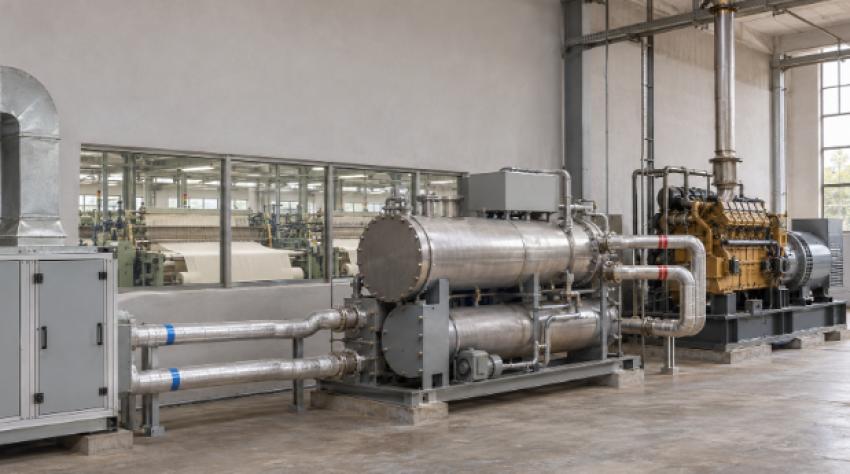
Yes. A textile mill that runs gas engines for its electricity can use the heat those engines throw away to make chilled water. The mechanism is an absorption chiller, which runs on heat instead of electricity. Whether it pays off depends less on the technology and more on how much cooling the mill needs and for how many hours a year.
This article explains how the system works, why engine cooling water is a usable heat source, and how to judge whether your mill has enough cooling demand to justify the investment.
Where the waste heat comes from
A reciprocating gas engine converts only part of its fuel energy into electricity. The rest leaves as heat, mainly through three streams:
Jacket water: the coolant circulating through the engine block, typically leaving at a temperature suitable for hot-water recovery.
Exhaust gas: very hot, and the source for higher-grade recovery.
Lube oil and charge air: smaller streams, usually recovered alongside jacket water.
For absorption cooling, jacket water is the most common starting point. It is hot enough to drive a single-effect absorption chiller and is already flowing through the engine, so the recovery work is mostly piping, heat exchange, and controls.
Engine data for the Saya project: [engine model and quantity, jacket water outlet temperature, recoverable heat in kW].
How an absorption chiller uses engine cooling water
A vapor-compression chiller uses an electric compressor. An absorption chiller uses heat to drive a chemical cycle, usually with lithium bromide and water. In a typical single-effect unit:
Hot water enters the generator. The heat drives refrigerant vapor out of a diluted absorbent solution.
The refrigerant condenses in the condenser, rejecting heat to cooling water.
The refrigerant evaporates in the evaporator at low pressure, producing the chilled water the mill uses.
The absorber reabsorbs the vapor, closing the loop.
The chiller's only significant electrical load is the solution pumps, which is a small fraction of what a compression chiller draws. The practical result is that the engine's waste heat, which would otherwise be dumped to a radiator, becomes cooling.
Engine jacket water is usually adequate for single-effect units, but the temperature and flow have to match the chiller's design. Lower-temperature water produces less cooling. The chiller and the engine's heat recovery loop must be designed together.
When a mill has enough cooling demand
The economics come down to three questions.
1. Is there a steady cooling load?
Spinning and weaving halls need humidity and temperature control for yarn quality and machine performance. That load is continuous while production runs, which favours absorption cooling.
2. Does the load run alongside the engines?
Waste heat is only available when the engines run. If the engines operate continuously, as in a mill running base-load captive power, the recovered heat is available nearly all year. If engines run intermittently, the chiller will sit idle for part of the year.
3. Is the cooling load large enough to use the heat?
A chiller that is sized too small for the recoverable heat wastes capital. One that is too large runs at part load and loses efficiency. Matching the chiller capacity to the engine's recoverable heat and the mill's cooling demand is the central design step.
A useful test: if the mill already runs electric chillers for process cooling and those run for many hours a year, the absorption option deserves a serious look. The displaced electricity is the main saving.
Cooling-load data for the Saya project: [installed or peak cooling demand in TR, operating hours, and existing chiller electricity use].
How OES approaches a project like this
OES is an authorised provider of INNIO Jenbacher and Waukesha gas engines and gensets in Pakistan, so the engine side of a heat-recovery project is handled by the same team that designs the power plant. That matters because the chiller's performance depends on the engine's heat output, temperatures, and operating schedule. A project that treats the engine and the chiller as separate purchases tends to miss this.
OES's engineering team covers the electrical, mechanical, civil, and CAD work needed to integrate a chiller into an existing plant. For a mill considering this, the first step is an assessment of recoverable heat and cooling demand, followed by a sizing and economic comparison.
Saya project outcome: [commissioning date, installed chiller capacity, measured chilled-water output, and annual savings, all to be confirmed from the project record].
Key takeaways
Gas engine jacket water is a practical heat source for absorption chilling.
The chiller converts heat into chilled water, drawing little electricity.
Viability depends on steady cooling demand, engine run hours, and correct sizing.
Engine and chiller should be designed together, not bought separately.
If your mill runs gas engines and has a meaningful cooling load, request a quote to get an assessment of recoverable heat and the likely payback. You can also contact OES to discuss your site.