

Information security is essential for protecting business data, maintaining customer trust, and ensuring reliable operations. Organizations implementing ISO/IEC 27001 need a structured approach to managing information security risks and establishing an effective Information Security Management System (ISMS).
One of the most important steps is preparing the right documentation. An organized ISO 27001 documents list helps organizations identify documentation needs, assign responsibilities, maintain records, and demonstrate how their ISMS operates. Understanding which documents to prepare also helps businesses avoid unnecessary paperwork and focus on information security activities that support their actual operations.
Why Is ISO 27001 Documentation Important?
ISO 27001 documentation provides a framework for managing information security activities consistently. It defines policies, establishes procedures, records important decisions, and supports the evaluation of security controls.
Proper documentation also helps organizations identify gaps, communicate responsibilities, and maintain evidence of their information security practices. However, documentation should reflect actual business processes rather than simply exist for certification purposes.
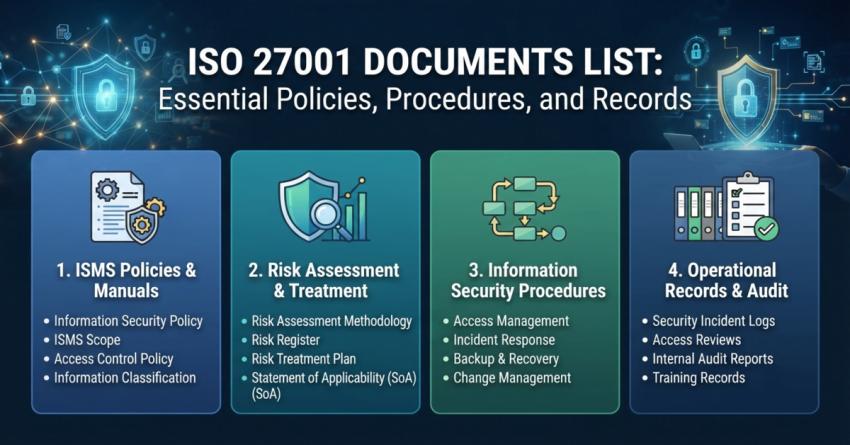
Essential ISO 27001 Documents List
The documentation required for an ISMS depends on the organization's size, activities, risks, and operational complexity. The following categories provide a practical starting point.
1. ISMS Policies and Manuals
An information security policy establishes management's commitment to protecting information and defines the overall direction of the ISMS. An ISMS manual can provide a structured overview of the management system, its scope, responsibilities, and key processes.
Other supporting policies may address access control, information classification, acceptable use, and supplier security.
2. Risk Assessment and Treatment Documents
Risk management is central to ISO 27001 implementation. Organizations should maintain documented information supporting their risk assessment and treatment processes.
Important records include the information security risk assessment methodology, risk register, risk treatment plan, and Statement of Applicability (SoA). These documents help explain identified risks, selected controls, and decisions made to address information security threats.
3. Information Security Procedures
Procedures describe how information security activities are performed. Depending on the organization's needs, these may cover access management, incident response, backup management, change control, and supplier relationships.
Clear procedures help employees understand their responsibilities and support consistent implementation of security controls.
4. Operational Records and Audit Documentation
Operational records provide evidence that established processes are being followed. Examples include security incident records, access reviews, training records, internal audit reports, management review minutes, and corrective action records.
Maintaining accurate records helps organizations evaluate ISMS performance and identify opportunities for improvement.
How to Organize ISO 27001 Implementation Documentation
Preparing documentation from scratch can require considerable time and coordination. Organizations should first identify applicable requirements, review existing documents, and determine which resources need to be created or updated.
A structured documentation approach can simplify this process. An ISO 27001 documents package can provide a useful starting point for organizations developing their ISMS documentation.
When evaluating an ISO 27001 documentation package, consider whether it includes relevant policies, procedures, forms, records, and implementation resources. Editable ISO 27001 documents can also help teams adapt content to their organizational structure, operational processes, and information security risks.
Conclusion
A well-organized ISO 27001 documents list supports effective information security management, consistent processes, and continual improvement. By preparing appropriate policies, procedures, and records, organizations can establish a practical ISMS that reflects their actual operations.
Using structured ISO 27001 document templates can help reduce preparation effort and provide a foundation for developing reliable implementation documentation. The key is to maintain accurate, relevant documents that support the organization's information security objectives.