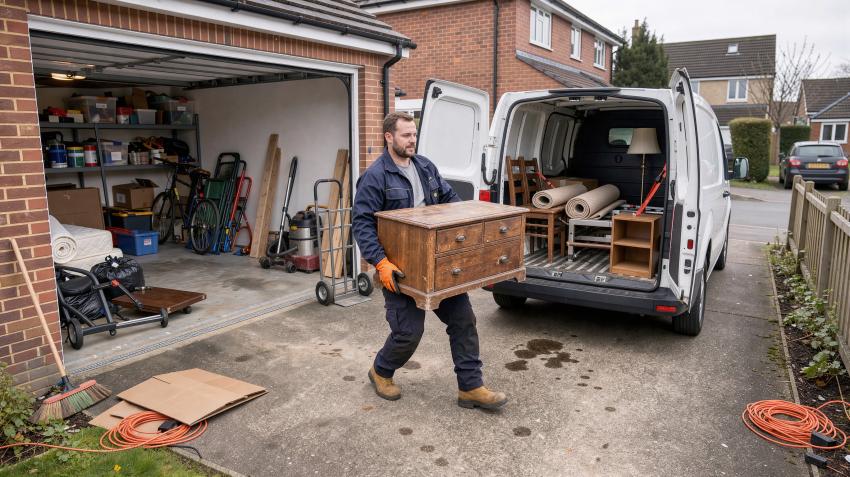
A garage is the room where good intentions go to wait. A bike that needs a new chain, a shelf that came loose, boxes from the last house move, half a tin of paint. Years pass, and the car never gets back in. If that sounds familiar, garage clearance Dublin households book is probably the next step, and it is simpler than most people expect.
This guide is written for first-timers. It explains what a clearance is, what can and cannot be taken, how a job runs from the first message to the last sweep, and what usually decides the price. Read it once and you will know what to ask, what to prepare and what to expect on the day.
What Is a Garage Clearance, in Plain Words?
A garage clearance is a service where a crew comes to your property, lifts everything you no longer want, loads it into a van or truck and takes it away. You do not carry, load or drive anything. You decide what goes, and the crew does the physical work.
It differs from hiring a skip. A skip is a container left outside your home. You still fill it yourself, and a skip on a public road can need a permit. A clearance service does the lifting for you, which matters when the items are heavy, awkward or buried behind other things.
It also differs from a quick trip to the recycling centre. A trip works for a few bags. A garage that holds years of stuff can mean dozens of trips, a lot of lifting and a lost weekend.
Full clearance and partial clearance
There are two main kinds of job.
Full clearance: the garage is emptied down to the floor. This suits a sale, a house move, a tenancy ending or a conversion into living space.
Partial clearance: only some items go, such as the broken furniture, the old shelving or the bulky pieces that block the door. This suits people who want their garage back without starting from zero.
Either way, you point out what stays and what goes. Walking the space with the crew before they start prevents mistakes.
Who Books a Garage Clearance, and When?
Most people book at a turning point. Common moments include:
Selling a home and wanting the garage to look empty and tidy for viewings.
Moving out of a rented property and leaving it clean at the end of a tenancy.
Finishing a renovation and facing a pile of leftover materials.
Clearing a relative's property, which is often emotional as well as practical.
Turning the space into a workshop, gym, studio or home office.
Making room for a car again, or for proper storage.
Businesses use the same service for storage rooms, workshops and yards. The steps are the same, only the volume changes.
What Can Go in the Van?
Most non-hazardous household and garage items can be taken. According to the company's own service page, that includes:
Old furniture and broken shelving
Cardboard, storage boxes and bagged rubbish
Tools and garden equipment
Scrap wood and metal
Old bikes and toys
Small appliances
Renovation debris and other bulky waste
The word to watch is non-hazardous. Items such as paint, solvents, fuel, chemicals and gas bottles need special handling, so ask about them before the day. A good crew will tell you plainly what they can and cannot take instead of leaving you to guess.
How a Garage Clearance Job Runs, Step by Step
The process is short. Knowing it takes the worry out of the first call.
Get in touch and describe the job. Say how big the garage is, whether it is a single or double, and what is inside. Photos help a great deal, because they let the crew judge the volume without guessing.
Receive a quote. The price is based on the amount and type of waste. A clear description gives you a clearer number.
Book a time. Pick a slot that suits you. Some services run flexible appointments across the city, so ask what is open.
Lifting and loading. On the day, the crew lifts and loads the items. You do not need to move a thing.
Sorting and disposal. The waste is sorted and disposed of responsibly, so reusable and recyclable material is not all dumped together.
That is the whole sequence. For a small job, the loading itself can be quick. For a packed double garage, expect a longer visit.
Where Garage Clearance Dublin Services Fit Into Your Plans
Many people wonder how garage clearance Dublin bookings fit around a sale, a move or a build. The short answer is that it works best when it comes before the next stage, not during it.
If you are selling, clear first and tidy after. A bare garage with a swept floor lets buyers see the space. If you are renovating, book the clearance for the end of the work, when the debris is finished. If you are leaving a rented home, schedule it a few days before the handover, so there is time to deal with anything unexpected.
One local provider, Fast Junk & Rubbish Removal, describes its garage clearance service in Dublin as covering single and double garages, storage areas and workshops, including end-of-tenancy clear-outs and clearances before a sale or after a renovation. The same page lists full and partial jobs, along with bulky and heavy item removal. It is a useful example of what a service description should tell you before you book.
When you compare providers, look for the same clarity. A good page names the types of space, the kinds of item and the way the price is worked out.
What Shapes the Cost of a Clearance?
Many beginners expect a flat fee. In practice, the price follows the job. The main factors are:
Volume of waste: more items fill more of the van and take more time.
Type of item: some materials cost more to handle and dispose of than others.
Weight of the load: heavy items such as scrap metal, concrete or old workbenches add to the effort.
Access: a garage on the ground floor with a clear drive is easier than one behind a narrow side passage or up steps.
Loading time: tightly packed spaces take longer to reach and empty.
Number of bulky items: a sofa, a freezer or a workbench each takes more effort than a box.
Because these factors differ for every home, no honest guide can give you one number. Treat any provider who quotes a fixed price without hearing the details with some caution. A quote built from your description, and ideally your photos, is more likely to match the final bill.
A hypothetical example
Picture a single garage in a Dublin semi-detached house. It holds an old sofa, a broken shelving unit, ten boxes of cardboard, a rusted bike and some timber offcuts. Access is easy, with a wide door and a drive. Compare that with a double garage packed to the ceiling, with a narrow side entrance and a heavy workbench. The first is a short job. The second needs more time, more lifting and possibly a bigger load. Same service, very different quote. This example is invented only to show how the factors work together.
How to Prepare Before the Crew Arrives
You do not need to do much, but a little preparation saves time and money.
Decide what stays. Set aside anything you want to keep, and move it into the house or mark it clearly.
Check for sentimental items. Old photos, paperwork and family keepsakes are easy to lose in a clear-out. Look through the boxes you are unsure about.
Look for hazardous items. Paint, fuel and chemicals should be flagged in advance.
Think about what could be sold or donated. Working tools, bikes and furniture in good shape can find a new home.
Clear the way. Make sure the crew can reach the garage and park close by.
Take photos. They help with the quote, and they give you a before-and-after record.
None of this is difficult. It simply helps the job go smoothly.
Common Mistakes First-Timers Make
A few errors come up again and again.
Underestimating the volume. A garage looks smaller when it is full and bigger when it is empty. Photos fix this.
Forgetting hazardous items. A forgotten tin of paint can hold up a job.
Not agreeing the scope. Say clearly whether it is a full or a partial job.
Choosing on price alone. The lowest quote can leave out lifting, loading or proper disposal.
Leaving it to the last minute. A rushed clearance before a sale or a handover adds stress.
Questions People Ask Before Booking
Do I need to be home?
It helps to be there at the start so you can point out what goes and what stays. For some jobs, access can be arranged in advance. Agree this when you book.
Can the job happen on the same day?
Sometimes. Same-day service depends on the location, the access and the size of the job, so it is never a certainty. Ask early.
What happens to the waste?
Reputable services sort what they collect and dispose of it responsibly. Ask how the provider handles recycling and reuse, since practice varies.
Is the service only for houses?
No. Homes and businesses both use it, from small storage areas to larger workshops.
Getting Your Garage Back Without the Stress
A first clearance can feel like a big task, but the shape of it is simple. Describe the job, get a quote, pick a time, let the crew do the lifting, and know that the waste is sorted and disposed of properly. The most useful things you can bring are a clear description, a few photos and a decision about what stays.
For anyone weighing up garage clearance Dublin options, the checklist is short. Ask what is taken, how the price is worked out, what happens to the waste and how soon a slot is available. Fast Junk & Rubbish Removal is one of the local names that publishes these details, and the same questions work for any provider you consider.
Once the space is empty, the real fun begins. Park the car, build the workbench, set up proper shelving or simply enjoy the room. A cleared garage is one of the few home projects where the finished result is visible the moment the door goes up.