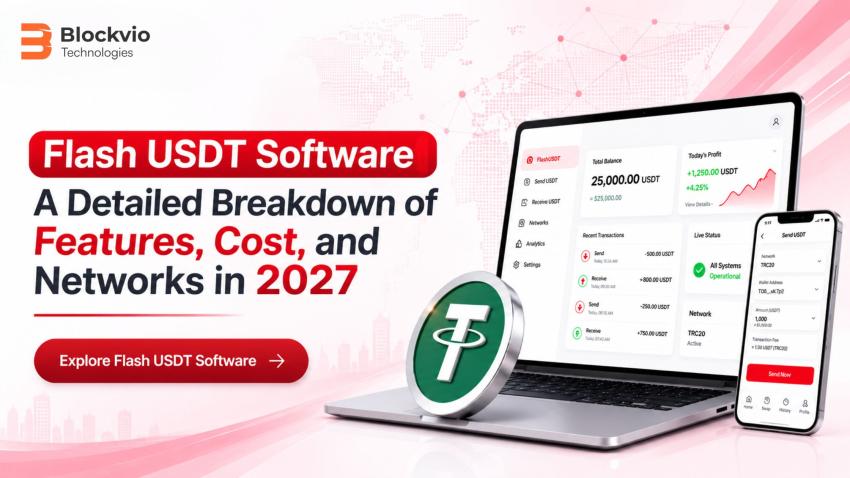
The cryptocurrency industry continues to expand, creating demand for digital wallets, blockchain payment systems, and multi-network transaction platforms. Among the search terms attracting attention in this space is Flash USDT Software. Many people are curious about its features, pricing, and compatibility with networks such as TRC-20, ERC-20, and BEP-20.
However, it is important to understand the technology behind the term. Flash USDT is not an official Tether product, and third-party software cannot generate genuine USDT or create a spendable temporary balance. Genuine USDT is issued by Tether on supported blockchain networks. For businesses interested in this area, legitimate USDT wallet and payment software offers a practical way to explore multi-network cryptocurrency functionality. Let's examine its features, development costs, and network requirements in 2027.
1. Understanding Flash USDT Software
Flash USDT Software is a term used by third-party sellers to describe tools that claim to generate temporary USDT balances or transactions. These claims should be treated carefully because a displayed balance or token name does not prove that genuine USDT has been received. A legitimate cryptocurrency application works differently. It connects with blockchain networks, reads verified token balances, and processes actual transactions through supported protocols. Businesses planning to develop a similar software solution should focus on genuine wallet integration, transaction monitoring, payment processing, and clearly labelled test environments.
2. Important Features of Legitimate USDT Software
A reliable USDT wallet or payment platform needs features that support secure transactions and convenient asset management.
Multi-Network Wallet Integration: Allows users to manage supported digital assets across compatible blockchain networks through one application.
Send and Receive Transactions: Enables users to transfer genuine supported tokens and view transaction details.
Live Balance Tracking: Retrieves token balances from blockchain data instead of displaying manually generated figures.
Transaction History: Maintains records of completed, pending, and failed transactions.
QR Code Payments: Makes it easier for users to share wallet addresses and receive cryptocurrency.
Admin Dashboard: Helps platform operators monitor application activity, manage users, and review transaction information.
Security Management: Can include encryption, secure key storage, authentication, and transaction risk checks.
Testnet Simulation: Allows developers to test wallet operations and transaction interfaces using test tokens that have no real monetary value.
3. Understanding Network Compatibility
Network compatibility is an important part of USDT software development. Each blockchain follows its own technical standards, transaction processes, and fee requirements.
TRC-20 – TRON Network
TRC-20 USDT operates on the TRON blockchain. It is commonly considered for applications that need TRON-based wallet and payment integration. Transactions may require TRX to cover network resources when available resources are insufficient.
ERC-20 – Ethereum Network
ERC-20 USDT operates on Ethereum. It is supported by a large smart contract ecosystem and is widely integrated into cryptocurrency applications. Users need ETH to pay Ethereum network gas fees.
BEP-20 – BNB Smart Chain
BEP-20 is the token standard used by BNB Smart Chain. However, businesses should not automatically assume that a token labelled BEP-20 USDT is official Tether USD₮. Tether's current supported-protocol documentation should be checked before integrating an asset.
The key requirement is to verify the official token contract, issuer, and supported network before accepting deposits or displaying an asset as genuine USDT.
4. How Much Does USDT Wallet Software Development Cost in 2027?
The development cost depends on the application's complexity, supported networks, security architecture, and required integrations. For a legitimate cryptocurrency wallet project, the following are indicative planning budgets, not fixed market prices:
Basic wallet application: 15,000–35,000. May include wallet creation, balance tracking, and basic send-and-receive functionality.
Multi-network wallet: 30,000–70,000. May include additional blockchain integrations, transaction monitoring, and network selection.
Advanced wallet platform: 50,000–150,000+. May include stronger custody architecture, advanced security, administrative controls, and additional integrations.
These figures are broad development estimates. Actual quotations depend on the development team, project scope, location, and security requirements. There is no legitimate market price for software that generates genuine Flash USDT because no such Tether-issued generation product exists.
5. Factors That Influence Development Cost
Number of Networks: Supporting additional blockchain networks requires more integration, testing, and maintenance.
Security Requirements: Secure key management, authentication, independent audits, and transaction monitoring and development effort.
Application Type: A web wallet, mobile wallet, and enterprise payment platform have different development requirements.
Third-Party Integrations: Blockchain node providers, analytics services, and compliance tools may involve additional fees.
Maintenance: Network upgrades, security updates, bug fixes, and infrastructure management create ongoing costs after launch.
6. Future Scope of Multi-Network USDT Applications
In 2027, businesses can explore more advanced cryptocurrency applications by combining wallet services, payment integrations, transaction analytics, and security tools. Multi-network support can help applications serve users who hold assets on different supported blockchains. Better dashboards and transaction monitoring can also make digital asset management more convenient. The long-term value of these platforms depends on genuine blockchain integration, reliable security, transparent operations, and compliance with applicable regulations.
Final Thoughts
Flash USDT Software is a popular search term, but it should not be confused with an official Tether product or a method of generating genuine cryptocurrency. Businesses interested in this market should focus on legitimate USDT wallet development, verified network integration, transaction management, and secure payment applications. From TRC-20 and ERC-20 support to wallet security and development budgeting, every technical decision contributes to building a dependable platform. Businesses exploring cryptocurrency software development can consider as a technology development partner to discuss their project requirements, platform architecture, and multi-network integration needs.