A retailer wants to know whether its products are priced competitively across the market. At first, the task sounds simple: find the same product on a few ecommerce websites, record the prices, and compare them. The problem appears when the same product has a different title, SKU, product ID, pack size, description, or even a slightly different image on every website. What looks like a straightforward comparison quickly turns into a product identification problem.
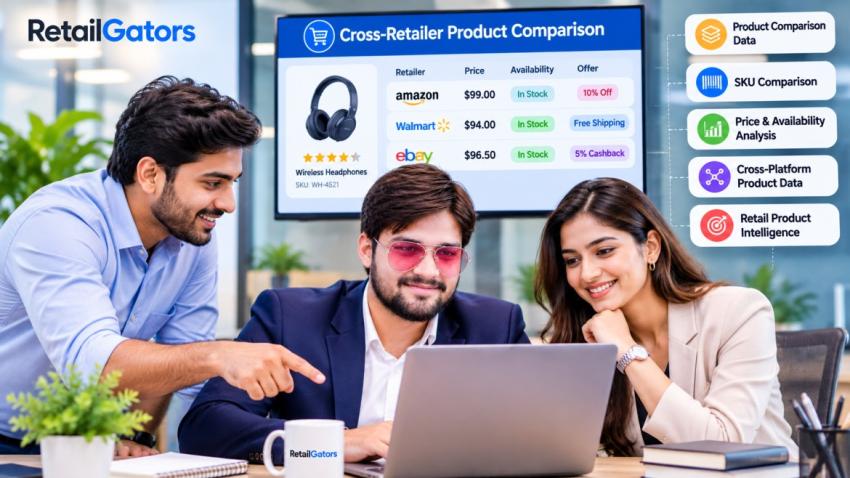
This is why Cross-Retailer Product Comparison requires more than collecting prices from different websites. Retailers need to determine whether the listings actually represent the same product before comparing their prices, availability, promotions, or other attributes. A 500 ml product cannot be fairly compared with a 750 ml version, and a single-item listing should not be treated as equivalent to a multipack simply because the product names look similar.
For brands, retailers, pricing teams, category managers, and market researchers, accurate comparison creates a much clearer view of the market. It helps them understand competitor positioning, identify pricing gaps, monitor assortment changes, and make better decisions using structured ecommerce data rather than manually collected snapshots.
Why Is Cross-Retailer Product Comparison More Difficult Than It Looks?
The first challenge is that ecommerce websites rarely describe products in exactly the same way. One retailer may use the manufacturer's full product name, another may shorten it, and a marketplace seller may create its own title. Even when the products are identical, the wording can be completely different.
Product identifiers create another problem. A retailer may use its own SKU, while the manufacturer uses a model number, UPC, or GTIN. These identifiers are useful, but they are not always available on every listing. Some sellers provide detailed specifications, while others publish only a short title and a few basic attributes. As a result, a reliable ecommerce product comparison process needs to combine several signals instead of depending on one field.
The difficulty becomes even greater when products have variants. Color, size, storage capacity, flavor, weight, quantity, and bundle configuration can all change the actual product being sold. If these differences are ignored, the resulting comparison may look accurate in a spreadsheet while being completely misleading from a business perspective.
What Data Should Retailers Compare?
A useful comparison starts with product identity and then expands into commercial information. The basic dataset may include product name, brand, category, SKU, UPC or GTIN where available, model number, product attributes, pack size, variant, price, discount, availability, rating, review count, seller, and product URL. The exact fields depend on the retailer's objective, but the principle is the same: capture enough information to determine whether two listings are genuinely comparable.
Price is obviously important, but it should not be viewed in isolation. A competitor may have a lower displayed price but offer a smaller pack, limited availability, or a temporary promotion. A retailer comparing only the headline price could therefore reach the wrong conclusion. Normalized unit pricing, promotion information, and product configuration can provide much more meaningful context.
Availability is another useful signal. If a competitor's product is consistently out of stock, its displayed price may not represent a real competitive threat at that moment. On the other hand, a competitor offering the same product at a lower price with strong availability may require much closer attention from a pricing team.
The Hardest Part: Matching the Same Product Across Retailers
The foundation of reliable comparison is accurate product matching. Before asking whether Product A costs more on Retailer X than Retailer Y, a business first needs confidence that Product A on both websites is actually the same item.
A practical matching process can begin with strong identifiers such as UPC, GTIN, manufacturer part number, or model number. When those identifiers are missing, the system can compare brand, product title, specifications, dimensions, size, color, pack quantity, and other attributes. In more complicated catalogs, text similarity and image-based signals can provide additional evidence.
This is why product matching across retailers deserves separate attention. Product matching is not just a technical preprocessing step; it directly affects the quality of every pricing, assortment, and competitor analysis that follows. A wrong match can make a competitor appear cheaper or more expensive than it actually is.
Consider a simple example. One retailer sells a coffee maker for $89, while another lists what appears to be the same model for $79. A closer review shows that the $89 listing includes two additional filters and a larger accessory bundle. The original price comparison was technically correct but commercially meaningless. Good product matching and attribute normalization prevent these errors.
How SKU Comparison Works Across Different Ecommerce Websites
SKU comparison sounds easier than it actually is because SKUs are generally created by individual sellers or retailers. The same manufacturer product can have completely different internal SKUs across two websites.
For example, Retailer A may identify a television as SKU-TV-4521, while Retailer B uses 883721. Neither number tells the system that the two listings represent the same model. That connection has to be established using other product information.
This is where SKU comparison becomes a data reconciliation exercise. Businesses can create a reference catalog containing manufacturer identifiers, UPCs, model numbers, standardized product names, and important attributes. Retailer-specific SKUs can then be mapped to that reference catalog.
The process becomes particularly valuable for large catalogs. Instead of manually deciding whether every listing is comparable, retailers can establish repeatable matching rules and review uncertain cases separately. The result is a cleaner product dataset that can support pricing analysis and ongoing monitoring.
Why Product Comparison Should Include More Than Price
A retailer comparing products across websites can learn much more than who has the lowest price. Product assortment, availability, promotions, seller activity, reviews, ratings, and product attributes can all provide additional market context.
For example, imagine a retailer notices that a competitor has a lower price for a popular skincare product. At first, matching the price may seem like the obvious response. But the comparison shows that the competitor's product has fewer available units and is not being promoted across other channels. The retailer may decide that an immediate price reduction is unnecessary.
This broader approach is part of retail product intelligence. Instead of treating every data point independently, businesses connect product, price, inventory, and marketplace information to understand what is actually happening.
The same principle applies to promotions. A product may appear significantly cheaper because of a temporary coupon or seasonal offer. Historical data can help determine whether the price represents the competitor's normal position or simply a short promotional window.
Comparing Product Prices During Seasonal Events
Product comparison becomes even more useful during major shopping periods because competitors can change prices and promotions quickly. A retailer tracking a product before and during a seasonal event can see whether competitors introduced discounts, changed bundle structures, or adjusted availability.
For retailers preparing for major promotional periods, a Black Friday price monitoring playbook can provide a useful framework for thinking about product selection, monitoring frequency, promotions, stock signals, and pricing changes.
The important point is that seasonal comparison should not rely on a single snapshot. A product priced at $100 on Monday and $80 on Friday tells a very different story from a product that has been priced around $80 for several weeks. Historical comparison gives the retailer the context needed to interpret the change.
How Availability Changes the Meaning of Product Comparison
Price comparison without availability can produce misleading results. A retailer may find that a competitor sells a product for less, but if that product is unavailable in the locations where customers are shopping, the competitive impact may be different.
This becomes especially important for grocery, convenience, and quick-commerce businesses. Product availability can vary by location, store, fulfillment center, or delivery zone. A product that is available in one market may not be available in another.
For brands operating in these environments, quick-commerce price and availability intelligence illustrates why price and stock signals are often better analyzed together. A meaningful cross-retailer comparison should consider not only what a customer is being asked to pay, but whether the product can actually be purchased.
How Automated Cross-Platform Product Data Helps
Manual product comparison becomes increasingly difficult as the number of retailers and SKUs grows. A category manager may be able to check twenty products across three websites, but doing the same work for thousands of products quickly becomes a full-time data operation.
Automation allows businesses to collect product information on a recurring schedule and organize it into a consistent structure. Data can then be standardized, matched, validated, and prepared for analysis. Historical records make it possible to compare current prices with previous observations instead of relying on memory or scattered spreadsheets.
This is where eCommerce Data Scraping Services can become part of a broader product intelligence workflow. Structured product, pricing, availability, promotion, seller, and category data can be used as the foundation for comparison systems, dashboards, pricing analysis, and competitive research.
Automation does not remove the need for business judgment. It reduces the repetitive collection work so teams can spend more time interpreting what the data means.
Turning Cross-Retailer Product Data Into Business Decisions
The real value of Cross-Retailer Product Comparison appears when the data leads to a business action. A pricing team may use it to identify products that are consistently priced above competitors. A category manager may discover that competitors have expanded their assortment in a particular segment. A brand may notice that one product is widely available while another has frequent stock issues.
The same dataset can support different decisions depending on the business objective. Pricing teams may focus on price gaps and promotions. Merchandising teams may focus on assortment and product attributes. Market researchers may examine category expansion and competitive movement. Inventory teams may look at availability patterns.
This is why cross-platform product data should be structured around the questions the business needs to answer. Collecting thousands of fields does not automatically create useful intelligence. The better approach is to determine which signals matter and build the comparison around them.
Common Mistakes in Cross-Retailer Product Comparison
One of the most common mistakes is comparing products based only on their titles. Titles are useful for discovery, but they are not reliable enough to establish product equivalence in every case. Another common mistake is ignoring pack size, quantity, or product variants when comparing prices.
Businesses can also create problems by treating current data as permanent. Ecommerce catalogs change constantly. Products are renamed, listings disappear, sellers change, and new variants are introduced. A product match that was correct several months ago may require validation again after a catalog update.
Finally, retailers sometimes collect data without deciding how it will be used. A large spreadsheet full of prices may look impressive but still leave the pricing team unable to answer basic questions. A useful comparison system should connect the data to a clear business purpose, whether that is pricing, assortment, inventory, competitive intelligence, or market research.
What a Reliable Product Comparison Workflow Looks Like
A practical workflow begins by defining the retailers, products, categories, and business questions that need to be monitored. The next step is collecting the relevant product attributes and identifiers from each source. Those records are then normalized so units, names, variants, and other attributes can be compared consistently.
Product matching comes next. High-confidence matches can be established using identifiers, while more complicated records may require attribute-based or similarity-based checks. Once products are matched, businesses can compare prices, discounts, availability, promotions, sellers, and other relevant fields.
The final layer is historical analysis. Instead of simply saying that one retailer is cheaper today, the business can understand whether that difference is normal, temporary, seasonal, or unusual. That context turns raw product comparison data into a more useful source of retail intelligence.
Final Takeaway
Comparing the same product across multiple ecommerce websites is not simply a matter of collecting prices from different pages. The difficult part is establishing that the products are genuinely comparable and then preserving enough information to understand the difference.
Accurate Cross-Retailer Product Comparison combines product identifiers, attributes, SKU mapping, pricing, availability, promotions, and historical information. When these signals are organized properly, retailers can identify pricing gaps, assortment opportunities, availability issues, and changes in competitive positioning with much greater confidence.
For businesses managing large catalogs, automation can make the process more consistent and scalable. More importantly, a well-designed comparison workflow gives pricing, merchandising, analytics, and market research teams the same reliable product view from which to make decisions.
The goal is not to collect the most data. It is to make sure the right products are matched, the right information is compared, and the resulting insights can actually support a business decision.