When a brand has hundreds or thousands of products distributed across multiple retailers, finding these changes manually becomes difficult very quickly.
This is where a MAP Monitoring Service becomes useful. MAP, or Minimum Advertised Price, refers to the minimum price a brand specifies for how its products may be advertised under its MAP policy. It is not necessarily the same as controlling the final selling price, and the legal and commercial treatment of MAP policies can vary by market and policy structure. For brands, the practical challenge is having enough visibility to identify advertised-price changes, understand where they are occurring, and determine whether further investigation is required.
MAP monitoring is therefore about more than finding a low price. It gives brands a structured way to watch advertised pricing across retail channels, identify recurring patterns, preserve historical information, and understand whether pricing issues are isolated events or part of a broader channel problem.
Why Do Brands Need MAP Monitoring?
Pricing consistency matters because retailers and customers see advertised prices before they see the complete commercial picture behind a product. If one retailer consistently advertises a premium product below the level established by the brand's pricing policy, other retailers may face pressure to respond. Over time, this can create friction between channel partners and make it harder for a brand to maintain the positioning it intended for its products.
A brand may initially notice the problem as a simple price difference, but the underlying issue can be more complicated. The listing may belong to a third-party seller, the price may be linked to a promotion, or the product may have been listed with a different pack size or variation. Without detailed product and retailer information, a pricing team can easily spend time investigating the wrong listing or treating a legitimate promotion as a violation.
This is why minimum advertised price monitoring needs context. The goal is not to react to every price movement automatically. The goal is to create enough visibility for the brand to identify meaningful exceptions, verify what happened, and decide what action makes sense under its own pricing policy.
For brands looking at pricing, promotions, and competitor activity together, a broader MAP Monitoring Service can fit naturally within a wider price and market monitoring strategy.
What Is MAP Price Monitoring?
MAP price monitoring is the ongoing process of checking advertised product prices across retailers, marketplaces, brand stores, and other digital sales channels and comparing those observations against a brand's defined MAP requirements. A basic system may simply compare an observed price with a threshold, but a more useful approach captures the surrounding information needed to understand the listing.
That can include the product name, SKU, UPC or other identifier, retailer, seller, advertised price, original price, discount information, promotion details, availability, product URL, and the time when the price was observed. These details matter because two listings that look similar at first glance may not actually represent the same product or commercial offer.
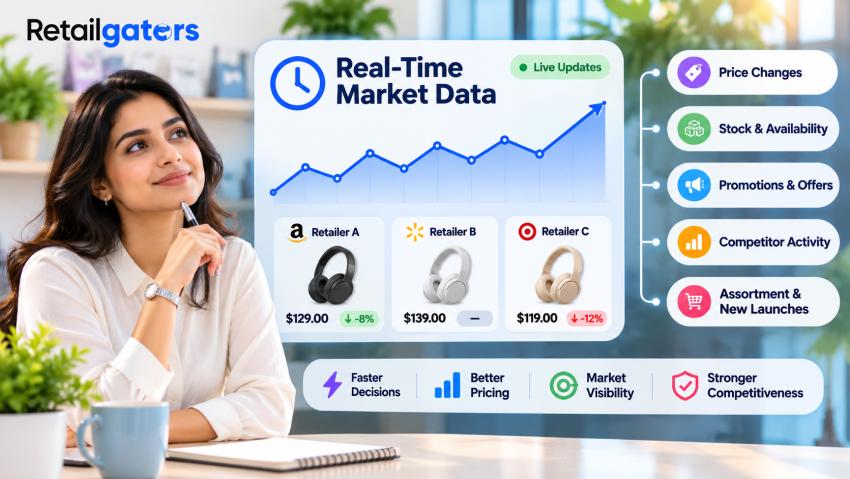
Imagine a brand selling premium headphones. One retailer advertises the exact model at the expected MAP, while another lists it below the threshold. Before contacting the retailer, the brand may need to determine whether the second listing is the same model, whether a coupon is being applied, whether the seller is authorized, and whether the advertised offer falls under the relevant MAP policy. Historical monitoring can then show whether this was a one-time event or a recurring pattern.
That level of context makes MAP monitoring much more useful than a simple spreadsheet of prices.
MAP Compliance Requires Accurate Product Matching
One of the most overlooked parts of MAP compliance is product identification. A pricing alert is only useful when the system is comparing the right products.
Retail websites often use their own product titles, internal IDs, descriptions, and category structures. The same product can appear with slightly different names across multiple retailers. Variations in color, size, model number, pack quantity, or bundle configuration can create misleading comparisons if they are not handled correctly.
For example, a retailer might advertise a two-pack at a price that appears lower than the MAP for a single unit. A simple price comparison could flag the listing even though the products are not directly comparable. Similarly, a retailer may sell a bundle that includes accessories or additional products, making the advertised price difficult to compare with a standard product listing.
This is why a reliable monitoring workflow should establish clear product-matching rules before generating alerts. Product identifiers such as UPCs, SKUs, manufacturer part numbers, and other available attributes can help create a more consistent comparison framework.
Brands that need broader structured product information can also connect MAP monitoring with E-commerce & Retail data solutions to organize product, pricing, inventory, seller, and promotion information across retail sources.
What Data Should Brands Track for MAP Monitoring?
Price is the obvious starting point, but it should not be the only field being monitored. When a pricing team receives an alert, it needs enough information to understand what happened without opening dozens of unrelated pages and manually reconstructing the situation.
Useful monitoring data can include the advertised price, list price, discount, promotional wording, retailer name, seller name where available, product identifier, product title, product variation, availability, product URL, and observation timestamp. Depending on the business model, brands may also want marketplace-specific identifiers, shipping information, seller ratings, or other signals that help distinguish between legitimate retail activity and unusual listings.
Historical records are particularly valuable. A current price can tell a brand that a product is below its threshold today. A history of observations can show that the same retailer has advertised the product below the threshold repeatedly over several weeks. Those are very different situations from a monitoring and channel-management perspective.
The same historical information can also help brands identify patterns across categories. If pricing exceptions are concentrated around a particular product line or retail channel, the business may want to investigate whether there is a distribution, promotion, or channel-specific issue behind the pattern.
MAP Monitoring and Retailer Price Monitoring Are Not the Same
Retailer price monitoring has a broader purpose. It can be used to understand competitor prices, promotions, product availability, assortment changes, and overall market positioning. MAP monitoring is narrower because it focuses specifically on advertised pricing in relation to a brand's MAP requirements.
The two approaches, however, work well together. A brand might use retailer price monitoring to understand the competitive environment while using MAP monitoring to identify potential pricing-policy exceptions. This creates a much more useful picture than looking at MAP violations in isolation.
For example, suppose a brand sees several retailers reducing the advertised price of a product during a major shopping period. Broader retailer monitoring can show whether the reduction is part of a category-wide promotional trend, while MAP monitoring can highlight which listings may require additional review. The brand can then investigate the situation with more context rather than treating every price movement as an individual problem.
This broader approach is particularly useful for brands selling through multiple channels, where pricing decisions made by one retailer can quickly influence expectations across the rest of the network.
How MAP Monitoring Helps Protect Brand Value
Brand protection is often discussed in terms of counterfeit products, unauthorized sellers, or misleading listings, but pricing consistency can also influence how a product is perceived. A premium product that repeatedly appears at heavily reduced advertised prices may gradually lose some of the pricing signal the brand has worked to establish.
There is also a channel-partner dimension. Retailers that follow a brand's pricing policy may be frustrated if other sellers repeatedly advertise the same product at lower prices. If those differences continue, the issue can become more than a pricing problem; it can affect relationships, promotional planning, and the broader structure of the retail channel.
MAP monitoring gives brands visibility into these situations. It does not automatically determine why a price changed or establish that a seller intentionally violated a policy. Instead, it gives the team reliable observations that can be reviewed alongside seller information, product details, promotions, and historical activity.
That distinction is important. Good monitoring should help a brand investigate and make informed decisions rather than simply generate a large number of alerts.
Why Automated MAP Monitoring Is More Practical at Scale
Manual monitoring becomes increasingly difficult as the number of products and retail channels grows. A person can check a handful of products, but maintaining consistent monitoring across hundreds of SKUs and multiple retailers requires far more time and introduces the possibility of missed changes and inconsistent records.
Automation allows businesses to define the products and retailers they want to monitor, collect pricing information on a recurring schedule, standardize the data, compare listings against defined rules, and maintain historical records. Teams can then focus their attention on meaningful exceptions instead of manually checking every product page.
This is where Web Crawling & Automation can support a broader monitoring workflow. Automated crawling can help businesses monitor frequently changing retail pages and maintain structured information across large numbers of sources. The exact monitoring frequency should depend on the category, price volatility, number of products, and business requirements.
The important point is that automation does not replace judgment. It makes the collection and organization of information more consistent so that pricing and channel teams have better evidence when making decisions.
Turning MAP Monitoring Data Into Business Decisions
The most useful MAP monitoring programs are built around business questions rather than raw alerts. A pricing team may want to know which retailers have recurring pricing exceptions, which products are most affected, whether certain sellers appear repeatedly, or whether violations tend to happen during particular promotional periods.
Historical data makes these questions easier to answer. A single observation tells the team what happened at one point in time. A series of observations can reveal frequency, duration, and patterns. That distinction can change how a brand prioritizes its response.
For instance, imagine a brand discovers that a retailer has advertised one product below MAP once. The team may simply verify the listing and monitor it. If the same retailer repeatedly advertises dozens of products below the threshold, the pattern deserves a much closer review. Monitoring data helps separate these situations and gives the brand a stronger factual basis for its internal discussions.
This is also where analytics can become useful. Brands managing large datasets may combine pricing history with product, seller, promotion, and market information to identify recurring patterns and prioritize the issues that deserve attention. A broader AI & Analytics Data approach can help turn large volumes of structured data into more usable analytical outputs when the monitoring program grows beyond basic reporting.
What Should Brands Look for in a MAP Monitoring Service?
Choosing a MAP Monitoring Service should begin with the brand's actual channel requirements. The number of retailers covered matters, but it is not the only consideration. Brands should also look at product-matching accuracy, monitoring frequency, historical data, seller visibility, promotional context, reporting options, scalability, and how potential exceptions are presented to the team.
A useful solution should make it easy to answer basic questions about every flagged listing: Which product is it? Which retailer or seller is advertising it? What price was observed? What MAP threshold applies? When was the listing captured? Is there historical evidence showing that the issue is recurring?
Brands should also consider whether the monitoring workflow can grow with the business. A solution that works for a small product catalog may need to support substantially more SKUs, retailers, countries, or product categories later. Building the process around structured data and automation from the beginning can make that expansion easier.
Most importantly, monitoring should fit into the team's existing workflow. Alerts that cannot be reviewed efficiently or reports that require extensive manual cleanup may create another operational burden instead of solving the original problem.
How RetailGators Can Support MAP Monitoring Workflows
RetailGators provides data collection, monitoring, and analytics capabilities that can be used to build structured ecommerce and retail intelligence workflows. For brands concerned with MAP, the process can be designed around the products, retailers, pricing rules, monitoring frequency, and data fields that matter to the business.
The broader Price & Market Monitoring category is relevant when MAP monitoring needs to sit alongside competitor pricing, promotional activity, product availability, and historical market tracking. This broader view can help brands understand not just whether an advertised price changed, but how that change fits into the surrounding retail environment.
The objective should be practical: collect consistent information, identify meaningful pricing changes, preserve historical evidence, and give pricing or channel teams the information they need to investigate and respond. The exact workflow should be built around the brand's products and retail network rather than applying the same monitoring logic to every business.
Final Takeaway
A brand cannot protect its pricing strategy effectively if it does not know how its products are being advertised across the market. As product catalogs expand and retail channels multiply, manually checking prices becomes less reliable and increasingly difficult to maintain.
A MAP Monitoring Service gives brands a structured way to track advertised prices, identify potential exceptions, maintain historical records, and understand recurring pricing patterns. MAP price monitoring becomes even more useful when combined with accurate product matching, retailer information, promotion data, and broader market intelligence.
The goal is not to react to every price movement. It is to create enough visibility to distinguish normal market activity from patterns that deserve investigation. When monitoring, product data, automation, and analytics work together, brands can manage their retail channels with a clearer understanding of what is happening across the market and make more informed pricing and channel decisions.