
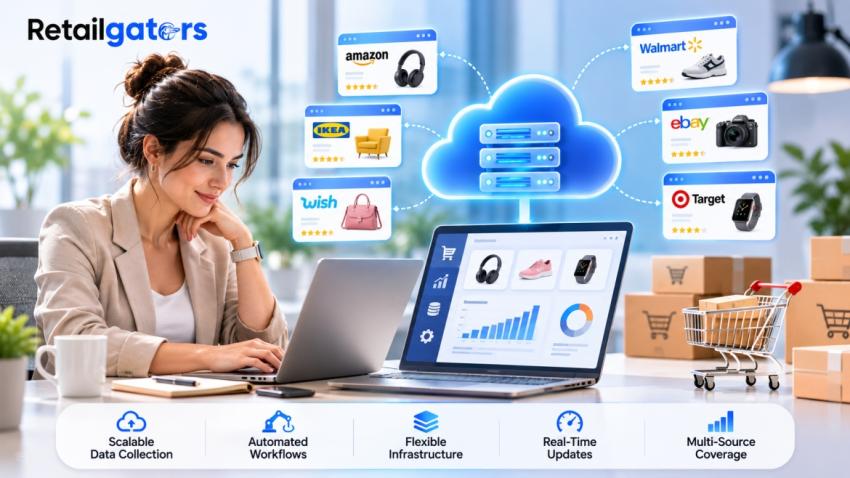
This is where Cloud Based Web Scraping becomes useful. Instead of relying on a single computer or a small script running at a fixed location, businesses can use cloud infrastructure to run data collection processes at scale and on a recurring schedule. For ecommerce teams, that can mean collecting product details, prices, availability, seller information, reviews, categories, and other public marketplace signals across large catalogs. The important part is not simply moving scraping to the cloud; it is creating a reliable data collection process that can grow as the business adds products, websites, markets, and monitoring requirements.
What Is Cloud-Based Web Scraping?
Cloud Based Web Scraping is the use of cloud computing resources to run web data collection workflows rather than depending entirely on a local machine or on-premise server. A business can use this approach to collect information from many ecommerce websites and marketplaces, process the data, store historical records, and repeat the workflow according to its business needs. The practical advantage is scale. Cloud resources can support larger workloads while separating collection, processing, storage, and reporting into manageable stages. For teams evaluating the approach in more detail, Cloud Based Web Scraping can be a relevant starting point for understanding a scalable data collection workflow.
Why Ecommerce Data Becomes Difficult to Manage at Scale
Ecommerce data looks simple until a business tries to maintain it continuously. A product may have several variants, different pack sizes, changing prices, multiple sellers, temporary promotions, and different availability states. The same product may also be represented differently across websites. A team that only collects the current price may therefore miss the context needed to understand what actually changed.
Monitoring 50 products manually is manageable; monitoring 50,000 products across several sources is an operational problem. Ecommerce data collection at that level requires consistent scheduling, data validation, product matching, storage, and monitoring. A scalable workflow can preserve historical observations and make them available for analysis instead of leaving teams with isolated snapshots.
How Cloud Web Scraping Supports Scalable Ecommerce Data Collection
The main strength of cloud web scraping is that it can support recurring collection across a large number of URLs and sources. Businesses can organize workloads by marketplace, category, country, product group, or monitoring frequency instead of running everything as one large task. This matters when the data requirement grows from a few hundred SKUs to thousands or when a company expands into additional marketplaces.
Cloud-based workflows can also separate different types of data jobs according to their importance. Product catalog information may need less frequent collection, while price or availability information may require more frequent checks. This makes it possible to design a monitoring process around the volatility of the data rather than treating every ecommerce page in exactly the same way.
What Ecommerce Data Can Businesses Collect?
The exact dataset depends on the business objective, but ecommerce collection commonly covers product titles, brands, categories, descriptions, specifications, variants, prices, discounts, availability, ratings, reviews, seller information, and promotional details. Businesses may also collect product identifiers where available, because consistent identifiers make it easier to match products across sources.
For brands and retailers, product-level collection can support very specific use cases. A furniture company may need product dimensions, materials, prices, and availability. A marketplace seller may need competitor listings and pricing. A manufacturer may want to understand how its products are represented across retail channels. For product matching and catalog analysis, UPC product scraping services can be relevant when UPC-based product identification is part of the requirement.
The same principle applies to category-specific monitoring. A retailer researching furniture competitors could use scrape IKEA product data as part of a broader assortment analysis, while a marketplace project may require scrape product data from Wish.com. The dataset should still be designed around the business question rather than collecting information simply because it is available.
Cloud-Based Web Scraping for Price and Availability Monitoring
Price and availability are among the most time-sensitive ecommerce signals. A product can move from in stock to unavailable, or from full price to promotion, without much warning. For businesses competing on price, a weekly snapshot may be too slow to explain what happened.
This is where recurring automated web scraping can become valuable. A monitoring workflow can collect the same product information repeatedly and preserve the results as historical records. Over time, the business can see how prices moved, when promotions appeared, how often products went out of stock, and whether competitors changed their offers around particular events. For use cases that require frequent pricing updates, live price crawling services can be relevant. The right monitoring frequency depends on the category and business objective; the goal should be useful data at an appropriate cadence, not simply collecting data as often as possible.
From Raw Data to a Usable Ecommerce Data Pipeline
Collecting web pages is only one part of a scalable system. Raw information needs to be cleaned, standardized, matched, stored, and delivered in a format that business teams can actually use. Otherwise, a company may end up with a large volume of records but very little usable intelligence.
A practical web scraping infrastructure typically has several connected layers. Data is collected from selected sources, normalized into consistent fields, checked for errors, matched against existing product records, and stored for historical analysis. The resulting dataset can then feed dashboards, analytics systems, internal databases, or other business applications.
Product matching is particularly important. A competitor may describe a product differently, use another product ID, or sell a different pack size. If those records are treated as identical without validation, pricing comparisons can become misleading. Good infrastructure therefore focuses not only on collection speed but also on data quality and consistency.
Why Different Ecommerce Use Cases Need Different Scraping Workflows
There is no single ecommerce dataset that works for every business. A brand monitoring its own products may care about price, seller visibility, promotions, and MAP compliance. A retailer may focus more heavily on assortment, stock status, competitor pricing, and category changes. A wholesaler may need product catalogs, specifications, and supplier information across many websites.
For wholesale businesses, wholesale data scraping can be relevant when the objective involves large product catalogs and related information. For brands concerned about advertised pricing, a MAP monitoring service may be more relevant because the business question is not simply “What is the price?” but “Where and how are products being advertised?” The infrastructure should serve the business objective rather than force every project into the same collection template.
Why Automated Web Scraping Is Better Suited to Large Catalogs
Manual collection becomes increasingly expensive as the number of products and sources increases. Teams have to revisit pages, copy information, check changes, update spreadsheets, and investigate discrepancies. Even when the process is carefully managed, historical coverage can be inconsistent.
With automated web scraping, recurring jobs can be scheduled and organized around monitoring requirements. The system can collect data, process it, store it, and make changes available for analysis without requiring someone to manually repeat the same task every day. Automation also makes it easier to connect collection with downstream processes: a pricing team can receive change alerts, an analyst can use historical datasets in a dashboard, and a category manager can review assortment changes.
What Businesses Should Look for in Cloud-Based Web Scraping
Businesses evaluating a cloud-based approach should look beyond whether a provider can collect data. They should consider whether the workflow can handle catalog size, source mix, update frequency, and data quality requirements. Scalability matters, but so do product matching, historical storage, monitoring frequency, error handling, data validation, delivery formats, API availability, and integration requirements.
The business question should come before the dataset. Price monitoring may require price history, promotions, availability, and product matching, while assortment intelligence may need category structure, variants, specifications, and new-product detection. A focused dataset is more useful than collecting everything simply because it is technically possible.
How RetailGators Can Support Scalable Ecommerce Data Collection
RetailGators provides ecommerce data solutions that can be structured around different retail and marketplace requirements, including product data, pricing, availability, competitor monitoring, and promotional intelligence. A business that needs a large-scale collection workflow can define the sources, products, fields, frequency, and delivery requirements around its particular use case.
For retailers comparing many competitors or markets, a retail data scraping service can be relevant when the objective involves structured product information, real-time pricing, and broader market insights. The important consideration is to build the workflow around the decisions the data needs to support, rather than treating scraping itself as the final objective.
Conclusion
Cloud Based Web Scraping helps businesses move ecommerce data collection from small, manual tasks toward repeatable workflows that can support larger catalogs, more sources, and recurring monitoring. The real advantage is not simply that data runs in the cloud. It is the ability to organize collection, processing, storage, and analysis into a system that can grow with the business.
For ecommerce teams, scalable web scraping provides a practical foundation for monitoring product information, prices, availability, promotions, sellers, and assortment changes. Combined with accurate product matching and historical storage, ecommerce data collection becomes much more useful for pricing teams, retailers, brands, analysts, and market intelligence teams. Businesses considering this approach should start with the decisions they want the data to support and then design the infrastructure around those requirements.
FAQs
What is Cloud Based Web Scraping?
Cloud Based Web Scraping uses cloud computing resources to collect, process, and manage data from websites at scale. It is particularly useful when businesses need recurring collection across large product catalogs, multiple sources, or different markets.
How does cloud web scraping help ecommerce businesses?
Cloud web scraping helps ecommerce businesses manage larger collection workloads without relying entirely on a local computer. It can support recurring product, price, availability, promotion, and competitor monitoring workflows.
Is cloud-based scraping suitable for large ecommerce catalogs?
Yes. Scalable web scraping is particularly useful for businesses monitoring thousands of products or multiple marketplaces. Workloads can be organized around product groups, sources, regions, and collection frequency.
What ecommerce data can be collected through cloud-based scraping?
Depending on the source and business requirement, ecommerce data may include product names, categories, specifications, prices, discounts, availability, ratings, reviews, sellers, variants, and product identifiers.
Why is web scraping infrastructure important for ecommerce data collection?
Web scraping infrastructure provides the foundation for collecting, processing, validating, storing, and delivering data consistently. Without these supporting processes, large volumes of collected information can be difficult to maintain or analyze.
Can cloud-based web scraping support frequent price monitoring?
Yes. A cloud-based workflow can support recurring and frequent monitoring when the source, technical setup, and business requirements allow it. The appropriate frequency depends on how quickly the relevant prices, inventory, or promotions change.