

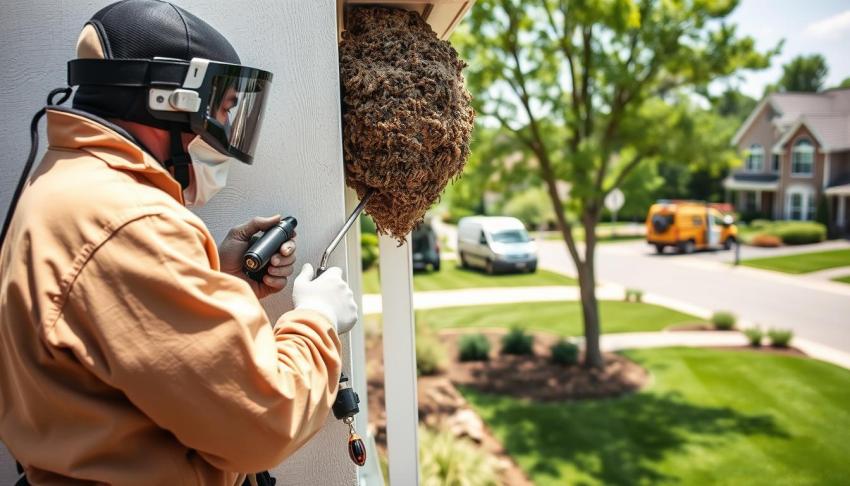
Flying insects around a home can be difficult to identify quickly. Bees and wasps may appear similar from several feet away.
Correct identification matters because their nesting habits can differ considerably. The right removal approach depends on what occupies the property.
Homeowners considering Bee & Wasp Removal in Sugar Land, TX should begin with careful observation.
Start With Body Shape
Bees often appear fuller or hairier than many common wasps. Wasps commonly have smoother bodies and more defined waists.
However, appearance should not be your only identification method. Distance, movement, and lighting can make visual identification difficult. Never approach an active nest simply to inspect the insects more closely.
Observe Their Flight Activity
Flight patterns can provide useful clues. Bees may repeatedly travel between flowers and an established nesting location.
Wasps may patrol food sources, structures, or outdoor gathering spaces. They can also move repeatedly around their nest entrance. Professional assessment may be needed when activity remains unclear.
Look at the Nesting Location
Nesting location provides valuable information. Honey bees may establish colonies inside walls, trees, roofs, or other protected cavities.
Wasps can build exposed nests beneath eaves or inside sheltered spaces. Some can also occupy structural or ground cavities. Bee Removal in Sugar Land may require access to comb inside a protected space. Wasp Removal in Sugar Land may involve a different nest structure entirely.
Examine the Visible Nest From a Distance
Never approach closely just to inspect nest material. Observe only when the nest can be viewed safely.
Some wasp nests have a paper-like appearance. Honey bee colonies create wax comb within their nesting areas. Many structural nests remain completely hidden. In these cases, insect movement provides more useful information than nest appearance.
Watch the Entry Point
Repeated entry through one small opening usually indicates nearby nesting activity. Pay attention to siding, roof edges, soffits, vents, and utility gaps.
Ground openings can also support certain stinging insect colonies. Do not block an entrance while insects remain active.
Professional Bee & Wasp Removal starts by locating active routes and likely nesting spaces.
Consider Where the Insects Are Gathering
Bees visiting flowering plants may simply be feeding. That activity does not automatically mean a colony occupies your property.
Wasps may gather around outdoor food, waste containers, or sweet drinks. Feeding activity also does not prove a nest is nearby.
Consistent travel toward one structural location provides stronger evidence.
Why Correct Identification Matters
Using the wrong approach can fail to address the actual nesting problem. Honey bee colonies may contain substantial comb and stored honey.
Wasp nests have different structures and removal requirements. Hidden locations can further change the necessary process.
Accurate identification makes Bee & Wasp Removal more targeted and efficient.
What If the Colony Is Inside a Wall?
Avoid sealing the entrance immediately. Active insects may search for another route after their usual opening disappears.
Indoor emergence can become possible when alternative pathways connect with occupied spaces.
A professional inspection can determine whether Bee Removal in Sugar Land or Wasp Removal in Sugar Land is appropriate.
What Should You Do Before Professional Help Arrives?
Keep children and pets away from active nesting locations. Close nearby windows and doors when insects are close to the building.
Avoid hitting, spraying, flooding, or burning nests. Do not attempt to open walls without knowing the colony's position.
Observe activity from a safe distance. Useful observations can support faster identification during the inspection.
How Can Future Nesting Be Reduced?
Inspect exterior surfaces regularly for developing gaps or damaged materials. Pay attention to roof edges, siding, vents, and utility penetrations.
Address appropriate openings after active colonies are removed. Keep outdoor waste covered and clean food spills promptly.
These measures cannot prevent every colony. However, they can reduce some attractive nesting and feeding conditions.
Final Thoughts
Body shape, nesting location, flight patterns, and nest materials can help distinguish bees from wasps. However, hidden colonies can make identification difficult.
Professional Bee & Wasp Removal can confirm the insect before removal begins. Choosing Bee & Wasp Removal near Sugar Land, TX is especially useful for concealed nests.
Proper Bee & Wasp Removal begins with identification and ends with practical prevention around the property.