A product can be useful, a message can be important, and a campaign can be carefully planned—yet audiences may still forget what they watched. Often, the problem is not the information itself but how that information is presented.
Creative 2D animation offers a way to transform ordinary messages into distinctive visual experiences through character design, expressive movement, color, and imaginative storytelling. Unlike conventional video production, animation allows creators to visualize situations that would be difficult, expensive, or impossible to film.
However, originality requires more than colorful illustrations. The strongest animated content combines artistic decisions with a clear understanding of audience expectations, communication goals, and emotional impact.
What Makes Creative 2D Animation Different From Standard Animation?
Not every animated video is designed to achieve the same result.
Some projects prioritize straightforward explanations, using simple icons, text, and predictable transitions. Others depend on distinctive characters, unusual visual metaphors, and carefully constructed narratives.
The difference lies in how creative choices contribute to communication.
Creative 2D animation emphasizes originality while maintaining clarity. Rather than relying exclusively on familiar visual templates, artists develop imagery that reflects the personality and purpose of a particular message.
For example, a financial planning application could explain savings through animated charts. Alternatively, it might represent financial decisions as a character navigating a changing landscape.
Both approaches can communicate useful information, but the second introduces opportunities for personality, humor, and emotional connection.
Creativity becomes valuable when it makes an idea easier to understand or remember, not simply when the artwork looks unusual.
Turn Abstract Ideas Into Recognizable Visual Stories
Many businesses communicate concepts that have no obvious physical appearance.
Trust, convenience, productivity, collaboration, and digital security are difficult to represent through conventional footage without relying on familiar stock imagery.
Animation provides greater freedom.
A cybersecurity company might illustrate online threats as mischievous creatures attempting to enter a digital city. Protective software becomes a coordinated defense system rather than an invisible technical process.
This type of visual metaphor makes abstract relationships easier to recognize.
However, metaphors require discipline.
If the comparison becomes too elaborate, viewers may spend more time interpreting the fictional world than understanding the intended message.
An effective creative concept should maintain a recognizable connection between the animated imagery and the real-world subject.
Build the Story Around One Central Idea
A short animated video rarely benefits from several competing creative concepts.
Consider a productivity platform that helps teams organize deadlines, conversations, and shared documents.
Instead of introducing separate metaphors for every feature, the animation could portray the entire workspace as a busy train station.
Tasks become arriving trains, deadlines become departure times, and the platform acts as the system coordinating movement.
One consistent visual concept creates continuity and gives viewers a familiar framework for understanding different features.
Character Design Gives a Brand Its Own Personality
Characters can communicate emotions and attitudes before a single word is spoken.
Their shapes, expressions, proportions, and movement styles influence how audiences interpret them.
Rounded shapes may suggest friendliness, while angular designs can communicate energy or tension, depending on their presentation.
Color choices also contribute to personality, although cultural context and overall composition affect how colors are perceived.
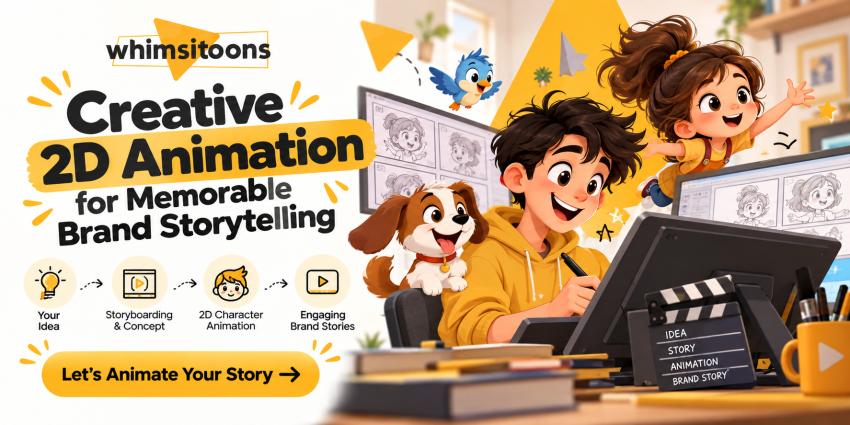
Creative brands such as Whimsitoons, associated with character animation and illustration, operate within a field where these artistic decisions are central to visual storytelling.
For a character-driven campaign, designers should establish recognizable features that remain consistent across scenes.
A character with an oversized backpack, distinctive hairstyle, and energetic walk can become identifiable even when viewed from a distance.
Consistency is particularly useful when the same character appears across advertisements, educational videos, and social media content.
Where a Creative 2D Animation Service Adds Value
Originality becomes more manageable when artistic exploration follows a defined communication objective.
A creative 2d animation service can support the development of visual concepts, character designs, storyboards, and animation styles suited to a particular message.
The most valuable creative decisions often happen before full animation begins.
Concept sketches allow teams to compare visual directions without committing to detailed production.
Storyboards reveal whether the narrative makes sense, while animatics—rough sequences of storyboard images with approximate timing—help evaluate pacing.
Suppose a sustainable packaging company wants to explain how its reusable containers circulate between restaurants, customers, and cleaning facilities.
A conventional video might use diagrams and arrows.
A more imaginative approach could follow one animated container as it travels through different environments, meeting characters who represent each stage of the system.
The recurring character gives the process continuity without requiring complicated technical explanations.
The key is ensuring that creative elements reinforce the actual process rather than misrepresenting it.
Use Movement to Direct Attention, Not Just Add Energy
Animation creates opportunities for expressive motion, but excessive movement can weaken communication.
When backgrounds, characters, typography, and decorative elements move simultaneously, viewers may struggle to identify the most important information.
This is a problem of visual hierarchy.
A well-designed sequence directs attention through timing, composition, contrast, and movement.
For example, an animated character might pause before revealing a surprising result. That brief stillness prepares the viewer for the next action.
Similarly, a product feature can appear through a simple transition rather than an elaborate sequence that distracts from its purpose.
Why Timing Changes Emotional Meaning
The same character movement can communicate different emotions depending on its speed and spacing.
A slow head turn may suggest curiosity or suspicion. A quick turn can imply surprise or excitement.
Animators also use anticipation, a preparatory movement that helps viewers understand an upcoming action.
A character bending its knees before jumping creates a more readable movement than suddenly moving upward without preparation.
These details make animation feel intentional and expressive.
Balance Artistic Freedom With Brand Recognition
One challenge in creative 2D animation is maintaining originality without losing the visual identity audiences already associate with a brand.
Creative exploration should account for established colors, typography, tone of voice, and design principles.
That does not mean every animated element must reproduce existing marketing materials exactly.
A brand with a restrained visual identity might introduce playful characters while retaining recognizable colors and graphic shapes.
The result can feel fresh without appearing disconnected.
When developing a campaign with Whimsitoons or another animation-focused creative provider, useful discussions include how the artwork will relate to existing brand assets and whether the visual language can support future content.
This is especially relevant for businesses planning recurring animated campaigns.
Designing reusable characters, backgrounds, and visual elements can help maintain continuity between projects, although reuse should be planned rather than assumed.
Test Creative Concepts Before Full Production
A creative idea may appear promising in a presentation but become confusing when viewers encounter it without explanation.
Testing early concepts can reveal problems before substantial animation work begins.
Useful review methods include:
Silent viewing: Check whether the central action remains understandable without narration.
Storyboard review: Confirm that visual transitions communicate a logical sequence.
Audience feedback: Ask representative viewers what they understood rather than whether they liked the artwork.
Brand recognition checks: Evaluate whether the content feels connected to the intended organization.
Small-screen testing: Make sure expressions, text, and important visual details remain readable on mobile devices.
These checks are particularly useful when experimenting with unusual characters or abstract visual metaphors.
A creative 2d animation service should also be able to explain why a proposed artistic direction supports the video's objective.
A visually impressive concept that obscures the message may require simplification rather than additional detail.
Make Creativity Serve a Lasting Purpose
Memorable animation is rarely the result of decoration alone. Its effectiveness comes from the relationship between storytelling, design, movement, and the audience's ability to understand what is happening.
Creative 2D animation gives brands opportunities to develop distinctive visual identities, explain abstract subjects, and communicate through characters and imaginative environments. Yet those opportunities become meaningful only when artistic choices support a clear purpose.
Whimsitoons is associated with animation and visual storytelling services that fit within this broader creative discipline, where character development and thoughtful visual communication play important roles.
Before developing an animated campaign, identify the emotion, idea, or action viewers should take away from the experience. Then evaluate every visual concept against that objective.
Originality can attract attention, but purposeful creativity gives audiences something worth remembering.