Data privacy has become an important consideration for organisations operating in India. With the Digital Personal Data Protection (DPDP) Act, 2023, businesses that collect and process digital personal data need to establish appropriate processes for managing personal information and protecting the rights of Data Principals.
As organisations handle personal data across websites, mobile applications, customer platforms, employee systems, and third-party services, managing privacy activities manually can become increasingly difficult. A DPDP Compliance Platform can help businesses organise these activities through centralised workflows for consent management, privacy requests, data governance, compliance records, and related processes.
In this article, we explore 10 DPDP compliance platforms that businesses in India can consider when developing or improving their data privacy programmes.
What Is a DPDP Compliance Platform?
A DPDP Compliance Platform is software designed to help organisations manage different aspects of their data privacy and compliance processes.
Depending on the solution, a platform may provide capabilities such as:
Consent management
Consent withdrawal
Data Principal rights management
Personal-data discovery
Data mapping
Privacy request workflows
Grievance management
Cookie and tracker management
Compliance documentation
Audit trails
Privacy reporting
The exact features vary between platforms, so businesses should assess solutions according to their specific data environment and privacy requirements.
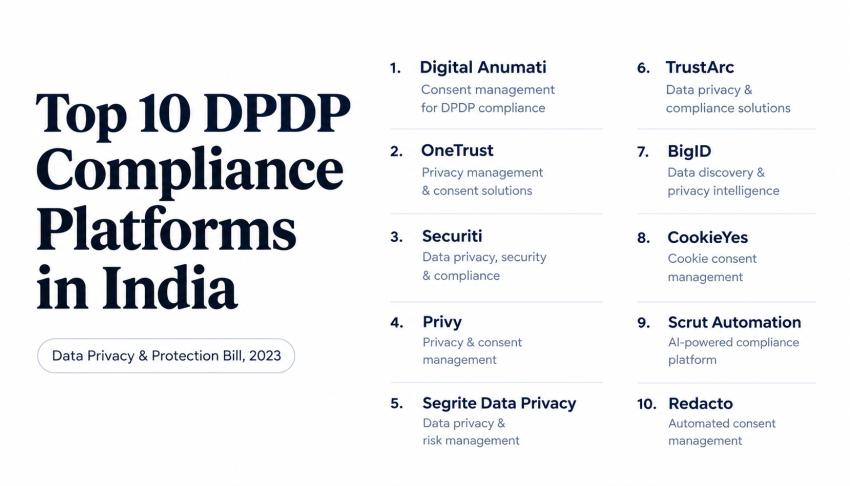
Top 10 DPDP Compliance Platforms in India
1. Digital Anumati
Digital Anumati is an India-focused DPDP Compliance Platform and consent management solution designed to help organisations manage digital personal data and privacy processes through a centralised system.
The platform brings together privacy capabilities such as consent management, consent withdrawal, Data Principal rights management, data discovery, data mapping, grievance management, cookie and tracker governance, and audit trails.
One of the platform's key areas of focus is the Indian market. Digital Anumati supports more than 22 Indian languages, helping organisations create consent and privacy experiences for users across different regions and language preferences.
The platform also provides APIs, SDKs, and integration capabilities, allowing organisations to connect privacy and consent workflows with existing applications and technology infrastructure.
Its solutions are designed for sectors such as BFSI, healthcare, education, and other industries that process significant amounts of personal data.
For organisations looking for an India-focused DPDP Compliance Platform to manage consent, privacy requests, data governance, and DPDP-related workflows, Digital Anumati offers a centralised approach to privacy management.
2. OneTrust
OneTrust is a global privacy management platform offering capabilities across consent management, privacy operations, data governance, risk management, and regulatory compliance.
Its broad range of privacy tools can be relevant to organisations managing privacy requirements across India and other international markets.
Businesses operating across multiple jurisdictions can consider its wider privacy management capabilities when developing a structured privacy programme.
3. Securiti
Securiti provides solutions covering data privacy, security, governance, and data intelligence.
Its platform helps organisations discover and manage personal and sensitive information across complex data environments. By combining data intelligence with privacy workflows, it can support businesses that need greater visibility into their data landscape.
4. Privy by IDfy
Privy by IDfy is a privacy management solution focused on helping businesses manage data protection and privacy operations.
Its capabilities include areas such as consent management, personal-data management, privacy workflows, and compliance activities, with a focus on businesses operating in the Indian market.
5. Seqrite Data Privacy
Seqrite Data Privacy is part of the broader Seqrite cybersecurity ecosystem and focuses on data privacy and protection.
It can be considered by organisations looking to manage privacy requirements alongside cybersecurity and information-security practices.
For businesses seeking to bring privacy and security activities closer together, solutions within a broader cybersecurity ecosystem may be relevant to their overall governance approach.
6. TrustArc
TrustArc is a privacy management platform that provides capabilities for managing privacy programmes, assessments, risks, compliance activities, and regulatory requirements.
Its platform is relevant to organisations that operate across multiple jurisdictions and need a broader framework for managing privacy programmes and regulatory obligations.
7. BigID
BigID focuses on data discovery, classification, privacy, and data intelligence.
The platform helps organisations identify and understand where personal and sensitive information exists across databases, cloud environments, applications, and other data sources.
This type of data visibility can support organisations in developing broader data governance and privacy processes.
8. CookieYes
CookieYes primarily focuses on website cookie consent and privacy management.
Its capabilities include cookie banners, consent preference management, consent records, and website-related privacy functions.
It can be particularly relevant for organisations that need to manage cookie consent and privacy experiences across their websites.
9. Scrut Automation
Scrut Automation provides compliance and security automation solutions designed to help organisations manage controls, evidence, risks, and compliance workflows.
Businesses can consider such platforms when they want to automate broader governance, risk, and compliance activities as part of their overall compliance programme.
Its focus extends beyond privacy alone, making it relevant for organisations looking at privacy within a wider compliance and security framework.
10. Redacto
Redacto is a privacy-focused solution designed to help organisations manage personal-data protection and privacy processes.
It can be considered by businesses looking to introduce a more structured approach to privacy management and organise activities associated with data protection and compliance.
Why Do Businesses Need a DPDP Compliance Platform?
As organisations grow, personal data can move across multiple systems, departments, applications, and third-party services.
Managing privacy activities manually through spreadsheets, emails, and disconnected systems can make it harder to maintain visibility and consistency.
A DPDP Compliance Platform can help bring different privacy activities into a centralised and trackable workflow.
Depending on the platform, businesses may use it for:
Consent collection and management
Consent withdrawal
Data Principal request management
Personal-data discovery
Data mapping
Privacy documentation
Cookie and tracker management
Grievance management
Compliance records
Audit trails
Privacy reporting and monitoring
The objective is to create a more organised approach to privacy operations as the organisation and its data environment grow.
Key Features to Look for in DPDP Compliance Software
Not every privacy platform offers the same capabilities. Before selecting a solution, organisations should evaluate the features that align with their business, technology environment, and privacy requirements.
1. Consent Management
A platform should provide appropriate mechanisms to collect, record, manage, and withdraw consent where consent is the applicable basis for processing.
Organisations should also consider how easily consent workflows can be integrated into websites, applications, and other digital experiences.
2. Data Principal Rights Management
Businesses should look for workflows that help them receive, track, assign, and manage applicable requests from Data Principals.
Centralised request management can make it easier for relevant teams to monitor the status of privacy requests.
3. Data Discovery and Mapping
Understanding where personal data is collected, stored, processed, and shared is an important part of privacy management.
Data discovery and mapping capabilities can provide organisations with greater visibility into their data environment.
4. Audit Trails
Privacy activities should be appropriately recorded so organisations can review relevant actions and events.
Audit trails can help provide visibility into what happened, when it happened, and how privacy workflows were handled.
5. Integration Capabilities
APIs, SDKs, plugins, and other integration options can make it easier to connect privacy functions with existing websites, applications, CRM systems, databases, and business platforms.
6. Multilingual Support
Businesses serving users across different parts of India may benefit from multilingual consent and privacy experiences.
Language support can help make privacy notices and consent interactions more accessible to users.
7. Scalability
A privacy platform should be capable of supporting an organisation as its number of users, applications, data sources, and privacy processes increases.
Scalability is particularly relevant for businesses that expect their digital operations and data volumes to grow over time.
Conclusion
As businesses in India increasingly collect and process digital personal data, structured privacy management is becoming an important part of their operations.
A DPDP Compliance Platform can help organisations bring activities such as consent management, Data Principal requests, data discovery, privacy workflows, governance, and audit records into a more organised system.
The right solution will depend on the organisation's specific requirements, technology environment, industry, and data-processing activities. Businesses should therefore assess platforms based on the capabilities they actually need and how effectively each solution can fit into their broader privacy, security, legal, and governance framework.
Frequently Asked Questions
Q1. What is a DPDP Compliance Platform?
A1. A DPDP Compliance Platform helps organisations manage privacy activities such as consent, Data Principal requests, data mapping, and compliance records.
Q2. Why do businesses need a DPDP Compliance Platform?
A2. It can help businesses organise personal-data privacy processes and reduce reliance on manual workflows.
Q3. What features should a DPDP Compliance Platform have?
A3. Common features include consent management, data discovery, privacy request management, audit trails, integrations, and reporting.
Q4. Is Digital Anumati a DPDP Compliance Platform?
A4. Digital Anumati is an India-focused DPDP Compliance Platform designed to support consent and privacy management.
Q5. Can DPDP platforms manage consent withdrawal?
A5. Platforms with consent management capabilities can help organisations record, manage, and process consent withdrawals.
Q6. Can these platforms handle Data Principal requests?
A6. Many privacy platforms provide workflows to receive, track, assign, and manage applicable Data Principal requests.
Q7. Do DPDP Compliance Platforms support multiple languages?
A7. Some platforms offer multilingual capabilities to help businesses create more accessible privacy and consent experiences.
Q8. Can a DPDP platform integrate with existing systems?
A8. Many platforms provide APIs, SDKs, plugins, or other integration options for connecting with existing websites and applications.
Q9. Does using a DPDP platform guarantee compliance?
A9. No, Organisations also need appropriate policies, processes, security measures, contracts, governance, and employee awareness.
Q10. How should businesses choose a DPDP Compliance Platform?
A10. Businesses should evaluate features, integrations, scalability, language support, data-management capabilities, and alignment with their specific privacy requirements.