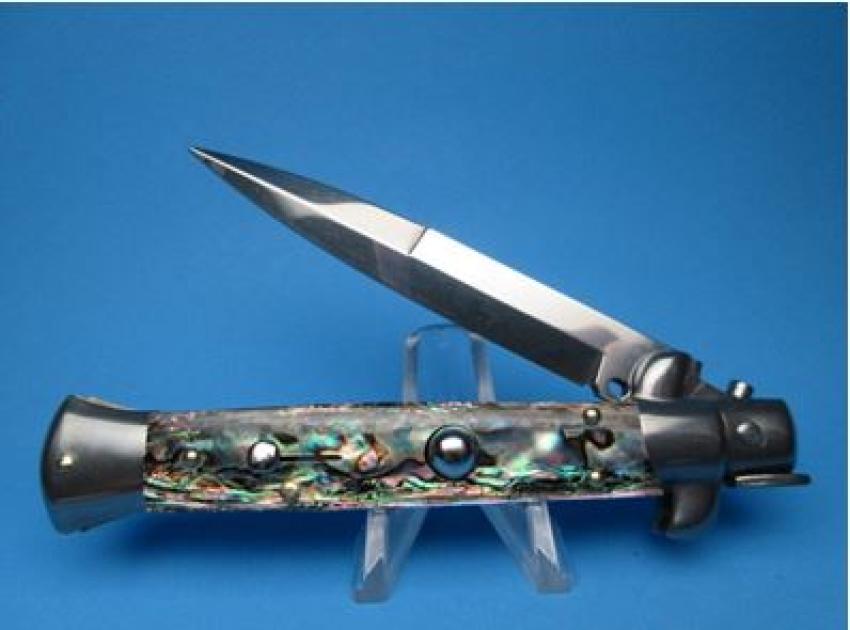
The history and evolution of knife designs may be very exciting and give us a lot of useful information about the craftsmanship, cultural phenomena, and technological progress. There are many historical trends in knives, but one of the most significant is the trend of elegant, slender stiletto knives because of its beautiful design and association with European knife-making.
Stiletto switchblades are the modern versions of the blade design trend that includes the combination of classical design and an automatic opening mechanism of the blade. The history of Italian stiletto knives is tightly related to the history of folding knives and technological advancements in knife manufacture during the 19th and 20th centuries. Automatic pocket knives of Italy gained popularity due to their classical design and popular culture influence.
Five Important Points of Stiletto Switchblades That Collectors Often Miss
1. Blade and Handle Design Features
Don’t stop at simply analyzing the general shape of a historic Italian stiletto. Blade dimensions, handle design, material, decoration, bolsters, and other minor things may become crucial when discerning different types and generations of knives. The smallest difference in any of these aspects may be helpful in figuring out where and when a certain knife was made.
2. Materials and Workmanship
Certain materials and methods of construction may be indicative of the historical nature of an artifact. In certain situations, depending on the period and artisan, the handles, blades, hardware, and other aspects could reveal a particular manufacturing process and materials that were used at that time. This may be helpful when trying to determine the historical nature of an artifact.
3. Maker’s Marks, Provenance, and Authenticity
The manufacturer’s marks or other details, such as engravings on stiletto switchblades, can be useful in the research of the object. Provenance, which is the record of its history of ownership or origins, can also serve as an extra source for information on where and when the item may have been made or obtained. It is important for collectors to keep in mind that copies, forgeries, repairs, and misidentifications can also make the research more difficult.
4. Condition, Restoration and Originality
Condition is another important element in studying historical objects. Examples such as deterioration, repairs, changes, or damage could serve to illuminate the past history of the object. In cases of restoration, an object is saved but also partly transformed. Recording any changes can be useful for knowing the state of an object at the present time. Identifying what part of the object is original can provide more information on its history.
5. Legal Issues Collectors Need to Be Aware of
Before buying the best stiletto switchblades for collectors and enthusiasts, one should further consider the Legal obligations related to such Italian knives. Such legal protocols will vary depending on the country, state, city, or any other jurisdiction that you happen to be in. Laws can concern possession, acquisition, transport, import, or any other situation. A person who is looking at a historical example will need to check the existing laws relevant to where they live instead of outdated laws. Knowing legal obligations will help in keeping history and practicality apart.
Conclusion
It is important to look at more than just the look of a knife to understand the history of a piece. For stiletto switchblades, there is more information available for collectors to analyze that will provide additional perspective on a particular blade. The following are five aspects that are usually ignored when analyzing such a knife but should be considered to understand the knife's history better. These areas are also part of a responsible and research-oriented process, which involves consulting relevant references and considering pertinent legal issues before buying, owning, or transporting a piece.
FAQs
1. How does the age of the stiletto automatic knife from Italy influence its historical value?
The age of a stiletto automatic knife may be one of the factors that add to its historical value, especially in cases where there is factual evidence concerning its period of manufacture, design, and condition.
2. Is ownership of stiletto switchblades legal?
The legality of owning automatic pocket knives varies depending on where one lives. One should, therefore, verify the laws that apply in their locality before obtaining such an item.
3. Why is condition important in studying these knives?
Condition is important as wear and tear, corrosion, restoration, replacements, and alterations may offer information about the history and authenticity of a knife.
4. What are some qualities that make automatic stilettos distinct?
Traditional stilettos typically have qualities such as slim, tapering blades, long handles, and automatic blade openings.
5. Are reproductions of the Italian stiletto knife available?
There are reproductions of automatic pocket knives, and they can be almost exact copies of historical knives.