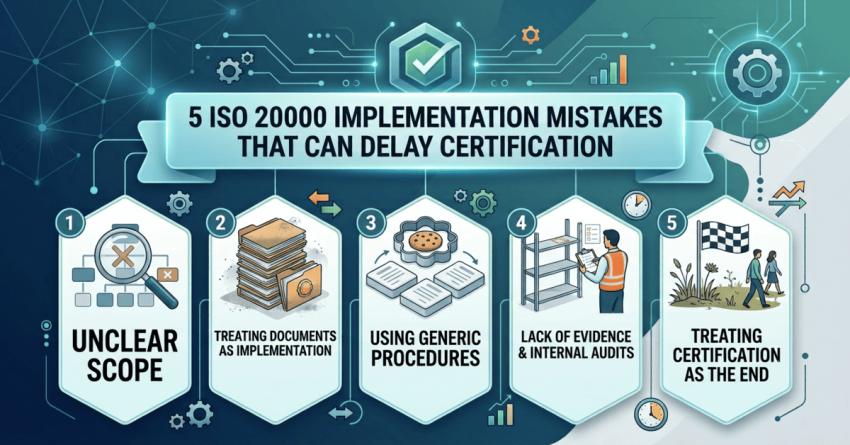
ISO 20000 implementation can become time-consuming when organizations overlook planning and focus mainly on preparing documents for the certification audit. A successful Service Management System (SMS) should reflect how IT services are planned, delivered, monitored, and improved. Avoiding common ISO 20000 implementation mistakes can reduce rework and improve audit readiness.
1. Starting Without a Clear Service Management Scope
A common mistake is failing to clearly define the scope of the service management system. Organizations may begin preparing procedures before deciding which IT services, locations, departments, suppliers, and activities are covered.
A clear scope establishes the boundaries of the SMS and determines which ISO 20000 requirements apply. It helps employees understand responsibilities and gives auditors a clear view of the included services.
Before developing an implementation plan, identify services, interested parties, requirements, supporting processes, and responsibilities.
2. Treating ISO 20000 Documentation as the Implementation
Another mistake is believing that creating policies and procedures means the SMS has been implemented. Documentation is important, but it should support processes that are actually operating.
ISO 20000 documentation may include policies, service management plans, procedures, forms, records, and other controlled documented information. These documents should explain activities and provide evidence that processes are followed.
Organizations looking for a structured starting point can use editable ISO 20000 documents and customize them according to their services, processes, responsibilities, and organizational requirements. This can reduce the effort involved in developing documentation.
3. Using Generic Procedures Without Aligning Them with IT Services
Generic procedures can create problems when they do not match actual operations. For example, an incident management procedure should reflect how incidents are reported, categorized, assigned, resolved, and reviewed.
During ISO 20000 implementation, each procedure should be reviewed with responsible employees. Responsibilities, approvals, escalation routes, forms, records, and service-specific requirements should be defined.
4. Failing to Maintain Evidence and Conduct Internal Audits
A further mistake is concentrating on written procedures while overlooking records generated from those processes. Auditors need evidence that the service management system is implemented.
Organizations should retain relevant records such as service performance results, incidents, changes, supplier evaluations, training, internal audit results, corrective actions, and management review outputs, as applicable.
Internal audits should be conducted before the ISO 20000 certification audit. An ISO 20000 audit checklist can help the implementation team review requirements, identify gaps, and verify whether sufficient evidence is available.
5. Treating Certification as the End of the Process
Some organizations focus on passing the initial audit and fail to maintain the system afterward. ISO 20000 requires an approach that supports ongoing monitoring and continual improvement.
IT services, technologies, customer expectations, suppliers, and operational risks can change. The SMS should therefore be reviewed periodically using service performance information, audit findings, incidents, feedback, corrective actions, and management review results.
Continual improvement helps keep the service management system relevant instead of allowing procedures and records to become outdated.
Make ISO 20000 Implementation More Manageable
Avoiding these ISO 20000 implementation mistakes can help reduce rework and improve certification readiness. A defined scope, practical processes, customized ISO 20000 documentation, reliable records, internal audits, and continual improvement provide a stronger foundation for an effective SMS.
Rather than preparing documents only to satisfy an auditor, organizations should develop an IT service management system that employees can use consistently in everyday operations. This approach can support ISO 20000 compliance and service management improvement.