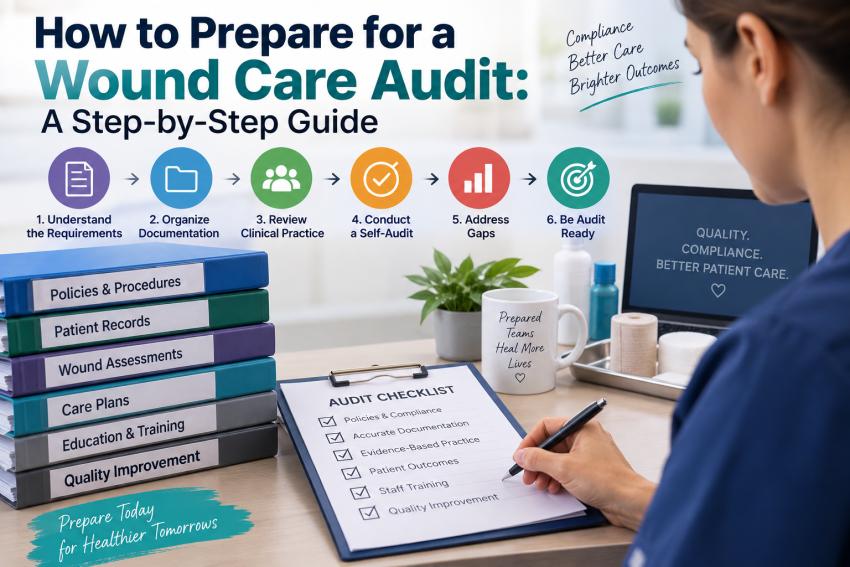
A wound care audit can place significant pressure on a practice, particularly when Medicare claims, medical necessity, debridement documentation, and coding accuracy are being reviewed. Effective preparation starts well before an audit notice arrives. By maintaining complete records, reviewing claims consistently, and aligning documentation with the services reported, we can reduce avoidable compliance problems and respond more confidently to an audit.
Medicare’s Targeted Probe and Educate (TPE) process is designed to identify claim errors and provide education to selected providers. A traditional TPE round generally reviews 20 to 40 claims and their supporting medical records, although sample sizes can vary. The process can continue for up to three rounds when compliance concerns remain.
For wound care practices, strong audit preparation should focus on documentation, medical necessity, coding, billing records, and consistency across the entire patient record.
What Is a Wound Care Audit?
A wound care audit is a structured review of medical records and claims to determine whether billed services are supported by documentation and applicable Medicare requirements.
Depending on the review, auditors may examine:
Wound assessment and measurements
Medical necessity
Debridement documentation
CPT and ICD-10-CM coding
Treatment plans
Procedure notes
Modifiers
Provider signatures
Patient progress
Frequency and duration of services
Supporting photographs or other clinical evidence
CMS states that common claim problems can include missing signatures, incomplete documentation, and records that do not adequately support medical necessity.
Step 1: Identify the Claims and Services Most Likely to Be Reviewed
We should begin by identifying services that represent a substantial portion of the practice's wound care billing or have historically generated documentation concerns.
Debridement services deserve particular attention because the billed code must correspond to the tissue actually removed and the documented depth and characteristics of the wound. CMS guidance emphasizes that the medical record should support the type of tissue removed, wound depth, wound size, and other relevant characteristics.
We should also review claims involving:
Surgical debridement
Selective debridement
Skin substitute applications
Same-day E/M services
Modifier 25 or 59
Repeated or prolonged wound care
High-frequency services
The goal is not simply to find a diagnosis or procedure code. We need to confirm that the entire record supports the service billed.
Step 2: Perform a Complete Medical Record Review
Before an external audit, we should conduct an internal chart audit.
For each selected claim, compare the claim against the corresponding medical record. Confirm that the diagnosis, procedure, date of service, provider, units, and billed code are consistent.
A useful internal review should answer:
What condition was treated?
Why was the service medically necessary?
What treatment was actually performed?
Does the procedure note describe the service sufficiently?
Does the CPT code match the documented procedure?
Does the diagnosis support the service?
Are required signatures and dates present?
Is the patient's progress documented?
This review can identify recurring problems before they become part of an external audit.
Step 3: Strengthen Wound Documentation
Wound documentation is one of the most important elements of audit preparation.
Records should clearly identify the wound location, size, depth, stage when applicable, tissue characteristics, and relevant clinical findings. CMS wound care guidance also emphasizes documenting medical necessity and objective evidence of treatment response.
For debridement services, the procedure note should provide enough detail to establish what was removed and how the procedure was performed.
Documentation may include:
Anatomical wound location
Length, width, and depth
Wound bed characteristics
Necrotic or devitalized tissue
Tissue removed
Depth of tissue removed
Instruments or method used
Anesthesia, when applicable
Immediate post-procedure care
Follow-up instructions
Patient response
Treatment goals
Photographs can also provide useful supporting evidence, particularly for prolonged or repetitive debridement services.
Step 4: Verify Medical Necessity
Correct coding does not automatically establish medical necessity.
We should ensure the record explains why the service was reasonable and necessary for the patient's condition on the specific date of service. CMS guidance states that wound care documentation should demonstrate medical necessity and, where applicable, objective evidence of ongoing benefit.
For ongoing treatment, the record should demonstrate whether the wound is improving, worsening, or remaining stable and whether the treatment plan is being adjusted when appropriate.
If a wound is not responding as expected, the documentation should address relevant factors affecting healing and any changes made to the treatment approach.
Step 5: Review Debridement Coding
Debridement coding requires particular attention because the code should correspond to the actual tissue removed.
For example, documentation of exposed bone does not by itself establish that bone debridement was performed. CMS specifically notes that CPT 11044 cannot be reported simply because bone is exposed when the procedure did not remove bone.
We should therefore compare:
Documented tissue removed → documented depth → wound characteristics → CPT code submitted
Any mismatch should be investigated before claims are submitted or included in an audit response.
Step 6: Check Same-Day E/M Services and Modifiers
Same-day services should receive an additional review when an E/M code is billed with a wound procedure.
CMS states that an E/M service provided on the same day as surgical debridement may be payable when documentation establishes that it was a separately identifiable, reasonable, necessary, and distinct service from the debridement.
We should not rely on the modifier alone. The medical record needs to demonstrate the circumstances supporting the separately reported service.
The same principle applies when reviewing modifier 59 or other modifiers: the documentation must support the circumstances represented on the claim.
Step 7: Organize Records Before an Audit Request
When an audit or Additional Documentation Request (ADR) arrives, organization becomes critical.
We should establish a consistent process for collecting:
Medical records
Procedure notes
Treatment plans
Claim forms
Relevant orders
Diagnostic information
Photographs, when applicable
Provider signatures
Supporting correspondence
CMS explains that TPE reviews use an ADR to identify the claims and documentation required for review.
The response should contain the requested records in an organized format and within the applicable deadline. We should also retain documentation showing what was submitted.
Step 8: Use Internal Audits as an Ongoing Process
Audit preparation should not begin only after receiving an audit notice.
A regular internal review can help identify patterns such as:
Missing wound measurements
Inconsistent procedure notes
Incorrect debridement levels
Unsupported modifiers
Missing signatures
Diagnosis-code mismatches
Incomplete treatment plans
Repeated services without adequate progress documentation
Using Woundcare billing services as part of a broader revenue-cycle and compliance process can also help practices review claims, identify documentation gaps, and monitor recurring billing issues without replacing the provider's responsibility for accurate clinical documentation.
FAQ
What documents should we prepare for a wound care audit?
We should generally be prepared to provide the medical records and supporting documentation requested by the reviewing contractor. Depending on the audit, this can include procedure notes, wound assessments, treatment plans, orders, photographs, and other records supporting the billed services.
What is Medicare TPE?
Medicare's Targeted Probe and Educate program is a medical review process in which MACs focus on specific providers and services based on identified compliance concerns. Traditional TPE generally involves 20 to 40 claims per round, with education provided when errors are identified.
What should a debridement note include?
A debridement note should clearly document the wound location and characteristics, tissue removed, depth, area, procedure method, medical necessity, and relevant post-procedure care. Specific requirements can depend on the applicable Medicare contractor policy.
Can an E/M service be billed with debridement?
It can be payable in appropriate circumstances when the E/M service is separately identifiable, reasonable and necessary, and distinct from the debridement. The documentation must support the additional service.
Conclusion
Effective wound care audit preparation depends on making every claim traceable to clear clinical documentation. We should routinely verify medical necessity, wound measurements, tissue depth, procedure details, coding, modifiers, signatures, and treatment progress.
A consistent internal audit process allows documentation problems to be identified before they become external audit findings. By treating compliance as an ongoing part of wound care billing rather than a response to an audit notice, practices can create records that more clearly support the services they report and respond to Medicare reviews with greater confidence.