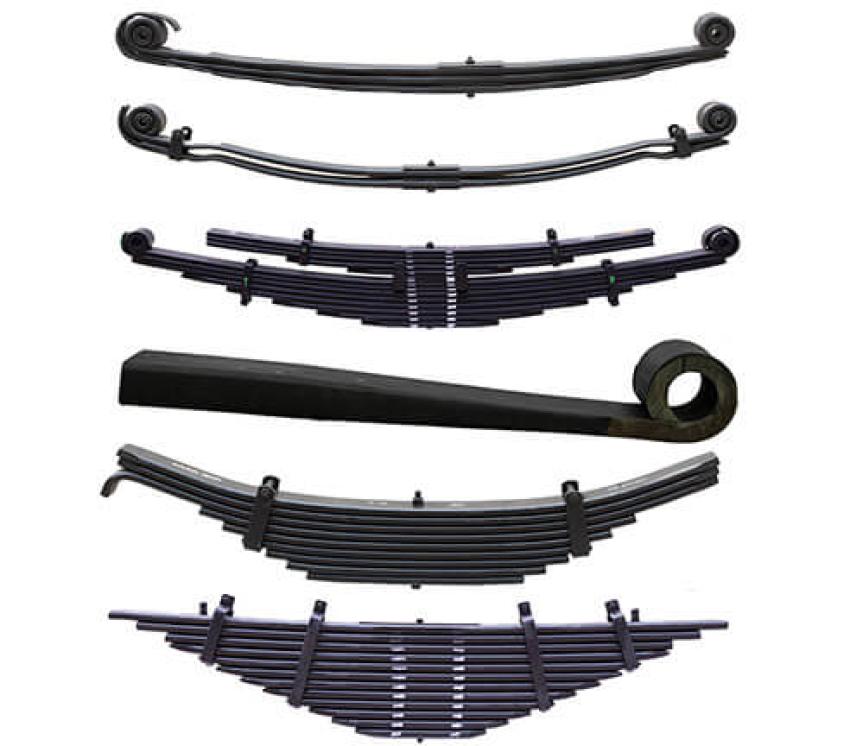
Leaf springs are designed to support vehicle loads while allowing the suspension to flex under changing road and operating conditions. Although several factors determine how much load a leaf spring can safely carry, the thickness and width of the spring leaves are two of the most important dimensional parameters.
A small change in either dimension can significantly alter the spring's stiffness, stress distribution, deflection, and fatigue behaviour. However, thickness and width do not influence load capacity in the same way. Increasing leaf thickness has a particularly strong effect on bending stiffness and stress, while increasing width generally increases the spring's ability to distribute load across a wider section.
This is why leaf spring dimensions cannot be selected simply by making the spring thicker or wider. The dimensions have to be matched with the required load, spring deflection, available space, axle configuration, material properties, and expected service conditions.
Why Leaf Spring Dimensions Matter
A leaf spring primarily works as a flexible beam. When a vehicle is loaded, the spring bends as it supports the axle and transfers the vehicle's weight to the chassis.
During this bending, stresses develop through the thickness of the spring material. The upper and lower regions of the leaf experience the highest bending stresses, while the neutral region experiences comparatively lower bending stress.
The dimensions of the leaf therefore have a direct effect on how efficiently it can resist bending.
For a rectangular leaf section, the second moment of area about its bending axis is proportional to:
I = bt³ / 12
where:
- I = second moment of area
- b = leaf width
- t = leaf thickness
The important point is the third-power relationship with thickness. Width has a direct linear relationship, while thickness has a much stronger effect on bending stiffness.
This difference is fundamental to understanding why a relatively small increase in leaf thickness can produce a substantial increase in stiffness.
Effect of Leaf Spring Thickness on Load-Carrying Capacity
Thickness is one of the most influential dimensional variables in leaf spring design.
When the thickness of a leaf increases, its resistance to bending increases significantly. Because bending stiffness is related to the cube of thickness, increasing thickness can produce a disproportionately large change in stiffness.
For example, if the thickness is increased by 10%, the theoretical bending stiffness associated with the section increases by approximately:
1.1³ = 1.331
or about 33%, assuming the other dimensions and material properties remain unchanged.
This does not mean that the spring's permissible vehicle load automatically increases by 33%. Actual load capacity depends on the complete spring design, including leaf length, curvature, number of leaves, material strength, stress concentration, mounting arrangement, and required fatigue life.
Nevertheless, the example illustrates why thickness is such a powerful design parameter.
Thickness and Bending Stress
For a rectangular section subjected to bending, the nominal bending stress is related to the section modulus:
Z = bt² / 6
and:
σ = M / Z
where:
- Z = section modulus
- M = bending moment
- σ = bending stress
Since the section modulus varies with the square of thickness, increasing thickness reduces bending stress for a given bending moment.
This is particularly important in heavy-duty applications where the spring may experience high static loads as well as repeated dynamic loading.
However, excessive thickness can create another problem: the spring becomes significantly stiffer. A spring that is too stiff may not provide the required suspension deflection and can transfer higher forces into other suspension and chassis components.
Therefore, the objective is not simply to maximise thickness. The thickness must provide the required strength and fatigue resistance while maintaining the intended spring rate and deflection.
Effect of Leaf Spring Width
Width also affects the load-carrying characteristics of a leaf spring, but its influence differs from thickness.
For a rectangular section, the second moment of area is directly proportional to width:
I ∝ b
Therefore, increasing the width increases bending stiffness approximately in direct proportion, provided the other parameters remain unchanged.
For example, increasing leaf width by 10% would theoretically increase the section's second moment of area by approximately 10%.
A wider leaf also provides a larger cross-sectional area for carrying load and increases the section modulus. This can reduce nominal bending stress for a given bending moment.
Why Width Is Important in Heavy-Duty Springs
Increasing width can be useful when the design requires greater load distribution without increasing thickness excessively.
A wider spring can distribute forces over a larger section, which can be advantageous in applications where the spring must support substantial loads over long service periods.
However, increasing width also has practical limits.
The spring must fit within the available suspension packaging. Its width has to be compatible with spring seats, axle attachments, clamps, bushes, shackles, and other components.
A wider leaf may also change the contact conditions between individual leaves in a multi-leaf spring.
Consequently, width should be considered as part of the entire suspension design rather than as an independent way of increasing load capacity.
Thickness Has a Stronger Effect Than Width
One of the most important distinctions in leaf spring design is that thickness and width do not contribute equally to bending stiffness.
For a rectangular leaf:
Bending stiffness ∝ width × thickness³
This means thickness has a cubic influence, whereas width has a linear influence.
Consider two hypothetical design changes:
- Increasing width by 20% → approximately 20% increase in the section's second moment of area.
- Increasing thickness by 20% → approximately 73% increase in the second moment of area, because 1.2³ = 1.728.
Again, these are theoretical section-property comparisons, not direct predictions of vehicle load capacity.
The practical consequence is that designers can make significant changes to spring stiffness and stress simply by modifying thickness.
This is one reason why controlling leaf thickness accurately during manufacturing is critical.
Thickness, Width and Spring Deflection
Load-carrying capacity cannot be considered separately from spring deflection.
When a vehicle is loaded, the leaf spring needs to deflect through a designed range. If the spring is excessively stiff, it may not provide enough deflection under the intended load.
Conversely, if the spring is too flexible, it may deflect excessively and approach a condition where stresses become unacceptable or the suspension reaches its available travel.
Thickness and width therefore influence the relationship between load and deflection, commonly described through spring rate.
A thicker leaf generally produces a substantial increase in stiffness. Increasing width also increases stiffness, but less dramatically for the same percentage change.
For a spring manufacturer, the objective is to achieve the required load-deflection characteristics rather than simply producing the strongest possible leaf.
Influence on Stress and Fatigue Life
A leaf spring does not experience only one loading event. Commercial vehicles, trucks, trailers and buses can subject their springs to thousands or millions of load cycles during service.
Repeated bending can eventually lead to fatigue failure if stresses become sufficiently high.
Leaf thickness and width influence fatigue behaviour because they affect the stress level generated by a particular bending moment.
Increasing thickness increases section modulus strongly, allowing the leaf to resist bending with lower nominal stress. Increasing width also increases section modulus, although the relationship is less pronounced.
However, fatigue performance is not determined by dimensions alone.
Material quality, heat treatment, surface condition, shot peening, residual stresses, corrosion, manufacturing defects, eye geometry and stress concentrations can all influence fatigue life.
For this reason, increasing the dimensions of a spring should not be considered a substitute for proper material and manufacturing control.
Thickness and Width in Multi-Leaf Springs
In a multi-leaf spring, several leaves work together to support the load.
The leaves may not all have the same length. The main leaf generally incorporates the spring eyes and provides the primary connection to the vehicle, while shorter leaves are progressively arranged beneath it.
In this configuration, the thickness and width of individual leaves influence how the overall spring distributes bending stresses.
Increasing the thickness of every leaf can significantly increase the overall stiffness. But simply adding thicker leaves may result in a spring that is too stiff for the intended suspension.
Designers may instead adjust the number of leaves, individual leaf thicknesses, lengths, or other parameters to achieve the required load-deflection curve.
This is why two leaf springs with similar overall dimensions can have substantially different performance characteristics.
Does a Wider Leaf Always Carry More Load?
Not necessarily.
A wider leaf has a greater section modulus and can theoretically withstand a greater bending moment at a given allowable stress. However, the actual load carried by a complete leaf spring depends on much more than the width of an individual leaf.
The load is affected by:
- Spring length
- Number of leaves
- Leaf thickness
- Material grade
- Heat treatment
- Spring curvature
- Mounting geometry
- Load distribution between leaves
- Axle and chassis configuration
- Required deflection
- Dynamic loading
- Fatigue requirements
Therefore, saying that a wider leaf automatically has a higher load rating would be an oversimplification.
The width must be evaluated together with the other design parameters.
Does a Thicker Leaf Always Mean a Higher Load Rating?
The same principle applies to thickness.
A thicker leaf can provide substantially greater resistance to bending and can reduce nominal bending stress. But increasing thickness also increases spring stiffness.
If the spring becomes excessively stiff, the vehicle may experience undesirable suspension behaviour. Higher forces can also be transferred to mounting points and other suspension components.
Furthermore, the manufacturer's rated capacity is based on the complete spring assembly and its intended operating conditions.
The correct approach is therefore to design the spring around a target load-deflection relationship and allowable stress, rather than selecting thickness solely according to the maximum load.
The Role of Material Strength
Dimensions determine the geometric resistance of the spring section, but material properties determine how much stress the material can withstand.
Leaf springs are commonly manufactured from spring steels specifically selected for their strength, toughness and fatigue performance.
Two springs with identical width and thickness can therefore have different load-carrying capabilities if their material properties or heat-treatment conditions differ.
Heat treatment is particularly important because it establishes the mechanical properties required for spring operation.
The final performance of a leaf spring is consequently determined by the interaction between:
Geometry + Material + Heat Treatment + Manufacturing Quality + Application
Changing the width or thickness without considering these factors can produce an incorrectly balanced spring.
Why Increasing Dimensions Is Not Always the Best Solution
If a vehicle requires greater load capacity, simply increasing leaf dimensions may appear to be the easiest solution. In practice, this can create several engineering compromises.
A thicker or wider spring can:
- Increase spring rate
- Reduce suspension compliance
- Increase component weight
- Change the load distribution between leaves
- Affect mounting compatibility
- Alter vehicle ride characteristics
- Increase forces transmitted to attachment points
For heavy vehicles, where suspension systems already operate under substantial loads, these changes need to be carefully evaluated.
The ideal spring is therefore not necessarily the heaviest or thickest spring. It is the spring that provides the required load capacity, deflection, durability and operating characteristics within the available design envelope.
Manufacturing Accuracy Matters
Once the correct dimensions have been established, maintaining them consistently during manufacturing becomes essential.
Small variations in thickness or width can change the section properties of the leaf. Because thickness has a cubic influence on bending stiffness, dimensional variation in thickness can have a particularly significant effect.
Other manufacturing characteristics also matter, including:
- Surface finish
- Edge condition
- Heat-treatment consistency
- Shot-peening quality
- Dimensional accuracy
- Spring camber
- Hole and eye geometry
- Absence of cracks and material defects
These factors can influence the stress distribution and fatigue performance of the finished spring.
How Engineers Determine the Appropriate Dimensions
1. Leaf spring dimensions are normally selected through engineering calculations, design requirements and validation testing.
The process generally begins with the required vehicle load and suspension geometry. Engineers then establish the desired spring rate, deflection range and allowable stress.
From there, parameters such as:
- Leaf thickness
- Leaf width
- Number of leaves
- Effective length
- Material properties
- Spring curvature
can be adjusted to obtain the required performance.
Computer-aided engineering and finite element analysis can also be used to examine stress distribution and identify areas of high stress.
Prototype springs may then be subjected to load-deflection testing and fatigue testing before the design is approved for production.
Final Takeaway
Leaf spring thickness and width both have a direct influence on load-carrying behaviour, but they do so differently.
Thickness has a much stronger influence on bending stiffness because stiffness varies approximately with the cube of thickness. Width has a linear influence on the same section property. Increasing either dimension can improve resistance to bending, but increasing dimensions does not automatically translate into an equivalent increase in the rated vehicle load.
A properly designed leaf spring must balance load capacity, stiffness, deflection, stress and fatigue life. Material grade, heat treatment, spring geometry, number of leaves and manufacturing quality are equally important in determining the final performance of the spring.
For heavy-duty applications, the most effective leaf spring is therefore not simply the thickest or widest option. Its dimensions must be engineered to provide the required load-carrying capacity while maintaining controlled deflection, acceptable stress levels and reliable performance over repeated loading cycles.