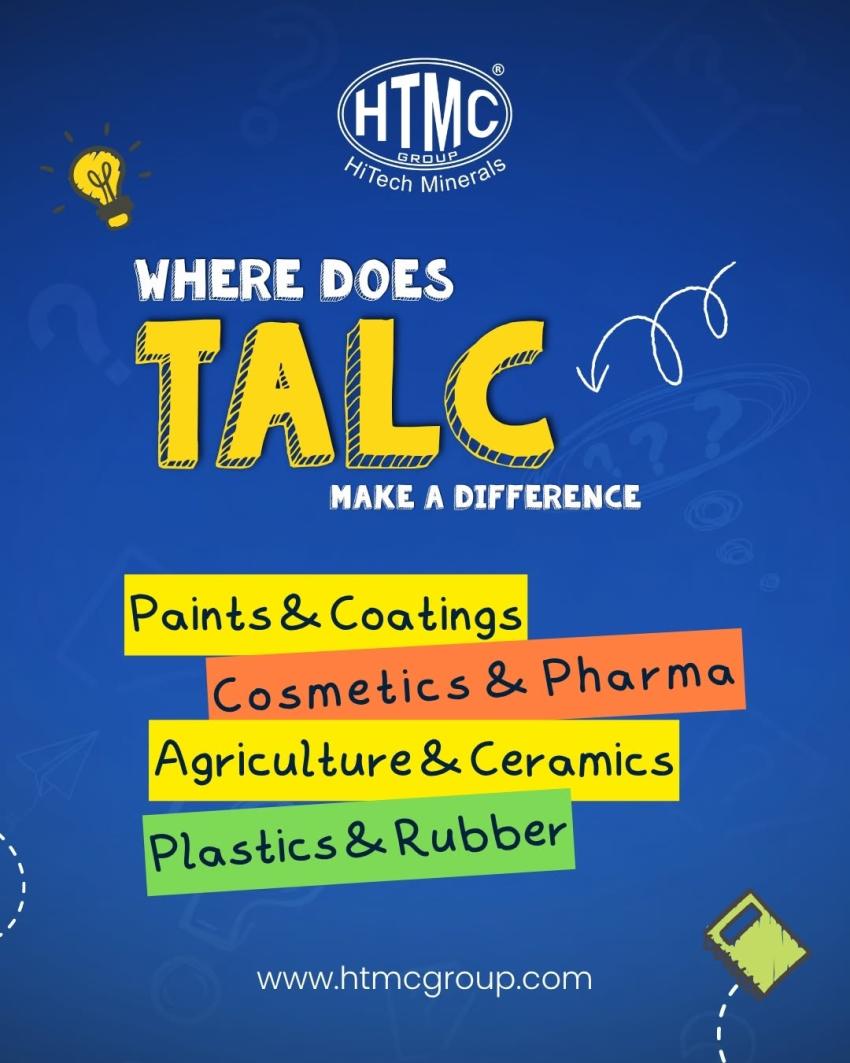
Manufacturers across different sectors often use mineral-based materials to improve formulation performance, control production costs, or achieve specific characteristics in finished products. Talc is one such mineral that has become a useful raw material because of its soft structure, fine texture, and versatile behavior.
However, not every talc powder is suitable for every application. The required mineral characteristics can vary according to the manufacturing process, formulation, and final product. This makes choosing experienced Talc Manufacturers an important part of industrial procurement.
HTMC Group supplies talc products for industrial requirements, supporting customers who need mineral materials for different manufacturing applications.
Understanding Talc Powder
Talc is a naturally occurring magnesium silicate mineral. In commercial applications, it is processed and classified into powder with characteristics suited to particular uses.
Its physical properties can make it useful as a filler, extender, or functional ingredient in several formulations.
Depending on the intended application, buyers may assess:
- Particle-size distribution
- Mineral composition
- Whiteness
- Moisture content
- Bulk density
- Surface characteristics
- Chemical properties
- Dispersion behavior
These parameters should be considered together rather than evaluating a talc product on a single specification.
Talc in Polymer Processing
Plastic manufacturers frequently work with mineral fillers to modify the characteristics of polymer compounds. Talc can be incorporated into selected polymer systems where properties such as rigidity, dimensional stability, surface finish, and processing behavior are important.
Its effectiveness depends on factors such as polymer type, filler concentration, particle size, and dispersion.
For this reason, manufacturers should conduct application-specific trials before adopting a particular grade for large-scale production.
Applications in Rubber Products
Talc can also have a role in selected rubber formulations. Depending on the compound, it may be used as a mineral filler or processing component.
Potential applications include:
- Rubber molded components
- Sealing products
- Industrial rubber goods
- Footwear components
- Certain flexible rubber products
The grade should be selected according to the characteristics required from the finished rubber product.
Talc for Paints and Coating Systems
In coating formulations, mineral fillers can influence texture, appearance, consistency, and other formulation characteristics. Properly selected talc may be used in certain paints, primers, industrial coatings, and related products.
Coating manufacturers generally consider factors such as particle fineness, brightness, oil absorption, moisture, and dispersion when assessing a mineral grade.
Use of Talc in Ceramic Products
Talc can be included in selected ceramic formulations as part of the mineral raw-material system. Ceramic producers may use it alongside materials such as kaolin, feldspar, quartz, and other ingredients.
The importance of individual specifications depends on the ceramic product and firing process. Chemical composition and thermal behavior can therefore be particularly relevant during grade selection.
What to Look for in Talc Powder Manufacturers
Choosing suitable Talc Powder Manufacturers requires a broader evaluation than comparing prices.
Industrial buyers should look at:
Consistent Specifications
Repeated orders should maintain the agreed technical characteristics as closely as possible.
Quality Testing
Relevant laboratory testing can help confirm whether the supplied material meets the agreed specification.
Product Range
A supplier with multiple grades may provide more options when applications have different requirements.
Packaging
The packaging should be appropriate for transportation, storage, and factory handling.
Production Capability
Buyers with recurring requirements should evaluate whether the manufacturer can support their expected volumes.
Technical Documentation
Data sheets, test reports, and certificates can help procurement and quality teams evaluate the material.
Sourcing From Talc Powder Manufacturers in India
India is an established source of minerals and processed mineral products for industrial markets. When evaluating Talc Powder Manufacturers in India, businesses can consider manufacturing capabilities, quality-control practices, available grades, packaging options, and supply reliability.
International buyers may also need to evaluate documentation and shipment requirements alongside the technical specifications of the product.
Industrial Talc Manufacturers and Quality Control
The work of industrial talc manufacturers extends beyond simply producing powdered mineral. Processing and classification can influence the characteristics of the final material.
A typical production approach may involve:
- Selection of suitable mineral feedstock
- Initial size reduction
- Grinding and processing
- Particle classification
- Quality evaluation
- Final packaging
The actual processing method can differ according to the source material and the specifications required for the finished product.
Why Application-Based Selection Matters
A talc grade that performs well in plastics may not necessarily provide the same value in ceramics or coatings. Each industry has different processing conditions and performance expectations.
Therefore, buyers should provide suppliers with information about:
- Intended application
- Manufacturing process
- Required particle size
- Desired physical properties
- Packaging requirements
- Expected purchase volume
This information allows the supplier to recommend products based on the actual requirement rather than using a generic grade.
HTMC Group: Supporting Industrial Mineral Requirements
HTMC Group offers mineral products for businesses across a variety of industrial sectors. Its talc solutions are intended for customers looking for dependable mineral materials for their manufacturing processes.
Customers can discuss their application, technical specifications, quantity, and packaging requirements with HTMC Group when evaluating a suitable talc product.
For companies researching Talc Manufacturers, Talc Powder Manufacturers, and Talc Powder Manufacturers in India, technical suitability and supply consistency should remain key factors during supplier evaluation.
Conclusion
Talc is a versatile mineral that can contribute to the formulation and processing requirements of plastics, rubber, coatings, ceramics, and other industrial products. Its performance depends heavily on the grade, particle characteristics, formulation, and manufacturing conditions.
Selecting the right supplier is therefore an important step for businesses purchasing talc on a regular basis. By reviewing specifications, quality documentation, production capabilities, and application suitability, manufacturers can make better sourcing decisions.
HTMC Group provides talc and other industrial mineral solutions for customers seeking reliable materials for diverse manufacturing requirements.