In the first article in this series, we explored the definition of Natural IVF and why the term 'natural' may send us in the wrong direction. Natural IVF is IVF. The only distinction between traditional IVF and Natural IVF is that the ovaries do not receive doses of stimulating medication in an effort to over produce eggs.
Natural IVF instead works around the egg your body has naturally chosen.
Your body will have made a decision regarding the 'best' egg to release around your time of ovulation. In Natural IVF, our aim is to collect and fertilise that egg in our laboratory. This distinction might sound small but begs the questions - is Natural IVF really for everyone?
It is not just someone who prefers to have fewer injections and is looking out for avoiding fertility drugs. Natural IVF might be right for some people; however, the same procedure might not be as suitable for someone else whose body is capable of producing multiple eggs through regular stimulation.
The decision therefore needs to begin with the individual rather than the treatment label.
Natural IVF is not necessarily for everyone
From a technical point of view, Natural IVF may be attempted on a broad spectrum of patients. A woman’s age, ovarian reserve, sperm characteristics or presence of blockage in the fallopian tubes should not necessarily rule out the use of the technique. However, there is a crucial distinction between whether a woman can undergo natural IVF and whether she will benefit from it.
That distinction is central to treatment planning.
Traditional IVF attempts to extract a maximum number of eggs from a single procedure. However, in case of natural IVF, the procedure is performed using a minimum number of eggs, which typically consists of a single dominant follicle chosen by the body during that particular cycle. In case the woman has a good ovarian reserve and can produce several eggs after stimulation, opting for a single egg extraction procedure implies missing out on several chances at once. On the other hand, if a patient consistently produces only one or two eggs despite ovarian stimulation, the advantage of stimulation may be considerably smaller.
This is where individualisation becomes important.
Candidate 1: When the tubes are the main problem
Imagine a young woman with no particular health issues and in her early 20s. Good ovarian reserve, normal sperm parameters for her male partner, and nothing that initially indicates issues with her fertility prospects. However, say she had suffered from a nasty pelvic infection in the past resulting in damage to her fallopian tubes, and ultimately both were removed.
Here the issue is not necessarily the quantity of her eggs or the quality of her eggs, but simply the fact that the egg and sperm cannot reach each other naturally in the fallopian tube.
IVF bypasses that, by allowing fertilization to occur in a laboratory setting.
Could such a patient undergo conventional IVF?
Yes.
Could she potentially be considered for Natural IVF?
Yes, depending on her individual circumstances.
The reason she may be a particularly reasonable candidate is that she is young and has good reproductive potential. If a naturally selected egg is retrieved, there may be a favourable possibility of fertilisation and embryo development compared with a patient whose reproductive potential has already been significantly affected by age or diminished ovarian reserve.
The important point is that Natural IVF in such a patient is not being selected because “natural” is automatically better.
It is being considered because the underlying reproductive potential may already be favourable, while the fallopian tubes are the factor preventing natural conception.
Candidate 2: When stimulation produces very few eggs anyway
Now consider a very different situation.
Imagine a woman in her mid-forties who has undergone fertility evaluation. Her fallopian tubes are open, the uterus appears healthy and her partner's sperm parameters are normal. She is otherwise healthy and active.
However, her age has affected her ovarian reserve and reproductive potential.
She undergoes conventional IVF because the usual expectation is that stimulation will provide a better opportunity by producing multiple eggs.
But despite stimulation, she repeatedly produces only one or two eggs.
The treatment team changes the stimulation protocol. Another cycle is attempted. Yet the result remains essentially the same: one or two eggs.
In this situation, an important question arises.
If stimulation is consistently producing only one or two eggs, how much additional benefit is the medication providing?
This is where Natural IVF may become a reasonable option to discuss.
The patient's ovaries are already demonstrating that stimulation is not producing a substantially larger cohort of eggs. If the natural cycle also produces one dominant egg, the difference in egg numbers between the two approaches may be relatively small.
That does not mean that Natural IVF will necessarily improve the chance of pregnancy.
Rather, it means that the patient and fertility specialist may need to consider whether continuing intensive stimulation is providing enough additional benefit to justify its medication burden, cost and treatment demands.
Why ovarian reserve matters
Ovarian Reserve One of the ways we evaluate our patients is by using ovarian reserve data as a basis to anticipate what the response to fertility treatment might be. Many with good ovarian reserve will most likely respond by generating several follicles to retrieve during stimulation in an IVF cycle. The IVF doctor will be able to leverage these to generate several opportunities from a single retrieval.
The diminished ovarian reserve patients generally respond poorly or not at all to medications.
Often multiple tweaks in their protocols or dosages will not translate their low response into a higher response.
This is the reason why a decision regarding a treatment protocol cannot be taken based solely on medicines.
It is not a matter of administering more medication just because of the need for ovarian stimulation in case of IVF.
In the case of poor responder patients, Natural IVF may be considered as an option.
However, even in this case, it is necessary to remember that having a lower number of oocytes does not change the biological problems involved in fertilization and embryo transfer.
The patient goes through the same series of events.
One egg means one opportunity
This is perhaps the most important limitation of Natural IVF.
Suppose one egg is retrieved.
That egg has to be mature.
It has to fertilise.
The resulting embryo has to develop.
It has to remain suitable for transfer.
And after transfer, it still has to implant successfully.
If any of these stages does not occur, there may be no pregnancy from that particular cycle.
With conventional IVF, multiple eggs can provide several opportunities for those stages to succeed.
This does not guarantee pregnancy, but it can provide a larger pool from which viable embryos may develop.
The difference is therefore not simply about the number of injections received. It is about the number of biological opportunities created during a single treatment cycle.
What if the patient wants more than one child?
Other reasons for pursuing IVF may play a role in the decision.
The young patient who has a favourable ovarian reserve may choose to undergo IVF procedures not for one pregnancy but for two or more children.
In such a case, traditional IVF procedure may have some definite advantages since many embryos can be generated in one egg collection cycle.
This is significant.
If the pregnancy does not occur during the first embryo transfer, the frozen embryo gives another chance without having to go through egg collection again.
On the other hand, if the woman decides at a later stage to have another child, there will be another option available.
Natural IVF is not usually as flexible when only one egg is retrieved during each cycle.
In such cases, there would be a need for multiple cycles with multiple retrievals for embryo creation.
For a young patient with a good ovarian reserve who wishes to have more than one baby, this difference could become clinically relevant.
Fewer medications do not always mean less treatment
Avoiding the use of ovarian stimulation drugs is one of the biggest draws of Natural IVF.
It’s easy to see why.
Fertility shots are scary, especially when you’re having your first round of IVF. The hormone medication might make you feel uncomfortable for a short while – headaches or mood swings – but many people find the thought of injecting themselves everyday a major worry.
But it is also necessary to note that there should not be an assumption that the absence of medication will make the whole process of treatment easier.
It might happen that natural IVF would need more than one cycle if the first one fails to produce a viable embryo.
Thus, one cycle of treatment and egg retrieval will be replaced with several cycles of monitoring and egg retrieval.
The whole process of treatment should be considered in its entirety rather than in the context of one menstrual cycle.
Treatment with fewer injections but several cycles of egg retrieval might not necessarily be less complicated than one stimulated cycle.
The cost questions
Cost is yet another factor that can affect interest in Natural IVF.
Fertility drugs can constitute a substantial part of the cost of conventional IVF especially if the healthcare system is such that drugs are paid separately by the patient.
With natural IVF, the need for ovulation stimulation drugs becomes minimized or disappears, which makes the particular cycle cheaper in this respect.
However, once again, this is not where the calculation should stop.
If the patient requires several Natural IVF cycles to acquire the required number of eggs or embryos that would have been acquired with one conventional IVF cycle, the total cost of treatment can end up being higher.
Furthermore, indirect costs—such as time off work, extra visits, procedures, travels and emotional distress of failed cycles—may become an issue.
Thus, what is seemingly the cheapest treatment route per cycle may not turn out to be the cheapest one overall.
Does Natural IVF reduce the risks associated with IVF?
The next popular misconception is that not stimulating means making Natural IVF treatment safe.
Of course, there are drug issues with conventional IVF treatment, and sometimes an exaggerated ovarian response may raise some clinical issues. However, safety of any treatment method needs to be assessed considering the number of interventions needed and how each individual reacts to them.
For example, when just one conventional IVF treatment cycle yields several embryos while a woman would need five or ten Natural IVF cycles to achieve similar results, then the number of interventions itself starts being important.
Each egg retrieval is an intervention.
Thus, decreasing drug intake but significantly increasing the number of interventions cannot always mean decreasing the treatment burden.
The proper comparison, in this case, cannot be made between medications and no medications at all.
The proper comparison should be between two different treatment strategies.
What about the risk of twins?
Natural IVF is sometimes marketed to reduce multiple pregnancies because only a single egg is recovered. But: The process of egg retrieval is completely separate from the process of transferring embryos, and it's the embryo transfer stage that determines the probability of multiple pregnancies. The transfer of a single embryo, however that embryo came from, guarantees fewer chances of twins.
IVF treatments are increasingly focused on the practice of the number of embryos to transfer, instead of automatically assume there'll be twins when a "normal" cycle of ovulation drugs is given.
The fertility drug doesn't, inherently cause twins.
Does stimulation damage eggs?
This sentiment is the primary reason why many favour the Natural IVF process. The logic Some patients tend to think that if the body is left to choose one egg for you it has to be superior than bombarding ovaries. From what we see in the source, we just don't buy the idea that going with multiple eggs automatically results in 'unhealthy" embryos.
More eggs mean more chances of finding an embryo that works for you.
You will not end up with eggs that are healthy. You will not end up with embryos that are born. More embryos may be good things. The latter matters when an older woman is concerned about a decline in fertility .
Stimulation, therefore, is not about "forcing eggs to grow".
The intent is to attract an increased pool of follicles.
Why age changes the conversation
The other factor which comes out clearly during the discussion of natural IVF is age.
A younger individual will have a greater probability of the egg being fertilised and developing into an embryo which would go on to complete the reproductive process. An older individual on the other hand will have a lesser number of eggs to work with and may also have age related changes in their eggs.
This could result in having just one egg available and leaving very little margin for error in terms of biology.
Should that egg fail to fertilise or should the embryo not develop properly, then the whole cycle could come to nothing.
Traditional IVF cannot overcome the problem of age related changes in the egg but will give you a greater chance of getting an embryo because of the attempt to harvest multiple eggs.
This is one of the major reasons why traditional IVF could be better than natural IVF for many individuals.
Age however is not everything when it comes to deciding how to proceed.
The patient who responds well versus the patient who does not
Eventually the distinction could probably be generalized into these two situations only.
A well-off the patient to have a good response when stimulation would have benefit from "classic" IVF since stimulating potentially leads to several eggs and embryos a cycle with a retrieval.
A patient who produces only one or two eggs every time on stimulation may result in a "different math". For the woman natural IVF is another possibility to consider, since the stimulation maybe not contribute considerably for increment egg number.
Neither of them does implies the dominance of the one upon the other.
This signifies that "the stimulation has its value only if you know your own "ovarian answer"".
This is why IVF therapy should be individualized.
Why this requires specialised reproductive medicine training?
The decision between Natural IVF and conventional IVF is a good example of why reproductive medicine cannot be reduced to learning individual procedures. A clinician needs to understand ovarian physiology, follicular development, ovarian reserve, stimulation protocols, ovum pick-up, embryology and the factors that influence implantation and pregnancy.
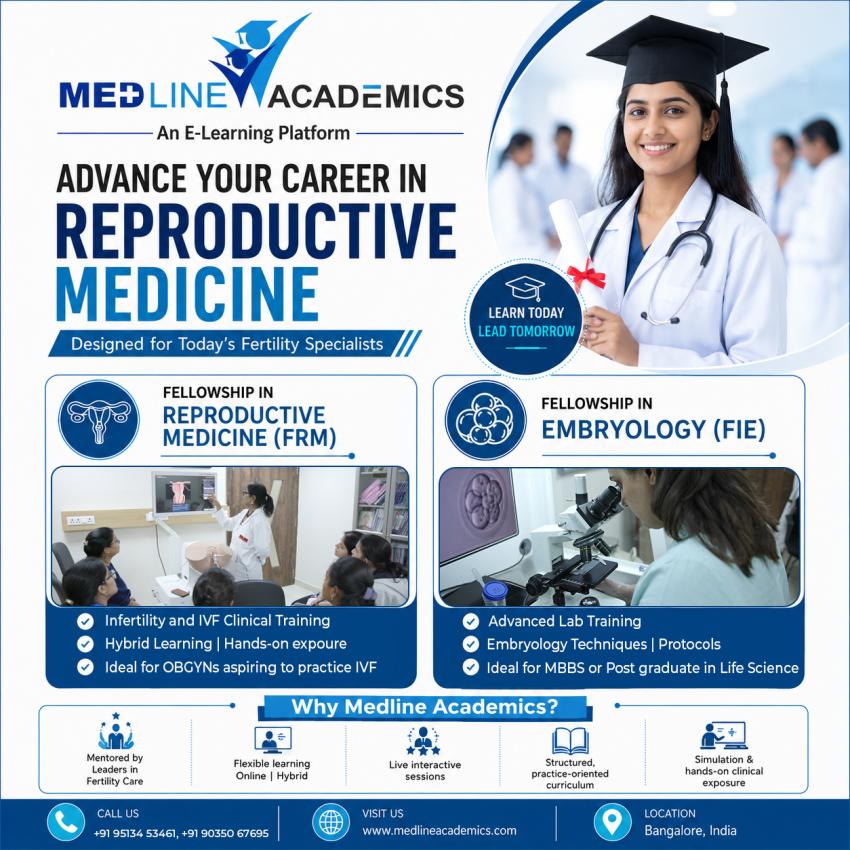
For medical practitioners who want to attain a Fellowship in IVF in India, Medline Academics provides a Fellowship in Infertility and Reproductive Medicine which is meant to give learners an opportunity to learn through a systematic approach within the broad field of reproductive medicine. The present syllabus covers such areas as reproductive endocrinology, infertility testing of females and males, ovarian reserve testing, stimulation protocols for ovulation induction, IVF, ovum pick-up, oocyte and embryo grading, IUI, endometrial transfer, poor ovarian response, recurrent implantation failure, genetics and other ART concepts. The program entails online theoretical training, simulation training and attachment, according to the present program information, involving theory which will be undertaken online followed by simulation training and attachment. This kind of approach is very helpful for medical practitioners who want to know not only how IVF is carried out but also how treatments are formulated for various patients.
Individualised fertility care matters
The same principle applies to patient care. In Dr. Kamini Rao Hospitals, the provision of fertility treatment is done within the context of an overall reproductive healthcare approach, with personalized treatment plans being among the core components of the hospital's approach. This hospital is described as a chain of infertility and Infertility treatment centres in Bangalore based on the work of Dr. Kamini Rao in the field of reproductive medicine over more than four decades, along with the offering of fertility and reproductive assistance services within a wider context of reproductive healthcare for women and men. In its current information, the hospital mentions that there is a team of reproductive medicine specialists, gynecologists, maternal fetal medicine specialists and embryologists. Hence, when searching for an IVF Hospital in Bangalore, one should not only take into account whether the center provides IVF treatment, but also whether its fertility specialists can analyze the patient's reproductive profile and explain the reason why one strategy may suit him better than another.
There is no “best IVF” for everyone
Natural IVF can be a viable choice for certain patients It’s a reasonable choice if you have decent reproductive capacity yet some reason for which you need IVF, or if the stimulation regimen consistently yields simply one egg. Sometimes the prospect of preventing the use of some of those “infertility-enhancing” drugs makes natural IVF an inviting choice too. But just because you’re bypassingstimulation doesn’t necessarily mean a successful procedure It’s often that the greatest perk of traditional IVF treatment is the potential of having multiple chances from a single egg retrieval, which results in the number of usable eggs, more chances for an embryo transfer and, potentially, chances to preserve some for future use.
With no back-up embryo to count on when it does not lead to goodresults, Natural IVF does everything it can on just the single, normally selected egg that is produced.
But patients require to comprehend the one critical distinction between these two procedures.
The decision should be based on biology, not terminology
“Natural IVF” sounds appealing because the word natural carries positive associations. But fertility treatment decisions cannot be made on terminology alone.
The important questions are:
1. How many eggs is the patient likely to produce?
2. How has she responded to previous stimulation?
3. What is her ovarian reserve?
4. How does age influence her reproductive potential?
5. Does she hope to have one child or more?
6. Would multiple embryos provide an important advantage?
7. How many procedures would each approach require?
8. And what are the financial, physical and emotional implications of each pathway?
Once these questions are answered, the choice becomes much clearer.
Natural IVF is not a replacement for conventional IVF, nor is conventional IVF automatically the right answer for every patient.
They are two different approaches that may have a role in different circumstances.
The most important takeaway is therefore simple: the goal of fertility treatment is not to choose the treatment that sounds the most natural. It is to choose the treatment strategy that makes the most sense for the individual patient.
For some, that may mean working with the one egg selected naturally by the body.
For others, it may mean using ovarian stimulation to create multiple opportunities from a single retrieval.
And that is why a personalised consultation remains the starting point, not a decision based on a treatment trend, a social-media claim or the reassuring sound of the word “natural.