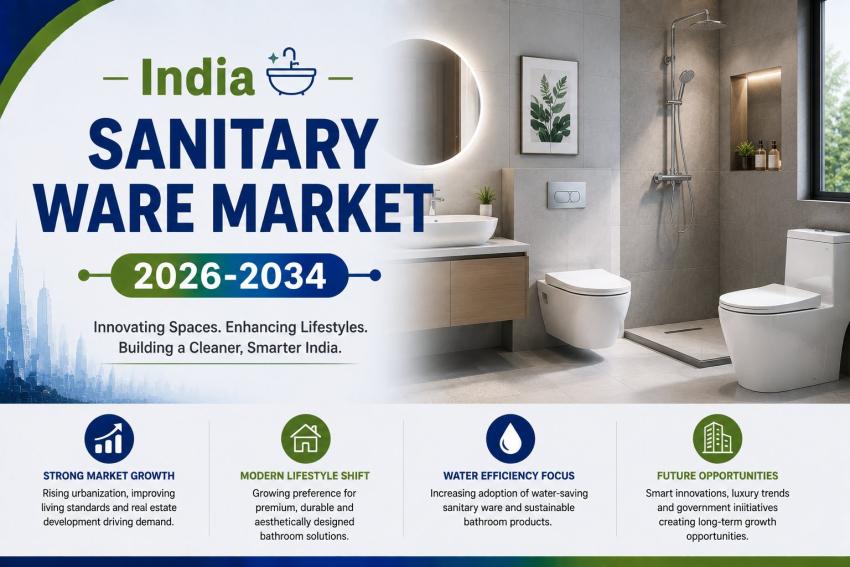
India Sanitary Ware Market Outlook
The India sanitary ware market is undergoing a significant transformation driven by rapid urbanization, rising disposable income, and growing aspiration for modern living standards. Premium product adoption, smart bathroom technologies, and hospitality sector expansion are collectively reshaping how Indian households and commercial establishments select and install bathroom and kitchen fixtures.
Government sanitation initiatives, real estate growth, and increased hygiene awareness are driving sustained demand across residential and commercial segments, positively influencing the India sanitary ware market outlook across materials, product types, and applications.
Market Snapshot
- Market Size (2025): USD 72,979.6 Million
- Forecast Market Size (2034): USD 1,30,084.7 Million
- CAGR (2026–2034): 6.43%
- Segments by Material: Ceramic, Plastic, Others
- Segments by Type: Toilet Sink/Water Closet, Wash Basins, Pedestals, Cisterns, Others
- Segments by Application: Kitchen, Bathroom
- Key Growth Drivers: Urbanization, premium adoption, smart bathrooms, government sanitation programs, hospitality expansion
Executive Summary
India's sanitary ware market reached USD 72,979.6 Million in 2025 and is projected to reach USD 1,30,084.7 Million by 2034, growing at a CAGR of 6.43% during 2026-2034. The market growth is attributed to rapid urbanization, rising disposable income, premium product adoption, smart bathrooms, government sanitation initiatives, real estate growth, hospitality expansion, and increased hygiene awareness.
Rising health consciousness, coupled with growing aspiration for modern living standards, is redefining consumer priorities across residential and commercial end-user segments. As urbanization is expected to reach nearly 40% by 2030, demand for contemporary housing, commercial developments, and public infrastructure is placing sustained upward pressure on sanitary ware consumption nationwide.
Evaluate Market Opportunity with the Business Sample Report
India Sanitary Ware Market Key Drivers
- Adoption of Smart Bathroom Technologies:
Smart fixtures like sensor faucets, smart toilets, and automatic-operation showers are being added by consumers seeking greater convenience, hygiene, and water savings. This aligns with the wider global smart home trend, expected to cover almost 400 million households worldwide by 2027. Industry players like Kohler have introduced touchless faucets and enhanced toilet technologies incorporating IoT for real-time water consumption monitoring.
- Rising Demand for Luxury and Premium Sanitary Ware:
Affluent buyers are increasingly inclined toward high-grade bathroom fittings that combine visual appeal with functional efficiency. India's luxury sanitary ware segment is estimated to grow at a 9% CAGR to reach $12 billion by 2029. Companies like Kohler and Hansgrohe are establishing experience centers and retail shops across major Indian cities to capture this demand.
- Government-Led Sanitation Initiatives:
Programs such as the Swachh Bharat Mission, launched in 2014, have significantly increased household access to toilets. As of September 2024, the initiative had facilitated development of more than 6.3 Million individual household toilets and over 630,000 public sanitation facilities. The Jal Jeevan Mission, AMRUT 2.0, and PM Awas Yojana are further fueling institutional and residential sanitary ware installations.
India Sanitary Ware Market Emerging Trends
- Urbanization and Technology Integration:
As urbanization in India is expected to reach nearly 40% by 2030, the need for contemporary housing, commercial developments, and public infrastructure is growing rapidly. This urban expansion is driving adoption of smart, compact, efficient sanitary solutions in both residential and institutional projects, with touchless faucets, sensor-based flush systems, and IoT-enabled smart bathrooms gaining traction across urban centers.
- Anti-Bacterial and Water-Saving Material Innovation:
Enhanced materials such as anti-bacterial coatings and water-saving mechanisms are aligning with the push for sustainable and hygienic solutions, particularly in high-density environments. Real estate developers and public sector projects are increasingly integrating these advanced systems to meet regulatory and user standards.
- Experience Center Expansion by Premium Brands:
Premium sanitary ware brands are establishing dedicated experience centers across Indian cities to showcase advanced product ranges and drive premium conversions among urban consumers seeking hands-on product experiences before purchase.
India Sanitary Ware Market Challenges
Despite robust growth momentum, the India sanitary ware market faces persistent structural headwinds:
- Price sensitivity in Tier-2, Tier-3, and rural markets continues to limit premium product penetration, as affordability remains a primary purchase consideration outside metro cities
- Fragmented distribution networks and inconsistent product availability in smaller cities constrain organized brand expansion beyond established urban markets
- Rising input costs for ceramic raw materials and energy-intensive manufacturing processes create margin pressure for domestic producers
- Intense competition between organized brands and unbranded regional manufacturers in the value segment limits pricing power for mid-tier players
India Sanitary Ware Market Segment Insights
By Material
- Ceramic
- Plastic
- Others
By Type
- Toilet Sink/Water Closet
- Wash Basins
- Pedestals
- Cisterns
- Others
By Application
- Kitchen
- Bathroom
By End User
- Residential
- Commercial
Regional Insights
- North India
- South India
- East India
- West India
The report has provided a comprehensive analysis of all major regional markets across these four zones of India, covering historical trends and forecasts for 2026-2034.
Competitive Landscape
The India sanitary ware market features a mix of established global premium brands and domestic manufacturers competing across product design, technology integration, and distribution reach. The market research report has provided a comprehensive analysis of the competitive landscape, including market structure, key player positioning, top winning strategies, a competitive dashboard, and a company evaluation quadrant, along with detailed profiles of all major companies.
Investment Opportunities
- Smart Bathroom Technology Integration: The convergence of IoT-enabled fixtures, sensor-based systems, and water-saving mechanisms presents a compelling opportunity as India's smart home adoption accelerates toward global benchmarks.
- Premium and Luxury Segment Expansion: With India's luxury sanitary ware segment projected to grow at a 9% CAGR through 2029, experience-center-led retail expansion in Tier-1 and emerging Tier-2 cities represents a significant growth avenue.
- Government Infrastructure-Linked Manufacturing: Continued investment under Swachh Bharat Mission, Jal Jeevan Mission, and PM Awas Yojana is creating sustained institutional and affordable-housing demand for domestic sanitary ware manufacturers.
Frequently Asked Questions (FAQ)
- How big is the sanitary ware market in India?
The sanitary ware market in India was valued at USD 72,979.6 Million in 2025.
- What is the future outlook of the sanitary ware market in India?
The India sanitary ware market is projected to exhibit a CAGR of 6.43% during 2026-2034, reaching a value of USD 1,30,084.7 Million by 2034.
- What are the key factors driving the India sanitary ware market?
Rapid urban growth, shifting lifestyle preferences, and a greater emphasis on hygiene are fueling demand. Rising disposable incomes, evolving interior design trends, and sanitation-focused government programs are also encouraging adoption of stylish, durable bathroom fixtures.
- Which material segment is covered in the report?
The report segments the market by material into ceramic, plastic, and others, alongside type, application, and end-user based classifications.
Conclusion
India's sanitary ware market presents a compelling multi-decade growth opportunity, underpinned by structural urbanization, rising disposable incomes, and an evolving consumer preference for smart, hygienic, and premium bathroom solutions.
Government-led sanitation programs, smart bathroom technology adoption, and expanding hospitality and real estate development will continue to reshape the market through 2034. Organizations that invest in technology integration, premium experience-center retail, and infrastructure-linked manufacturing will be best positioned to capture disproportionate value as India's sanitary ware industry matures.
Source: IMARC Group