That’s becoming one of the most overlooked ecommerce problems. Retailers have spent years improving storefront design, advertising, checkout, and personalization while the product catalog underneath those experiences often remains inconsistent, incomplete, or fragmented across systems.
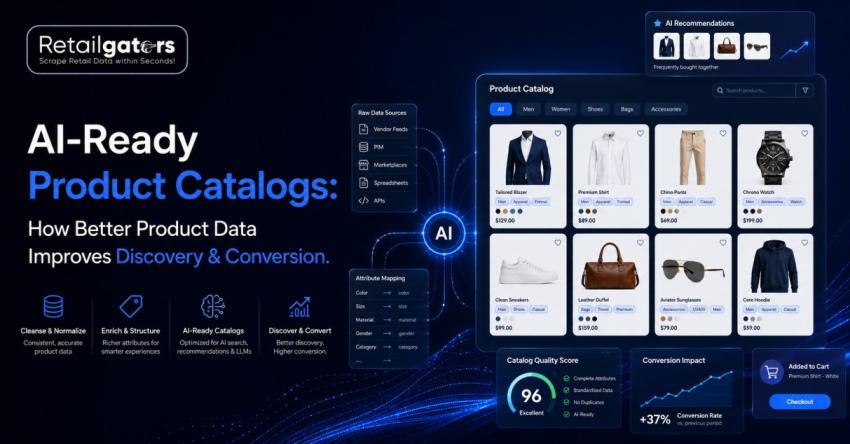
An AI-Ready Product Catalog changes that. Instead of treating the catalog as a database of titles, descriptions, images, and SKUs, it turns product information into a structured intelligence layer that search engines, recommendation models, marketplaces, analytics systems, and AI agents can reliably understand.
The business impact goes well beyond cleaner data. Better catalogs improve discovery, comparison, recommendations, merchandising decisions, and ultimately the shopper’s ability to find the right product quickly.
What Makes a Product Catalog AI-Ready?
An AI-Ready Product Catalog contains product information that machines can interpret without guessing what each field or value means. The data needs to be structured, normalized, sufficiently detailed, connected across variants, and kept current as products, prices, inventory, and attributes change.
Think about a large fashion retailer selling a black women's running shoe. One supplier may label the color “Jet Black,” another “BLK,” and another simply “Black.” Width might appear as “Wide,” “W,” “2E,” or disappear into a description. Without product data normalization, systems may treat those values as unrelated even though they describe similar characteristics.
An AI-ready catalog typically brings together:
Stable product, SKU, GTIN, UPC, or marketplace identifiers
Consistent category and taxonomy structures
Standardized brands, colors, sizes, materials, and specifications
Parent-child and product-variant relationships
Detailed searchable attributes
Images, descriptions, specifications, and supporting content
Pricing, availability, seller, and promotional information where relevant
Attribute provenance and validation rules
Regular refresh processes for dynamic fields
Google's Merchant Center already requires merchants to submit product information according to defined attributes and formatting rules, while structured product details help its systems understand technical specifications and match products to relevant queries.
The practical lesson is simple: richer data only helps when systems can interpret it consistently.
Why Catalog Quality Has Become a Discovery Problem
Traditional ecommerce search could tolerate fairly basic catalog structures. Matching a shopper's keyword against titles, categories, and descriptions was often enough to return something reasonable.
AI-driven discovery raises the bar.
Google's 2026 commerce initiatives are moving further toward agentic shopping experiences in which AI systems help shoppers research, compare, and act on product information. Google has also introduced merchant attributes designed for more conversational commerce scenarios, including question-and-answer data, related products, item-group titles, variant options, and popularity information.
That changes what ecommerce teams should consider “good” ecommerce catalog quality.
A search engine may need to determine that a jacket is appropriate for cold weather. A recommendation model may need to understand that two televisions have similar panel technology but different screen sizes. An AI assistant might need to compare ingredients, dimensions, compatibility, delivery options, and price simultaneously.
If those facts are buried in inconsistent descriptions, the system has to infer them. Every inference introduces uncertainty.
How Better Product Data Improves Discovery
Product discovery isn't one feature. It happens through site search, filters, marketplaces, recommendation systems, category pages, external search engines, advertising feeds, AI assistants, and increasingly conversational interfaces.
A stronger catalog improves each of these surfaces differently.
More Accurate Search Results :-
Structured attributes give search systems more context than product titles alone. Queries such as “stainless steel air fryer under 5 litres” can be interpreted against material, capacity, category, and price rather than relying on whether every word appears inside a description.
Good product attribute mapping also handles differences between supplier terminology and the retailer's taxonomy. “Brushed steel,” “stainless,” and “SS” shouldn't automatically become three unrelated material types.
Better Filters and Faceted Navigation:-
Filters become unreliable when attributes are missing or inconsistent. We've seen this problem frequently in large catalogs: thousands of SKUs exist, but only part of the assortment appears when a shopper selects a seemingly simple filter such as size, compatibility, material, or dietary preference.
That isn't primarily a UX problem. It's a data problem
Strong product catalog enrichment fills relevant attribute gaps and gives merchandising teams enough structured information to build meaningful filters without manually maintaining hundreds of exceptions.
Stronger AI Product Recommendations :-
Recommendation systems become much more useful when they understand why products are related.
Behavioral data tells the model that shoppers who viewed Product A often viewed Product B. Catalog data explains the relationship: both may share a category, use case, material, price range, style, compatibility requirement, or technical specification.
Combining behavioral signals with rich catalog attributes can therefore produce more contextual AI product recommendations, particularly for new products that don't yet have enough interaction history.
The Connection Between Catalog Quality and Conversion
Conversion problems are often diagnosed too late in the funnel. Teams look at product-page design, checkout abandonment, shipping costs, promotions, or payment options.
But a conversion can be lost several steps earlier because the shopper never encountered the right product.
The second catalog gives search, recommendation, merchandising, and analytics systems far more usable information. Shoppers see more relevant products, comparisons become easier, and fewer products disappear from discovery because an attribute happens to be missing.
That’s why retail data quality should be treated as a commercial metric rather than merely a data-engineering concern.
Building an AI-Ready Product Catalog: A Practical Workflow
Improving a catalog doesn't usually require rebuilding the entire commerce stack. The better approach is to identify the product decisions your systems need to make and work backward into the data required to support them.
1. Audit Attribute Coverage
Start by measuring completeness at the category level rather than across the whole catalog.
A laptop needs processor, memory, storage, display size, GPU, operating system, and connectivity information. A beauty product may need ingredients, skin type, formulation, shade, finish, certifications, and usage information.
A single universal completeness score hides these differences.
Define mandatory, recommended, and optional attributes by category, then measure how much of the assortment meets those standards.
2. Normalize Values Before Enriching Them
Adding more data to inconsistent records often creates a larger mess.
Standardize units, brands, categories, sizes, colors, materials, currencies, identifiers, and attribute names first. Good product data normalization provides the common language required by every downstream system.
For enterprise catalogs fed by dozens or hundreds of suppliers, normalization rules should also record the original value rather than overwriting it permanently. That makes troubleshooting much easier when upstream feeds change.
3. Resolve Product Identity
Product identity is where many catalog projects become difficult.
The same item may appear across retailers with different titles, descriptions, pack sizes, images, identifiers, and variant structures. Reliable product matching needs to combine identifiers with attributes such as brand, model, size, configuration, quantity, and category-specific characteristics.
For competitive analysis, this becomes especially important. Comparing the price of a 12-pack with a single unit may produce a perfectly calculated number that is commercially meaningless.
4. Enrich the Attributes That Influence Decisions
Don't enrich every field simply because you can.
Prioritize attributes that influence search, filtering, comparison, recommendations, merchandising, and purchase decisions. A furniture marketplace may benefit greatly from dimensions, materials, room type, assembly requirements, style, and seating capacity. Adding ten obscure manufacturer fields may contribute almost nothing.
RetailGators, for example, collects structured ecommerce product information across retail and marketplace sources, including product details, specifications, categories, variants, pricing, availability, and related market signals. Those external signals can complement internal catalog records when businesses are building retail intelligence or catalog-enrichment workflows.
5. Validate Before Publishing
An AI-Ready Product Catalog needs validation rules, not just enrichment.
Check whether values are plausible, whether mandatory attributes are populated, whether identifiers follow expected formats, whether variant relationships make sense, and whether sudden upstream changes have affected large groups of products.
Strong web data accuracy requires both automated validation and visibility into anomalies. A pipeline can technically succeed while still delivering commercially incorrect data.
6. Monitor Catalog Freshness
Catalog readiness isn't a one-time cleanup project.
Products are added, removed, reformulated, repriced, renamed, bundled, reclassified, and moved between categories. Marketplace sellers change. Specifications are corrected. New variants appear.
That makes freshness part of retail data quality. Mature retail data pipelines monitor not only whether data arrived, but also whether expected fields disappeared, values changed unusually, categories shifted, or refresh schedules were missed.
Where External Ecommerce Data Fits
Internal PIM and commerce systems tell you what you sell. They don't necessarily tell you how the wider market represents, prices, categorizes, or positions equivalent products.
This is where Ecommerce Data Scraping can contribute to catalog intelligence.
Public product information from retailers and marketplaces can help teams identify missing attributes, understand category conventions, benchmark descriptions and specifications, observe marketplace assortment, and support competitive intelligence.
The important distinction is between collecting more data and creating useful data. Raw marketplace records rarely arrive in the exact taxonomy an enterprise needs. They still require mapping, normalization, matching, validation, and freshness controls before they become decision-grade ecommerce data.
Platforms such as RetailGators can provide structured external product and marketplace data for those workflows, while the retailer's own PIM, MDM, analytics, and commerce platforms remain the systems responsible for internal product governance.
Common Catalog Mistakes That Limit AI Performance
One frequent mistake is generating longer product descriptions and calling the catalog “AI-ready.” Rich text may help shoppers, but descriptions aren't a substitute for structured attributes.
Another problem is aggressive automated enrichment without validation. AI may infer a material, compatibility rule, ingredient property, or use case incorrectly. High-confidence enrichment can automate a large portion of the workflow, but uncertain attributes should have validation rules or human review.
Teams also underestimate taxonomy maintenance. Categories evolve as assortments grow. Attributes useful for one category become irrelevant in another, and marketplace taxonomies don't always align neatly with internal merchandising structures.
Finally, don't separate catalog quality from business outcomes. Track discovery rate, zero-result searches, filter coverage, recommendation relevance, product matching confidence, attribute completeness, duplicate rates, and catalog freshness alongside standard conversion metrics.
From Product Database to Commerce Intelligence Layer
The strongest ecommerce catalogs are becoming more than repositories of product records.
They're becoming an intelligence layer connecting merchandising, search, recommendations, marketplaces, competitive analysis, advertising, pricing systems, and AI-driven shopping experiences.
Google's current direction toward agentic commerce illustrates why this matters. Its own guidance for CPG companies argues that product specifications, certifications, attributes, and other structured information are becoming part of how AI systems discover and evaluate products.
For enterprise retailers, that doesn't mean chasing every new AI channel. It means fixing the foundation first.
A well-governed AI-Ready Product Catalog remains useful regardless of which search interface, recommendation model, marketplace, commerce agent, or analytics platform becomes dominant next.
Conclusion
Better ecommerce discovery starts long before a shopper enters a search query. It starts with whether the underlying catalog can accurately describe what each product is, how it differs from similar products, and which customer needs it can satisfy.
Building an AI-Ready Product Catalog means improving identity resolution, product data normalization, product attribute mapping, product catalog enrichment, validation, and freshness as one connected process. Done well, those improvements support stronger search results, better filters, more relevant AI product recommendations, cleaner analytics, and more confident purchasing decisions.
The retailers that benefit most from AI won't necessarily be those deploying the largest number of models. They'll be the ones whose product data gives those models something trustworthy to work with.