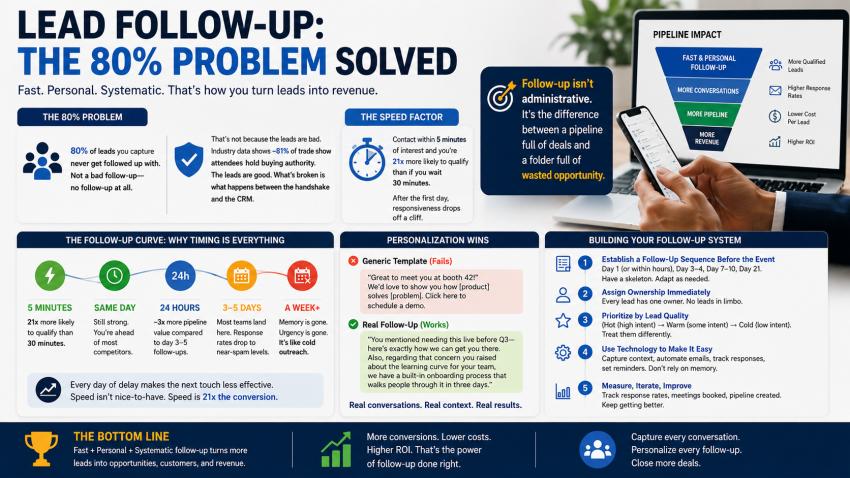
Eighty percent of leads you capture never get followed up with. Not a bad follow-up — no follow-up at all.
That's not because the leads are bad. Industry data consistently shows around 81% of trade show attendees hold buying authority. The leads are good. What's broken is almost always what happens between the handshake and the CRM.
The cold math is that prospects who are approached within five minutes of expressing interest are around 21 times more likely to be eligible than those who are contacted thirty minutes later. Twenty-one occasions. 21 times more likely than 21%. And that's only the initial five minutes. Responsiveness falls off a cliff after the first day.
Most sales teams lose money because of this gap between potential and reality. Teams don't consider follow-up as a dull administrative task. It makes the difference between a folder full of lost opportunities and a pipeline full of deals.
Why Everything Else Is Determined by Follow-Up
The ROI on your event, your advertising budget, your networking, and your cold outreach are all determined during follow-up. This is the point at which leads either die or convert. It's the place where you either appear attentive and professional or careless and chaotic.
Most teams treat follow-up as a reactive duty that happens after the lead is captured. "Someone will get to it eventually." Since they don't consider speed and personalization to be critical, they don't optimize for them. However, it is.
Think about the finances: A booth at a trade show costs between $10,000 and $30,000. That is actual cash. You will have spent between $1,500 and $3,000 on each converted lead if you collect 150 leads and only turn 10 of them into actual opportunities due to your generic and delayed follow-up. You will have spent between $222 and $667 per lead if you follow up quickly and personally and convert 45 of them. Follow-up discipline is nearly the only factor that separates a disastrous event from a phenomenally successful one.
The Follow-Up Curve: The Significance of Timing
The timing data is harsh. Let's examine what the figures actually indicate:
A 5-minute follow-up is 21 times more likely to be eligible than a 30-minute one. The wow factor is this. The discussion is new. The potential customer hasn't yet spoken with your rivals. You are at the forefront of my thoughts.
Same-day follow-up: Not magical, but still powerful. The majority of competitors are still behind you.
24-hour follow-up: Compared to day 3- 5 follow-ups, you observe around three times the pipeline value. Still sturdy. The prospect hasn't quite moved on and still recalls you.
Most teams end up with a 3–5 day follow-up. There have been fifteen further conversations with the prospect. It appears that any of them could be the sender of your email. Your response rate falls to almost spam levels.
A week or later: The memory is gone. The urgency is gone. You might as well be cold outreach.
What makes this worse: once you're past the first touch, every day of delay makes the next touch less effective. A prospect who didn't respond to your day-one email is less likely to respond to your day-five email. The trajectory is negative.
This is why booth teams that follow up the same evening have such different outcomes than teams that wait until the next week. Speed isn't a nice-to-have. Speed is 21x the conversion.
Personalization: Why Templates Fail and Real Follow-Up Works
Here's the second part of the equation: even with perfect timing, a generic follow-up email doesn't work.
The typical template approach: "Great to meet you at booth 42! We'd love to show you how [product] solves [problem]. Click here to schedule a demo."
The prospect walks away from your booth having talked to 12 vendors. Half of them send similar emails. You're indistinguishable. They don't respond.
Real follow-up references the actual conversation. "You mentioned needing this live before Q3 — here's exactly how we can get you there. Also, regarding that concern you raised about the learning curve for your team, we have a built-in onboarding process that walks people through it in three days."
That email sounds like a human who was listening. It doesn't sound like it is mailing to 500 people. It converts.
The difference between these two approaches isn't that one is nicer. It's that one works, and the other doesn't. And it's not harder to write the second version — it just requires capturing the right context at the booth in the first place.
Building Your Follow-Up System
A real follow-up system has five components:
1. Establish a Follow-Up Sequence Before the Event
Don't wait until after the event to figure out what you're going to say. Build your follow-up sequence in advance.
Usually, this looks like:
* Day 1 (or within hours): Quick, customized first touch based on the discussion.
* Days 3–4: Provide a resource or an answer to a query they posed.
* Days 7–10: Invitation to a webinar or gentle "checking in" contact.
* Day 21: "Haven't heard from you, here's what's new" and re-engagement.
This isn't set in stone — you adapt based on the prospect's response. But having a skeleton ready means you're not making it up as you go.
2. Customize at Scale
Writing 150 unique emails by hand is not what personalization entails. It entails adding in actual details from the dialog while templating the structure.
Template format: "[Reference to their specific situation] + [how we address that] + [specific next step]"
For instance: "You said that you are currently employing [Vendor X] for [purpose], however you are worried about [particular issue]. Our product was specifically designed to [solve it]. Would [particular recommendation] merit discussion?
Each email takes two to three minutes, not twenty. However, the reason it sounds individualized is that it is.
3. Establish Clear Ownership and Due Dates
Ambiguity is what ruins most follow-up systems. A shared mailbox has a lead. Everyone believes that it is being handled by someone else. No one is.
Before the event concludes, allocate each lead to a specific individual. That individual is responsible for day-one follow-up. They send the first message. They send follow-up #2 if they don't hear back—unambiguous deadlines and unambiguous ownership.
4. Use Lead Temperature to Distinguish Your Method
Every lead receives a different follow-up. A hot prospect who claims that "this solves our exact problem" attracts sales attention right away. A gentler nurture sequence is given to a cold lead who asks three questions. A long-term track is taken by a warm lead who appeared interested but was not yet certified.
This is made feasible by tagging at the point of capture: hot, warm, and cold. Different sequences apply after that.
5. Use a Tool That Reduces Friction
The easier your follow-up process is, the more likely it is to happen.
This tool should ideally: record contacts at the event with context already attached; automatically draft follow-up emails using the context you recorded; track when each follow-up was sent and when responses were received; remind you of follow-up deadlines before they pass; and immediately route hot prospects to sales while classifying warm and cold leads by next-action.
All of this relies on memory in the absence of a tool. Additionally, memory deteriorates at actual volume.
How RoloScan Enables Fast, Personalized Follow-Up
The gap between good follow-up and what most teams actually do comes down to infrastructure. RoloScan solves this by automating the parts that kill follow-up discipline: capturing context and generating personalized messages.
At an event, a staff member scans a badge and adds brief notes about the prospect's needs, concerns, and schedule. After reading those notes, RoloScan uses the context it has recorded to create a follow-up email draft automatically. "You mentioned needing this live before Q3; here's exactly how we can get you there." is a reference to the real conversation rather than a template.
When the encounter is still new, the employee can review and send it within hours rather than days. The email doesn't feel like spam because it is customized rather than generic. Instead of seeing a robot going through a checklist, the prospect sees a human who was paying attention.
For teams with several representatives at events, RoloScan ensures consistency: all messages are sent promptly, all follow-ups refer to the real discussion context, and nothing depends on any one person remembering what was discussed. The 21x conversion difference between 5-minute and 30-minute follow-up is made possible by RoloScan, which removes the annoyance of having to wait for someone to remember, find, and compose a response.
Common Follow-Up Failures
No follow-up at all. This is 80%. Someone captures a lead, it sits in a folder, nobody acts. By the time someone does, it's been two weeks, and the prospect has moved on.
Generic batch follow-up. All 150 leads get the same email sent on Tuesday. No personalization. It feels like spam. Response rate tanks.
Too much follow-up too fast. Three emails in three days. The prospect sees it as aggressive. They unsubscribe.
Inconsistent follow-up across team members. One rep's follow-up is thoughtful and personalized. Another rep is lazy. There's no standard. You get inconsistent results.
No differentiation by lead temperature. A hot prospect who's ready to buy gets the same nurture sequence as someone who was browsing. The hot one gets bored and leaves. The cold one gets pushed too hard.
Waiting for perfect information. You're still verifying the prospect's title and company before you send your first email. Meanwhile, a competitor already followed up and booked a call.
Follow-Up in Different Contexts
Follow-up operates the same way in most contexts; however, the timing and frame shift:
Trade shows: Quickest window for follow-up. The same evening works well. Refer to the particular booth discussion.
Career fairs: In less than a day. Talk about the position they were interested in and their unique qualities.
Networking events: Within 24-48 hours. Reference mutual connections or specific topics you discussed.
Cold outreach: Still benefits from personalization, but timing is less critical since there's no "freshness" to leverage. Focus on personalization and value-add instead.
Inbound leads: These are actually the easiest. They're already interested. Fast follow-up (same day) is critical.
In all cases: speed + personalization = results.
The One Thing That Matters Most
If you only optimize one thing about your follow-up process, make it speed. Within hours beats within days beats within weeks, every single time.
You can recover from a mediocre email if it comes fast. You can't recover from a great email that arrives a week late. The window closes.
Conclusion: Follow-Up Is Where Opportunity Becomes Revenue
Every stat on event ROI, networking ROI, cold outreach ROI — all of it depends on follow-up. The leads aren't the problem. The follow-up is.
Most teams have the leads. Most teams could convert more of them. But they don't because their follow-up is slow, generic, and inconsistent. Fix your follow-up timing and personalization, and you won't need to generate more leads. You need to convert the ones you already have better.
That's the whole game. That's where the 21x difference lives.