

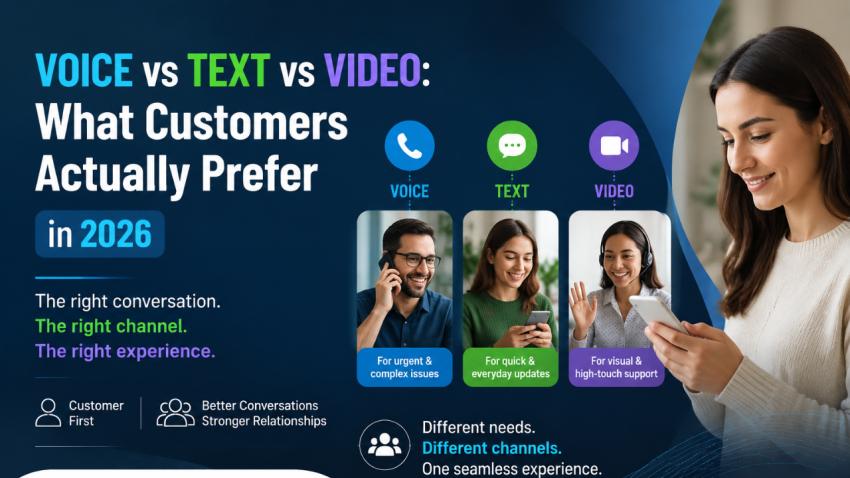
Every customer has a preferred way to communicate. The mistake many businesses make is assuming everyone prefers the same channel.
Some organizations invest heavily in chat because they believe phone calls are outdated. Others encourage customers to call even when a simple text would solve the issue. Many add video support without understanding whether customers actually want it.
The truth in 2026 is simple. Customers do not prefer one communication channel over another. They choose the option that is fastest, easiest, and most effective for the situation.
Businesses that understand this shift create better customer experiences, improve loyalty, and increase conversions.
Customers Choose Convenience, Not Channels
The biggest change in customer communication is that people no longer think in terms of voice, text, or video. They think about solving a problem with the least amount of effort.
A customer might browse products online, ask a quick question through chat, complete the purchase over a phone call, and watch a video tutorial after buying. To them, it is one seamless journey.
Successful businesses design experiences around customer intent instead of forcing customers into a single communication method.
Why Text Remains the First Choice for Everyday Conversations
Text messaging has become the preferred option for simple and routine interactions because it is quick, convenient, and non-disruptive.
Customers appreciate being able to send a message whenever it fits into their day instead of waiting on hold.
Text works especially well for:
- Appointment reminders
- Order confirmations
- Delivery notifications
- Billing updates
- Password verification
- Simple product questions
- Reservation confirmations
For businesses, text also improves efficiency by allowing support teams to manage multiple conversations simultaneously.
Voice Still Matters When Trust Is Important
Despite the rise of digital communication, voice remains essential for conversations that require empathy, urgency, or detailed explanations.
Customers often choose a phone call when they are frustrated, dealing with a billing issue, making an important purchase, or trying to resolve a complex problem.
Hearing a real person creates confidence and reduces misunderstandings much faster than long text exchanges.
Businesses using RingCentral can connect voice with messaging and collaboration, creating a more consistent customer experience across every interaction.
Video Creates Better Experiences for Complex Conversations
Video has become valuable when customers need to see something rather than read about it.
It is especially effective for:
- Product demonstrations
- Technical troubleshooting
- Software onboarding
- Virtual consultations
- Employee training
- Financial discussions
- Real estate tours
- Healthcare appointments
Instead of replacing voice or text, video adds clarity when visual guidance improves understanding.
AI Is Improving Every Customer Conversation
Artificial intelligence is transforming customer communication by making every channel more intelligent.
AI can now:
- Route conversations to the right team
- Predict customer intent
- Detect frustration
- Summarize interactions
- Recommend next steps
- Translate conversations
- Maintain conversation history across channels
The result is a smoother experience where customers no longer need to repeat information every time they switch from text to voice or video.
Omnichannel Is the New Standard
Offering multiple communication channels is no longer enough.
Customers expect every interaction to feel connected.
For example, a customer may begin with live chat, move to a phone call for additional support, and receive a text confirmation after the issue is resolved. The conversation should continue naturally without repeating information.
This seamless experience builds trust and reduces customer effort.
Common Mistakes Businesses Should Avoid
Many organizations still create unnecessary friction by using outdated communication strategies.
Avoid these common mistakes:
- Requiring phone calls for simple requests
- Sending detailed instructions through text messages
- Scheduling video meetings when they are unnecessary
- Asking customers to repeat information
- Ignoring individual communication preferences
- Measuring channel usage instead of customer satisfaction
The goal is not to increase phone calls or chat sessions. The goal is to make every interaction easier.
How Tollanis Solutions Helps Businesses Modernize Customer Communication
At Tollanis Solutions, customer communication is treated as one connected journey instead of separate conversations.
Businesses need solutions that bring together voice, messaging, video, automation, analytics, and AI into a unified experience. This approach improves response times, increases first-contact resolution, and delivers more personalized customer support.
With solutions powered by RingCentral, organizations can simplify communication across departments while giving employees complete visibility into every customer interaction. The result is faster service, stronger collaboration, and better customer experiences.
Final Thoughts
The debate is no longer about choosing between voice, text, or video.
Customers expect businesses to offer the right communication option at the right moment.
A quick text may be perfect for a delivery update. A phone call may be best for resolving a billing issue. A video session may save time when explaining a complex product.
Businesses that focus on customer choice instead of channel preference will build stronger relationships, improve customer satisfaction, and stay ahead in 2026.
The future of customer communication belongs to organizations that make every conversation simple, connected, and effortless.


